German airlines convince the government to cut taxes and operating costs
Chancellor Friedrich Merz's government has finally decided to halt the haemorrhaging of German air transport by adopting new measures, including lower taxes.
By Luc Citrinot -
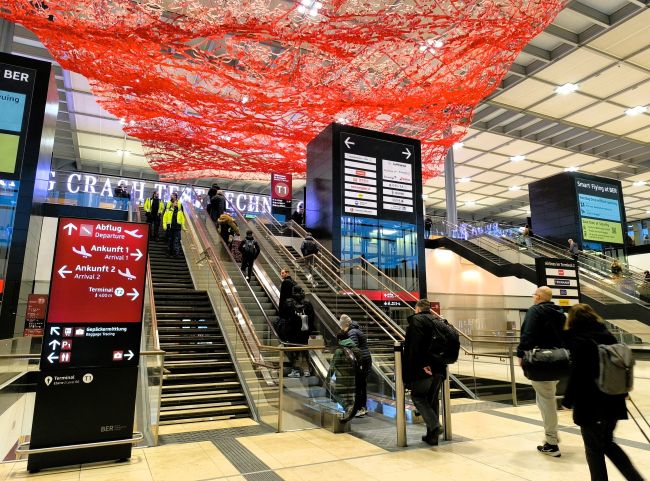
BBI, the German capital's airport, has just 5 intercontinental routes, including a single route to Newark in North America. A typical example of Germany's loss of attractiveness by air (Photo: Luc Citrinot)
It has been a struggle that has lasted several years, but it has finally borne fruit. After demonstrating for almost a decade that rising air taxes and operating costs were endangering German air transport - and the country's competitiveness - the airline industry has finally convinced the German federal government.
According to the German Airport Association ADV, Germany has lost almost 200 direct routes in ten years. Around forty non-stop destinations have disappeared from the radar.
The latest: the suspension of Stuttgart-Atlanta by Delta Air Lines, as well as London-Heathrow to Cologne and Stuttgart and London-City to Frankfurt, announced by British Airways for spring 2026. We could also mention the end of Berlin-Singapore, Düsseldorf-Chicago or Hamburg-New York...
Stopping the haemorrhage
Conservative Chancellor Merz's coalition, which has been in power since April, has presented a wide-ranging relief package for the sector. This includes cancelling the last increase in air tax from 1ᵉʳ July 2026, as well as a number of measures designed to reduce public costs and regulatory burdens, which are considered to be the highest in Europe.
Ralph Beisel, Managing Director of ADV, the German airports association, believes that this is the start of a trend reversal. "For the first time in years, the vicious circle of rising taxes, fees and regulatory obligations has been broken. The costs of a German presence, currently in excess of €4 billion, will finally be partially reduced", he believes. The airports hope that these measures will slow, if not halt, the exodus of aircraft based in Germany and the gradual abandonment of many routes.
The 2026 federal budget provides for a total of around €400 million to accompany these measures. Operators see this as an "important and long-awaited" signal that they need to regain competitiveness with European hubs.
The main measures include :
Flugsicherung (air navigation) First tariff cut in 2026, reduction of more than 10 % by 2029, at no extra cost to the federal budget.
Air safety : reduction through efficiency gains and proposals from the Länder.
Import VAT : switch to the compensation model.
Power-to-Liquid (synthetic fuels) elimination of national standards, application of European standards only.
Air tax A return to pre-May 2024 levels from July 2026, for annual savings of €350 million.
Renewed hope for airline operators
The hubs now want to believe in a "real change of direction", publicly announced by Chancellor Merz, who has promised a national strategy for airports and airlines.
Airports, for their part, affirm their commitment to growing, becoming greener and strengthening the country's connectivity, but believe that this can only be achieved with a more favourable competitive framework. In their view, the gradual reduction in public costs over the next few years is essential.
For their part, MEPs also confirmed that the State would cover the costs of air navigation at small airports to the tune of €50 million by 2026. Unlike the major international airports, air navigation at small and medium-sized airports is not provided by Deutsche Flugsicherung (DFS) but is financed directly by the operators. Without this federal compensation, these hubs would have had to assume this task, which is normally the responsibility of the State, on their own. With the potential bankruptcy of the smallest airports.
The new direction taken by Germany to stimulate air transport could finally be emulated in France. France will become the only major European country with the highest air fares and taxes in the EU...
By using our site, you consent to the use of cookies.
We use cookies on our site to store and/or access information about your device, in particular to offer you advertising and to compile statistics in order to improve ergonomics, navigation and editorial content.
Analytical cookies enable us to gather valuable information to optimise the performance of our site and improve your user experience.
By accepting cookies, you are supporting the work of our editorial team in providing you with quality information, while enabling us to offer you content and services tailored to your interests.
For more information, please consult our page Privacy policy.