
















Updated on 6 March at 6pm.
The Italian Rail Competition and Market Authority (AGCM) has just issued a favourable opinion for SNCF so that the French carrier can benefit from fair access to the high-speed market in Italy. After much prevarication, Rete Ferroviaria Italiana (RFI), the network operator and subsidiary of the public group Ferrovie dello Stato (FS), has agreed to comply and has granted the first part of the train paths requested by SNCF Voyages Italia, a subsidiary of SNCF Voyageurs. This will enable the company to complete its plans to launch in Italy in 2027.
In order to run its TGVs, SNCF Voyageurs had signed a 15-year framework agreement with RFI, the equivalent of SNCF Réseau on this side of the Alps, which is responsible for developing, operating and maintaining the Italian rail network. However, faced with a blockage and to obtain the desired train paths, SNCF appealed to the Italian regulatory authorities. In 2025, the Italian competition authority also opened an investigation against Ferrovie dello Stato, also Trenitalia's parent company, for abuse of a dominant position.
However, the AGCM's decision is only the first step for SNCF, which hopes to obtain all the train paths it has requested. " Without this minimum level of activity, the company does not have the necessary conditions to justify the investment and continue its operations. "warns the French airline in a press release. It also claims " the certainty of being able to access maintenance facilities in Italy and obtain approval for trains ".
13 return trips per day expected to date
At the same time, SNCF is announcing that it will begin operations in Italy in September 2027. This is a year later than originally planned, due to delays in the delivery of the TGV M, the first four of which are only due to start running in France at the beginning of July. Specially adapted to the technical constraints of Italy's high-speed lines, fifteen double-decker trainsets of this "TGV of the future" built by Alstom are intended for this offensive on the Italian domestic market. This is in response to Trenitalia's arrival in France at the end of 2021. To start with, customers will be able to take advantage of 13 daily return trips, i.e. 9 return trips between Turin/Milan/Rome and Naples and 4 return trips between Turin and Venice.
" Italy represents a natural and relevant market for high-speed rail, with more than 56 million passengers a year. "explains the SNCF. With the potential to carry 10 million passengers a year, SVI will serve Turin, Milan, Brescia, Verona, Padua, Venice, Bologna, Florence, Rome and Naples. However, the future challenger is open to " the possibility of serving other destinations, including southern Italy, as soon as infrastructure permits ". Italy's high-speed network currently covers some 1,000 kilometres, but is currently being extended south of Salerno, in Calabria, towards Sicily.

Attacking Trenitalia and Italo with Ouigo's low prices
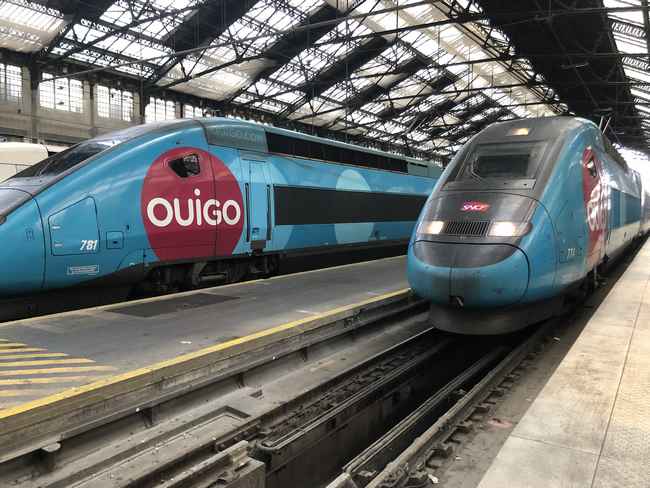
Via SNCF Voyages Italia (SVI), SNCF Voyageurs will unsurprisingly be rolling out its low-cost Ouigo brand against Trenitalia, the FS group's historic national operator, and NTV-Italo, the second largest operator since 2012, which has a market share of 30% on Milan-Rome routes and in which SNCF was once a shareholder with 20% [the Italian-Swiss group MSC is now the main shareholder with more than 49%]. With its future low fares, which will be facilitated by much lower rail toll costs than in France, SVI hopes to make a difference to the current more traditional offers and achieve a market share of 15% by 2030. In this way, SNCF intends to repeat the success of Spain, where Ouigo España has already captured 20% of the market and made its first profits in 2025, four years after its launch...