
















The future has never been closer than in China, notably with the arrival of robots in everyday life.
The country has just effectively given a spectacular demonstration of advances in robotics. Today marked the end of the second edition of the World Humanoid Robot Games in Beijing. For five days, from 22 to 26 August 2026, more than 2,000 humanoid robots took part in 51 sporting events, ranging from athletics to football. Notably, the Chinese robot Tiangong Ultra ran the 100 metres in 8.86 seconds, bettering Usain Bolt's human record set in 2009.
This demonstration of technological force is currently making its way into the hotel industry. China now wants to test robots in services such as hospitality. This is a way for China to ultimately alleviate labour shortages in this economic sector.
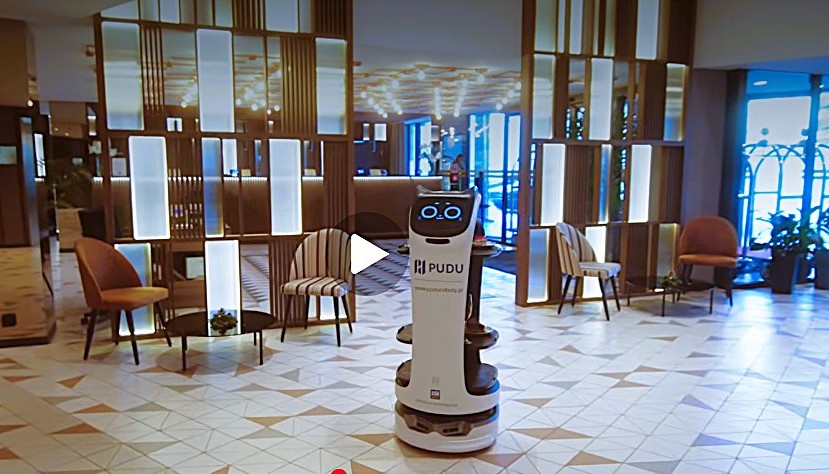
The country is thus preparing for a large-scale experiment. The company Pudu Robotics is set to create a revolution that will definitively transform the tourism industry: a hotel where robots will no longer be simple assistants assigned to cleaning corridors, but will handle all operations pertaining to hotel management.
This Chinese robotics specialist has indeed recently unveiled its project for a fully robotic hotel on an artificial island named West, created as part of the mammoth Shenzhen-Zhongshan Link, which connects several cities in the Pearl River Delta through a complex of bridges and tunnels.
The 44-room property is officially scheduled to open in 2027. However, an initial testing phase is expected to begin as early as late 2026, with a limited number of rooms and services accessible to the public.
A hotel world without humans?
Unlike hotels that already use robots for certain tasks, the new concept aims to automate almost the entire range of operations. Reception, check-in, concierge services, room delivery, luggage transport, cleaning, catering and guest assistance will be handled by robots.
Pudu Robotics has partnered with Shenzhen Culture & Tourism Industry Development to transform West Island into a showcase dedicated to artificial intelligence, robotics and smart tourism.
The system will rely in particular on the PuduFM 1.0 artificial intelligence model and the PuduAgent platform. These technologies will make it possible to coordinate the various robots within an integrated system.
Each model will have its own function: the FlashBot will handle the delivery of drinks and snacks ordered via smartphone. The T300 will transport luggage to the rooms, while the CC1 Pro and MT1 robots will handle cleaning thanks to AI-based waste detection systems.
China already makes extensive use of robots in the hotel industry. But the West Island project goes much further: it was designed from the outset as a fully robotised hotel ecosystem.
The hotel also represents the first stage of a broader tourism project. Over the next four years, robotics and AI are expected to be rolled out across the island's other services and infrastructure, transforming it into a real-life version of a science fiction film.
There remains an existential question to be resolved. Hotel brands always explain that the human touch is the quintessence of their business. What can be said then about a hotel managed almost entirely by robots?


