Gulf companies, the driving force behind global air transport
Among today's most powerful airlines, those of the Gulf embody, better than anyone else, the global nature of our world, with hubs connecting the whole planet. After long being vilified by the competition, they have even become the financial guarantors of certain players in peril.
By The Editor -
You'd almost have to pinch yourself to believe such a reversal of fortune. Just five years ago, the traditional airlines, from Air France to Qantas, from Lufthansa to Air Canada, were quick to denounce the imbalance between their operating methods and those of the Gulf carriers. Their complaint: on the one hand, players subject to the harsh laws of the market, and on the other, carriers unconditionally supported by their governments and benefiting from substantial discounts on their oil bills.
Well-founded or not, these recriminations have had their day. At a time when the air transport industry in Europe, and the Western world in general, continues to suffer under the combined effect of high oil prices and a major economic recession, the insolent health of Middle Eastern airlines can only arouse envy, if not covetousness.
Particularly in relation to the 'infernal trio' of Emirates Airlines, Etihad and Qatar Airways. To which we could add Turkish Airlines: although not strictly speaking a Gulf carrier, the Turkish airline has adopted the same model of all-out growth, the pace of which is no match for its Emirates or Qatar-based counterparts...
Crazy growth
When Brian Pearce, Chief Economist of the World Air Transport Association (IATA), presented a report on traffic trends last December, he predicted that the growth of Middle Eastern airlines would continue to outstrip the overall outlook for the industry. "On international markets, only Middle Eastern carriers continue to expand at a rapid pace, taking new market share over the long term. mail and developing new east-west traffic flows on the Africa-Asia route".he said at IATA headquarters in Geneva.
Powerful Triumvirate
Of the $6.7 billion in profits expected by the air transport industry as a whole in 2012, a fall of 23.7 % compared with 2011, Middle Eastern airlines are expected to make a profit of at least $800 million. This is less than the one billion recorded in 2011, but the slight decline can be explained by the difficulties faced by airlines in countries shaken by economic and political crisis, such as Egypt and Syria. Events linked to the 'Arab Spring' are still weighing on Egypt Air, Royal Jordanian Airlines and Middle East Airlines (Lebanon). However, IATA predicts a clear upturn in 2013, with the overall profits of the region's airlines expected to exceed one billion dollars once again, while at the same time generating a ?nancial margin up by 3 %.
Within this framework, the three giants Emirates Airlines in Dubai, Qatar Airways in Doha and Etihad Airways in Abu Dhabi are supporting the growth of traffic in the Middle East. To this solid triumvirate we could also add Oman Air. Since its conversion from a regional carrier to a global player, the sultanate's carrier has been steadily nibbling away at market share. With their dominant position, these four airlines, which enjoy the unconditional support of their governments, are now undermining the restructuring of the more traditional Middle Eastern carriers, Kuwait Airways and Saudi Arabian, and even more so Gulf Air. For a long time, Bahrain was the only carrier in the region, supported by Abu Dhabi, Qatar, Bahrain and Oman, before these emirates and sultanates went it alone...
The irresistible rise of the region's airlines is first and foremost a question of national ambitions based on the providential manna of the region's energy resources. Emirates Airlines, the first to emancipate itself 25 years ago from Gulf Air, has set the tone, leading the others in its wake. Etihad, Qatar Airways, Oman Air: no one is denying the growth model put in place by Dubai Airlines. "Except that what Emirates has achieved in 25 years, we have done in less than a decade".Qatar Airways CEO Akbar Al Baker likes to tell us, half-seriously, half-jokingly.
New epicentre
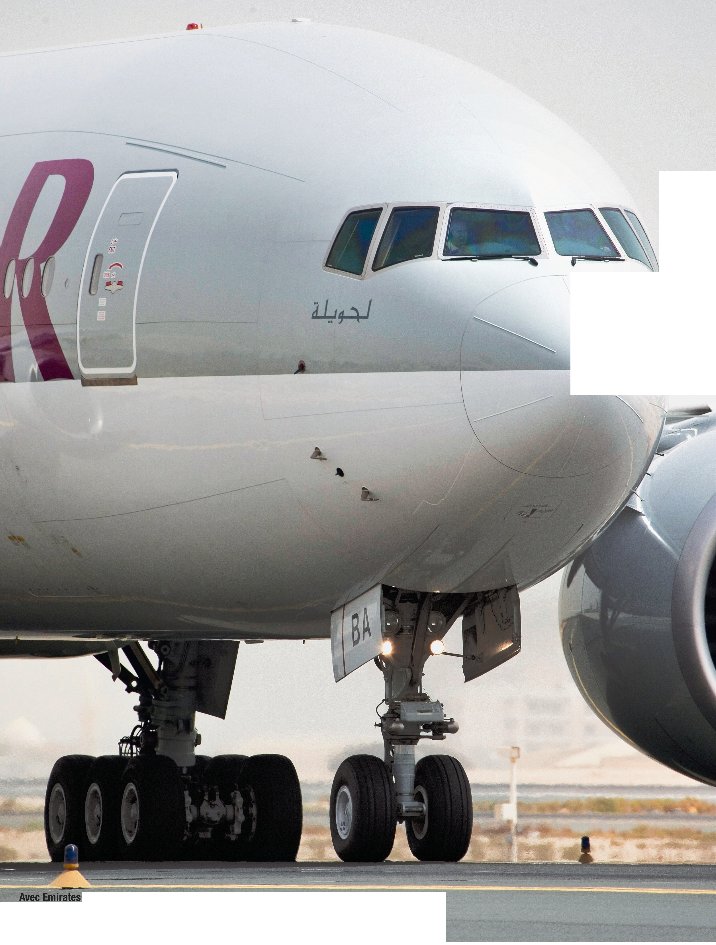
Emirates' success is based on a simple but diabolically effective idea: to promote its Dubai hub not as a regional hub, but as a global hub. A clear strategy, which consists of offering the emirate as a single connecting point for all passengers, from South America to Australia, from Europe to Asia or from North America to Africa.
This global hub concept alone explains the staggering figures announced for each order, often involving around a hundred aircraft. Here again, the competition between the big three in the Gulf is breathtaking. Nearly 900 aircraft are said to be on standby in the region, with Etihad, Emirates and Qatar Airways receiving an average of around fifty new aircraft each year. So it's no coincidence that Emirates is now the biggest customer for the Airbus A380, with 90 aircraft pre-empted, 31 of which entered service in 2012, while being the only airline to offer a dedicated terminal for the giant of the skies. This fleet of super jumbos serves around twenty destinations, including Paris, which has been linked to Dubai by two daily flights since January.
And this is just the beginning. Already with 196 aircraft in 2012, Emirates is set to almost double this figure by 2020. Qatar Airways, which receives an aircraft almost every 15 days, is expecting the delivery of 250 aircraft to modernise or add to its fleet of more than 120 aircraft. The airline will also be the launch carrier - probably in the second half of 2014 - for the Airbus A350, 80 of which have already been ordered. Qatar Airways recently amended its request to include the brand-new A350-1000 model, which offers a larger capacity than previous models. "We took this decision because we believe that an Airbus A350 XWB (Editor's note: for Xtra Wide Body) of large capacity is the most appropriate for our growth model".said Akbar Al Baker in December.
Etihad is obviously not to be outdone, preparing to bring 14 aircraft into service later this year. Overall, it will have taken the airline less than eight years to build up a fleet of 67 aircraft. And by the end of the decade, the Emirati carrier should be flying more than 180 additional aircraft, including nearly 70 Boeing 787 Dreamliners. The airline's customers will have to wait until 2014 to enjoy the comfort of these Boeing 787s, as well as the first Airbus A380s.
Dubai and its airline Emirates have turned the rules of the air transport game on their head, turning the emirate into a global hub linking continents with a state-of-the-art fleet.
A widely followed example
These giants are being emulated. Oman Air, the latest entrant to the long-haul market, is also showing its ambitions. The carrier, which only offered a dozen regional destinations five years ago, plans to serve 50 cities worldwide this year, with a fleet that should increase from 27 to 40 aircraft by 2015. Saudi Arabian Airlines is also affected by the Emirates syndrome. The airline, which has long been marginalised by regional competition but intends to establish itself as a global player, has also embarked on the race to modernise its product, placing an order for 90 aircraft, including 20 Boeing 777-300ERs and eight Boeing 787 Dreamliners. Last year it also put the last of its 35 Airbus A320s into service on its short- and medium-haul network.
Beyond the publicity effect of these giant orders, the tenfold increase in air ?otters is at the heart of the Gulf carriers' strategy of conquest. Not only because a new aircraft is a seductive element for passengers, who are delighted to be seated in aircraft with cutting-edge technology and comfort, but above all because these hundreds of aircraft entering service will have to find markets to serve...
As a result of these mass deliveries, the number of air routes has increased dramatically. Every year, dozens of Gulf carriers announce new services or increased frequencies. Emirates has doubled its flights to Paris by Airbus A380 and has just inaugurated a direct Lyon-Dubai route, opening up the capital of Gaul to the Middle East and Asia.
This continent, with some of the world's most dynamic economies and the emergence of urban middle classes, remains a prime target. Qatar Airways is pressing ahead with the opening of flights to Baku, Chongqing and Rangoon, and more recently to Chengdu and Phnom Penh. For its part, Saudi Arabian has been serving Guangzhou for a year now, with four flights a week, while Emirates has recently taken off for Phuket, while organising a veritable air bridge to Australia. Etihad is following the same flight plan with the launch of routes to Ahme-Dabad in 2012, then to Ho Chi Minh City from next October. The airline has also signed codeshare agreements with Indonesia's Garuda as well as with China's China Eastern and Hainan Airlines to expand its range of services.
To continue their conquest of the globe, 2013 will see the launch of routes to North America. Saudi Arabian has announced services to Toronto and Los Angeles, Etihad will fly to Washington and Emirates plans to serve Boston and Miami after launching routes to Washington, Dallas and Seattle in December. Qatar Airways, meanwhile, is preparing for its arrival in Chicago in April. The airline's CEO Akbar Al Baker told an American newspaper that he wanted to extend this network to Detroit, Boston and Atlanta. Only Canada still seems reluctant to allow Emirates carriers to develop on its territory, arguing that the traffic between the two countries does not justify the massive landing of these carriers.
Etihad partners with Air France
But Canada now seems to be alone in its ivory tower. The latest episode in the saga of the Gulf companies is that of a new respectability. The crisis affecting many Western countries is synonymous with opportunity for the Gulf companies, which have become strategic partners investing in what were still their bitter detractors five years ago.
Etihad has become a shareholder in Air Seychelles, Virgin Australia, Air Berlin in Germany and Aer Lingus in Ireland. This strategy of acquiring stakes could continue in India, with the airline possibly taking a stake in Jet Airways. What's more, last October the Abu Dhabi carrier signed a cooperation agreement with one of the sector's major players, Air France-KLM. The agreement, which is purely commercial, allows code-sharing on the networks of both airlines. While Air France passengers can connect at Abu Dhabi to Colombo (Sri Lanka), Dhaka (Bangladesh), Kathmandu (Nepal), Mahé (Seychelles) and Malé (Maldives), Etihad passengers benefit from Air France connections at CDG to Bordeaux, Copenhagen, Madrid, Nice and Toulouse. This agreement also includes the France-Germany routes, in partnership with Air Berlin. The same strategy applies to KLM, with the launch of a direct Etihad service to Amsterdam. This alliance is likely to become even stronger in the future. Cooperation could be extended to maintenance, group purchasing and ?delisation programmes. At a press conference earlier this year, Air France CEO Alexandre de Juniac admitted that the carrier was not ready to increase its stake in Alitalia, "the company's resources being extremely limited".At the time, the business daily Les Echos mentioned the possibility of Etihad coming to the rescue and taking part in the financing round in favour of the Italian airline.
Ultimately, it is reasonable to assume that the Abu Dhabi airline will join one or other of the alliances, and more likely SkyTeam, given its marketing agreements with Air France-KLM and China Eastern. This option has been rejected for the time being, according to Vijay Poonoosamy, Etihad's Vice President International Relations. But for how much longer?
A time of alliances
The Gulf airlines, hitherto on the sidelines, have now joined the alliance game. Indeed, while Qatar Airways is currently refusing to acquire a stake in another airline, it was the first Gulf airline to offer its entry into an alliance. In October, a few days after the announcement of the Etihad/Air France-KLM merger, the Doha-based airline announced that it was joining the oneworld alliance, with Cathay Paci?c, American Airlines and British Airways among its future partners... It is likely that other airlines will follow this example, like Gulf Air, whose survival can only depend on rapid integration into an alliance, guaranteeing a global dimension which it still lacks. Such a strategy has already been adopted in the region by Royal Jordanian, a member of oneworld, and by Middle East Airlines and Saudi Arabian, both of which have joined SkyTeam.
For its part, Emirates has pulled off a major media coup thanks to a cooperation agreement with Australia's Qantas. The new duo has shattered the historic partnership between the Australian airline and British Airways, which until now has monopolised traffic between Great Britain and Australia. Instead of transiting via Singapore or Bangkok, passengers travelling between London and Australia's major cities will change planes in Dubai, which has been repositioned as the main hub on the "kangaroo route"."A new era is dawning for global air transport, with greater cooperation between airlines pursuing similar objectives in terms of growth and quality of service", predicted Etihad CEO James Hogan last October at the World Routes exhibition in Abu Dhabi. From marginalisation to consecration in just two decades, everything suggests that the destiny of Middle Eastern airlines has all the makings of a fairytale. A thousand and one nights.
By using our site, you consent to the use of cookies.
We use cookies on our site to store and/or access information about your device, in particular to offer you advertising and to compile statistics in order to improve ergonomics, navigation and editorial content.
Analytical cookies enable us to gather valuable information to optimise the performance of our site and improve your user experience.
By accepting cookies, you are supporting the work of our editorial team in providing you with quality information, while enabling us to offer you content and services tailored to your interests.
For more information, please consult our page Privacy policy.