



















What is MK Partnair's mission?
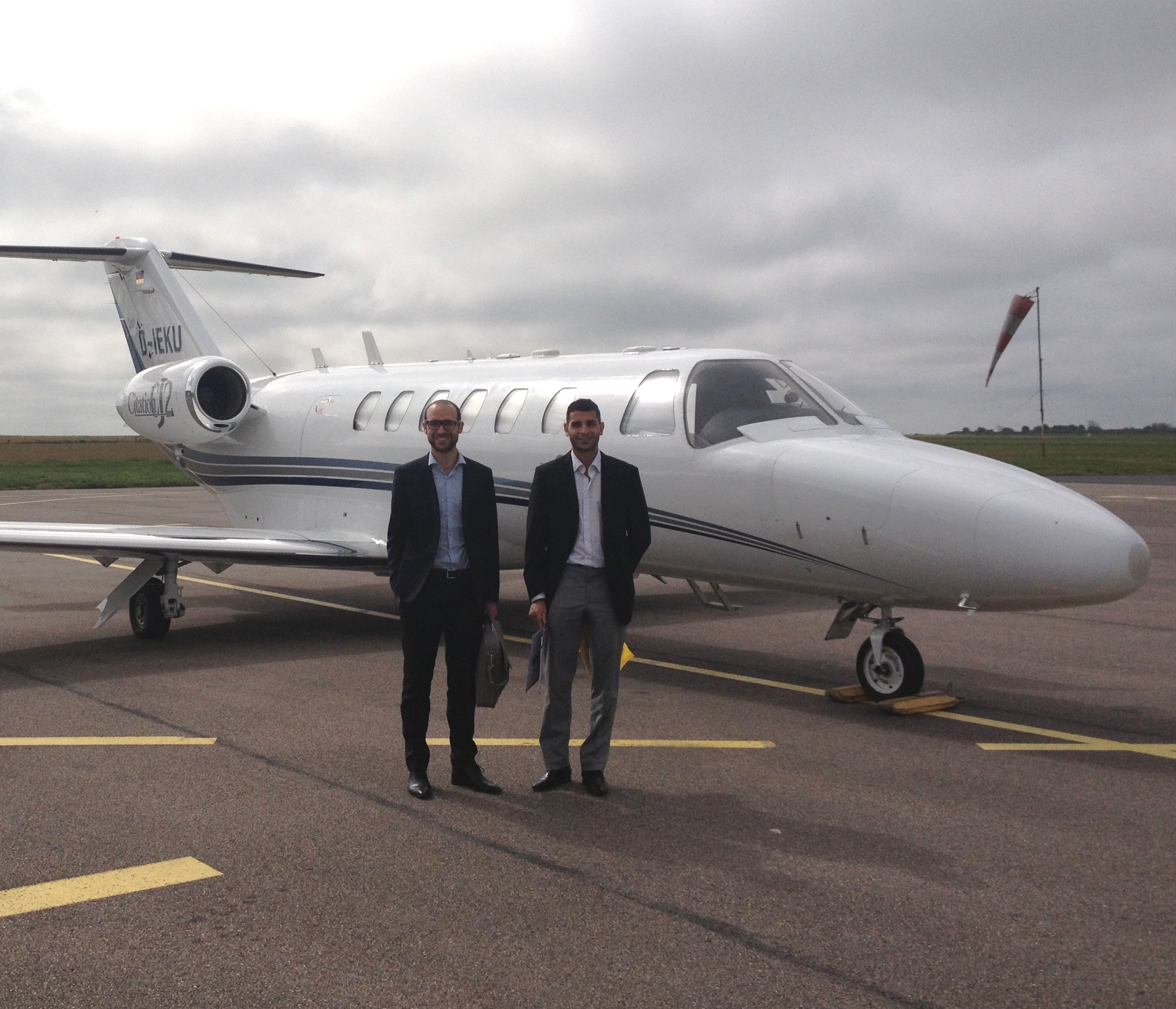
Hadrien Musitelli - For the past six months, we have specialised in chartering private jets and airliners for private and business clients, adding the possibility of also providing taxi transport, organising meetings and booking hotels: everything a business traveller might need. We have integrated a concierge service, which enables us to respond to all these requests. We can also personalise the aircraft and cabin crew to encourage group cohesion by adopting the company colours.
Why use this type of intermediary?
H. M. - We offer an all-inclusive service, with transparent pricing and no hidden costs. With over 4,000 aircraft in stock, we are able to cover all types of request, from top management trips to company seminars. The software we have developed enables us to display the nearest, most suitable aircraft at the best price for each request.
Isn't the elitist image of business aviation suffering as a result of the economic climate?
H. M. - Our ambition is to democratise the use of aircraft taxis and break down preconceptions. We need to make companies understand that hiring a jet is not so much a cost as an investment which, when all the advantages are added up, pays for itself. Of course, the face cost may seem higher, but in the end this service offers the possibility of saving several hours during the day, saving on a hotel room by coming straight home in the evening, reducing taxi bills by landing as close as possible to the destination...
What is the minimum budget for using a private jet?
H. M. - From 2,000 euros per flight hour for an aircraft carrying four people, although of course everything depends on availability and the number of seats. A company director based in Toulouse who has to go to Brest has two options: go via Paris and lose a day's journey, or take 1.5 hours by using business aviation. If it's a trip for eight executives, the loss of time ultimately represents a big loss of money. This is all the more true when you consider that a private plane allows you to work, to connect to Wi-Fi or other means of communication, or to organise an in-flight meeting. The constraints associated with check-in are also greatly simplified: all you have to do is arrive 10 minutes before take-off, everything goes very quickly, and you avoid the latency that you normally experience in airports, as well as the stress of missing your plane. So today it's the most flexible way of travelling for business, at increasingly competitive rates. So much so that SMEs are becoming increasingly interested.
Which routes are the most popular? Are they more "classic" business routes, or smaller, local airports?
H. M. - Many flights are province-to-province, or to nearby Europe: Italy, Switzerland, Germany. There are around ten times as many airports that can be served by a private route as by a scheduled route. This opens up many more possibilities.
What are MK Partnair's plans for the short and medium term?
H. M. - We just opened our Paris office six months ago, and will soon be setting up in Doha. We hope to establish our business model elsewhere, and we're also looking at Florida.


