












The inconsolable wounds of January and November 2015 won't change a thing: Paris will always be Paris. Intact and yet different. Over the last three years, new architectural landmarks, most of them cultural, have made their mark on the urban landscape: Renzo Piano's Fondation Pathé in the 13th arrondissement, Frank Gehry's Fondation Louis Vuitton in the heart of the Bois de Boulogne, Jean Nouvel's Philharmonie on the outskirts of Pantin and, more recently, the organic Canopée des Halles by architect Patrick Berger. Enough to attract the crowds and fill the 115,000 hotel rooms in the capital.
Paris, which rivals London as the world's leading destination, has long enjoyed a leading position in business tourism, with this segment accounting for 40 % of overnight stays in Paris. With almost 1,000 business meetings a year, Paris ranks among the world's top cities for hosting congresses; third in the International Congress and Convention Association (ICCA) rankings in 2015, behind Berlin and Vienna, after holding the top spot for the previous two years. And that's not counting major trade events such as the Paris Air Show, the Paris Motor Show and Batimat.


Several factors contribute to this favourable positioning, not least the quality and nature of the infrastructure. Paris has the largest exhibition surface area in Europe, with a total of 744,000 m2 spread over twenty-one sites, from Le Bourget to Villepinte, from Porte Maillot to Porte de Versailles, and including more central venues such as the Palais Brongniart and the Grand Palais, which are not directly dedicated to events, but can host all types of corporate meetings.
To maintain this high level of service, we are constantly looking to improve our infrastructure. And the stakes are high: the convention sector alone generates €1.2 billion a year for Paris. So one renovation or extension project follows another. In 2018, Porte de Versailles will become the "Paris Convention Center"This is Europe's largest convention centre, with a capacity of 30,000 people. As part of the 23 urban projects selected to "reinvent Paris", the redevelopment of Porte Maillot, in the vicinity of the convention centre, is also a major project. Two buildings will be completed in 2022, including a bridge building spanning the ring road, the "1,000-tree building" designed by Japanese architect Sou Fujimoto. "In the longer term, there are also plans for an extension to Le Bourget, which could become the media centre for the 2024 Olympics, followed by a conference centre."explains Jean-François Martins, deputy mayor of Paris with responsibility for sport and tourism.
Paris' bid for the Olympic Games - in the running with Los Angeles, Rome and Budapest - also seems to be in line with the spirit of the times, with two fundamental principles: economic sobriety and the desire to offer the best of Paris. For example, the archery events could be held on the esplanade des Invalides, the fencing events at the Grand Palais and the beach volleyball events on the Champ de Mars. Few new facilities will therefore be needed, but those that remain to be built will be permanent, with a second hall at Bercy, the development of Porte de la Chapelle to reduce the divide between Paris and its suburbs, a swimming pool and an Olympic village converted into 3,000 housing units in Saint-Denis...


PARIS FRENCH TECH
Despite the climate of political and social tension currently hanging over the capital, a certain effervescence is palpable, favourable to the deployment of new businesses. "Paris is a cultural, economic and political capital with a rich academic environment, which is essential for business."continues Anne Hidalgo's deputy. The proliferation of start-ups is proof of this dynamism. Three years ago, Welcome City Lab, the first Parisian incubator dedicated to tourism, opened its doors. "We welcome start-ups for a period of six to nine months to find out about their customers' needs and submit ideas for them to test in order to position Paris as the world leader in urban tourism."says Laurent Queige, General Delegate.
More generally, it is the entire new technology sector that is breathing new life into the French capital's economy. While Paris is still some way behind San Francisco in terms of the number of start-ups created, it is now ahead of London and on a par with New York. This dynamism is largely supported by local authorities. To help young companies find private funding, Bpifrance and the Paris Innovation Amorçage Fund are happy to provide the necessary support, while the Paris City Council offers them the opportunity to meet major CAC 40 companies as part of the Open Innovation Club. Another target is globalisation: the objective for 2020 is to integrate 30 % of international start-ups into the city's innovation platforms, such as Paris French Tech Ticket or Paris Landing Pack, and to organise twinning arrangements, notably with New York, Chicago, Montreal, Tel-Aviv, Amsterdam, Ramallah and Seoul.

BLEISURE SPIRIT IN DEFENCE
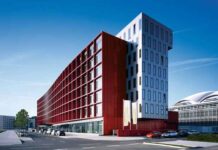
It is this same international reach that the La Défense district is aiming for, where companies from emerging countries such as India and China are slowly starting to set up shop. "As part of the Greater Paris project, La Défense is one of Europe's leading business districts, with 3.5 million m2 of office space.It's not just a question of developing the area," explains Laurent Roques, Deputy Director General of Defacto, the entity responsible for managing and promoting La Défense. But while the tertiary sector continues to develop, Defacto's current mission is to give the district a mixed vocation, to make it a destination in its own right. Many buildings, such as the Eqho tower dating from 1988, are being brought up to ecological standards while adding restaurants and shops. In the same vein, the D2 tower, completed in 2014, has been crowned at the top with a relaxation area offering splendid views over Paris. Other towers, such as the M2 tower, the future headquarters of Saint-Gobain, and the Trinity tower, due for completion in 2018 and 2019 respectively, will also have some entertainment facilities. "While the first phase of the district, between 1958 and 2000, focused on the tertiary sector, the current phase aims to give it a vocation for living and culture."insists Laurent Roques.
However, the ratio remains disproportionate: only 20,000 people live at La Défense, while 160,000 work there. This figure will soon rise to 180,000 once the twin Sisters Towers and Jean Nouvel's Hekla Tower are completed. A number of tempting projects are also being developed: in 2017, the Arena 92 will open, a stadium that can be converted into an auditorium designed by Christian de Portzamparc, and next spring, a new 45,000 m2 hybrid venue, Oxygen, with gardens, coworking spaces and restaurants. In early 2018, Table Square will be inaugurated, a gastronomic space featuring a lounge bar and a number of restaurants, one of which could be awarded a Michelin star.


PARIS CDG, A SHOWCASE FOR FRANCE
"To achieve our goal of gender diversity, we are also focusing on connectivity"concludes Laurent Roques. La Défense will soon be just a few minutes from Saint-Lazare station and Porte Maillot thanks to Eole, the E line of the RER, scheduled for 2020, and the new metro line 15, planned as part of the Grand-Paris-Express project, which will put the district half an hour from Roissy and Orly airports by 2025.
Already highly developed, accessibility remains one of Paris's key assets, thanks in particular to Paris CDG, continental Europe's leading airport in terms of passenger traffic and Europe's leading hub for connectivity. "There is no major capital city without a major airport.says Franck Goldnadel, Director of Paris-Charles de Gaulle airport. The ADP Group is convinced that it must contribute to the reputation of Paris and France, because airports are the gateway for foreign tourists: they are the first and last image that people have of a city and a country."
So everything is being done to make them want to come back. More than three billion euros will be invested over the next five years to improve the two Paris airports. "CDG wants to be a showcase for French know-how, with the presence of major luxury brands and art exhibitions, notably in the museum area of the new Hall M in terminal 2, in collaboration with major institutions such as the Rodin museum."explains Frank Goldnadel. While aesthetic efforts are being made throughout the airport, the practical is by no means neglected: CDG is the first European airport to have been awarded the "Chinese friendly" label thanks to the efforts made in terms of signage. In addition, digital tools have been put in place to help passengers feel accompanied on their journeys.

There is still one black spot: the airport-city link. The current RER, which is needed to transport the people of Ile-de-France, is not adapted to air passengers. The ADP Group therefore supports the CDG Express project, which represents a total investment of €1.7 billion. However, we will still have to wait until 2023, or perhaps 2025, to see the first trains leaving for the airport from Gare de l'Est... This is why other measures have been put in place, including, since last spring, a single fare for taxis between CDG and Paris and the launch in May of Bus Direct, a premium service between Paris and the two Paris airports, replacing the Air France coaches. Initiated in 2012, the project for a loop of the Francilienne that would bypass the airport to the east is also waiting to see the light of day. The other major problem is that of the A1 motorway, which is unable to cope with the growth in traffic forecast for CDG. And growth there will be. "We have to thank those who have been thinking about Roissy since 1974, with many possibilities for expansion in mind"explains its director.
While the airport already has four runways and there is no need to build a fifth, the possibility of an additional terminal, T4, is being considered. At present, the capacity of the runways is 120 movements per hour. By improving their management, an increase in traffic of 10 % can be expected. "We have already gone from 58 million to 62 million passengers between 2010 and 2015."concludes Frank Goldnadel. The economic impact of this growth is immediate: for every million extra passengers, 1,500 jobs are created. In total, the economic activity generated by Paris airports mobilises almost 350,000 employees, creating added value of around €30 billion, or 5.8 % of the GDP of the Ile-de-France region and 1.7 % of French GDP. So Paris still has a bright future ahead of it.
Special report - Paris: the influence of the City of Light
- Air du temps: the City of Light's influence
Bleisure: Cultural directory in the making
Meet Élisabeth Borne, CEO of RATP
Trend: French Tech weaves its web
Expansion: Paris extra muros
Interview : Bernhardt Eichner, Managing Director of Hermès services groupe
Hotels: bohemian chic in a boutique hotel
Paris: address book
The spirit of the place according to Alexandre Cammas


