















A major port and the seat of the country's administrative, political and economic institutions, Algiers is a maximum 3-hour flight from all the major European capitals, making this superb city, built on the foothills of the Sahel hills, an ideal bridge between Europe and Africa.
A city centre in need of renovation
However, the city, whose famous Kasbah is a UNESCO World Heritage Site, has not yet managed to plan its future. major urban renewal for its city centre, the heart of political and financial power. The district suffocates in a small space and permanent congestion. Its beautiful, dilapidated Haussmann-style buildings are often costly to renovate, even though a recent refurbishment has enhanced the city's façades and quaysides.
For the business world, the centre of Algiers is becoming synonymous with traffic congestion, car parks and unsuitable premises. As a result, companies that had long favoured the beautiful old district of Hydra because of the presence of the World Trade Centre are starting to look further afield, towards more modern, spacious and accessible spaces.
The Bab Ezzouar district, the Algiers of the future
To really see the Algiers of the future emerge, you have to go further out towards the suburbs. The Bab Ezzouar district, to the east of the capital, is a symbol of this. Located close to the airport, it has seen a host of property developments this year.
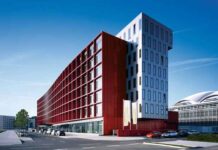
A number of company headquarters, including those of Baraka Bank and the Cosider construction and public works group, have been set up in the area. brand new towers. The Trust Center tower, which will house a new Marriott hotel, is nearing completion, as is the Oriental Business Park. This prestigious complex, comprising a 15,000 m2a 30,000 m2 and a sports centre, and will soon be home to the Chinese telecommunications company Huawei. The Oriental Business Park will be next door to an already popular shopping centre, a new Novotel under construction alongside the Ibis and Mercure hotels, as well as the headquarters of a number of major international names such as KPMG and BNP-Paribas, which inaugurated a new €57 million headquarters in Bab Ezzouar in 2016.


The economic downturn in the oil services sector has had a very positive impact on other companies, driving down office property prices. Even if Algiers remains the most expensive city in the Maghreb, at 30 dollars per square metre per month, 10 dollars more than Casablanca.
Result: the world of start-ups is expanding and seems to be divided between two destinations. On the one hand, a very active incubator in Algiers, Sylabs, located in the centre near the French Institute, and on the other, a government-sponsored facility in Sidi Abdelleh, some thirty kilometres west of the capital. The 100-hectare Cyber Park is home to around thirty companies specialising in the technology sector, as well as an incubator to support project leaders.


The huge infrastructure project
The fact remains that the urban infrastructure is still undersized in relation to the recent economic development of the city, which, with its suburbs, has a population of over four million and struggles on a daily basis with car congestion. A package worth 1.3 billion dollars was spent on road infrastructure between 2010 and 2014, and no fewer than 30 road projects are currently under way.
The work will focus on the construction of expressways to improve traffic flow in Greater Algiers. Two main roads are favoured: the ring road linking the capital's major western and eastern suburbs, and the eastern expressway linking central Algiers to Houari Boumediene airport.
This is a priority, especially as public transport is not yet up to scratch: almost 200,000 people use it every day, but Algiers has only one 23-kilometre tramway line and one metro line serving 14 stations over 13.5 km.
Two new sections are currently under construction. In particular, an extension will link up with Houari Boumediene airport. A substantial budget has also been released for the development and extension of 10 port infrastructures along the Algiers coastline. The entire Algiers coastline is currently being developed.


