















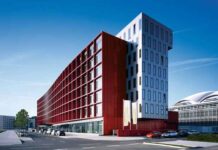



2.3 million square metres of living space spread out - or rather piled up - over 300 hectares, between the city centre and the airport: the Zuidas district, to the south of Amsterdam, is probably one of the most ambitious urban projects in Europe. What's more, Zuidas is no longer a project, it's already a reality. And although it will be a quarter of a century before the concept is brought to fruition, Zuidas has already established itself on the European business map since the opening of the World Trade Centre and the Gustav Malhlerplein towers. Companies such as ING Bank, ABN Amro, Fortis and Rabobank have already invested in these areas.
But Zuidas is not a dreary business district isolated in the suburban jungle: Amsterdam has the advantage of being a city on a human scale (750,000 inhabitants), which puts its outskirts and its greenfield sites at a perfectly decent distance. From Zuidas, a good walker can reach the city centre in just over an hour, while Schiphol airport is less than ten minutes away by train or car. Nor is Zuidas a 'simple' business district, since alongside the high-tech office towers, the project leaves plenty of room for residential areas and cultural facilities. 25,000 residents and 60,000 employees will rub shoulders daily around the 9,000 homes and one million square metres of office space that will soon be rising from the ground. When you look at the forward-looking plans for Zuidas, you immediately realise that Amsterdam is preparing to build a new district in its own image, one that incorporates respect for the environment and a certain art of living. Just take a look at the huge bike shed under Zuidplein - which can hold up to 2,500 bicycles! - or note that the developers hope to see the district running on 50 % of renewable energy within forty years. Zuidas lives primarily in the future, but also in the present. In fact, the district already has its own addresses.


