











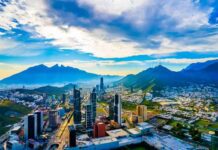





"Imagine an urbanised Paris from Melun to Rouen: that's Beijing!It's all about sustainable development," says Jean-Philippe Dufour, sustainable development and transport adviser at the French Embassy's Economic Mission in Beijing. Polycentric city of almost 23 million inhabitantsBeijing is also polymorphous and architecturally eclectic, with buildings by Rem Koolhaas, Zaha Hadid and Paul Andreu rubbing shoulders with dreadful Maoist-era concrete towers and charming traditional alleyways - the hutongs - and even a 528 m, 120-storey skyscraper, the China Zun Tower.
On a clear day, from this urban jungle of avenues as wide as football pitches, you can see nature in the distance, and the mountains on whose backs the famous city wall runs. In a short space of time, Beijing has abandoned its over-polluting manufacturing industries in favour of innovation, as advocated since 2016 by the 13e five-year plan. While the Chinese capital remains above all the centre of power and administration, it has nonetheless become the world's largest city.he city in the world where the most patents are filed per inhabitant.
"China wants to take the lead in a number of areas. In the field of electric vehicles, for example, it increased its share of the global market from 1 % to 3 % between 2015 and 2017."continues Jean-Philippe Dufour. In this race for economic renewal, the Zhongguancun technology park in the north-west has played a crucial role. "These include the Chinese Google BaiduLenovo, the world's leading computer manufacturer, which bought IBM's PC division, as well as Xiaomi mobiles, Didi - China's Uber - and Ofo and Mobike, the self-service bicycle start-ups."continues the consultant.


Beijing Silicon Valley
Nicknamed China's Silicon Valley, this technology park claims to be China's leading 'science park' and now manages land spread across the entire municipality, far beyond its original location near Beida and Tsing-hua universities. Today, no fewer than 25,000 companies, including 90 % SMEs, are part of this innovation zone. These companies generated sales of 720 billion US dollars in 2016, the majority in the field of information and communication technologies. And there are some 10,000 angel investors providing financing a high-tech park with over 300 listed companies, a third of which are based outside France.
However, when you arrive in Beijing, it's not what you might imagine. As soon as you get off the plane and connect to the Internet, you realise that nothing is working. No more Facebook, Google, Whats-App, Viber or Gmail... Everything is blocked. Without a VPN, there's no hope of getting past government restrictions. So, as you can quickly see, the Chinese are using other means of communication. WeChat, above all, has become the Sesame to Beijing. "Here, everything is done via this app: you pay your taxi and your bills, you pay your restaurant bills, you call your friends, you communicate with your family and friends, you organise conferences, etc."explains Thomas Courbière, Director of the French Chamber of Commerce in Beijing.
In other words, it's impossible not to have WeChat in China, a sort of WhatsApp, Uber, Facebook, Amazon and bank card all rolled into one. in a single application. In just a few years, WeChat has become a veritable phenomenon. There's no longer any need to carry a wallet around; people can even buy a kilo of potatoes using a QR code. "When Beijing makes decisions, it sticks to them. Five years ago, it wanted to become an entirely digital city. By putting in the necessary resources, it has indeed become one."says the director of the Chamber of Commerce.
However, as a result of this progress, many shopping centres built in the early 2000s and 2010s are now being abandoned. "E-commerce is growing by 30 % a year. And it's even penetrating the countryside, thanks in particular to groups like Alibaba and luxury e-commerce sites.It's not just a question of the economy," explains Julien Bonnet, adviser at the Economic Mission of the French Embassy in Beijing. There is even talk today of a New Silk RoadVirtual Silk Road, a kind of digital highway enabling the Chinese to export consumer goods around the world via multilingual platforms. In 2017, in over 200 countries, $140 billion was spent on Chinese products sold online, mainly via Amazon or AliExpress. "Beijing's population is young, it's a city on the move, with large universities set up on American-style campuses, and this population is a major factor in innovation."says Julien Bonnet.
To help French entrepreneurs, who are sometimes overwhelmed by the speed of change in this market, Laure de Carayon launched China Connect in 2011, a European event dedicated to Chinese consumer trends. Her aim: bridging the gap between China and the West in the digital sector and enable investors to understand social networks, content platforms, technological innovation and data made in China. "There are more and more players and access to this market is becoming more and more expensive. Purchasing power is high, and the Chinese are being approached by a huge number of successful local brands. It's an extremely complicated marketexplains the CEO and founder of China Connect. You have to be opportunistic and agile in relation to China, have strong backbones, be realistic, cautious, fast, bulimic and curious by nature..."


Big Brother
If there's one thing foreigners need to get used to, it's data transparency. The Chinese, on the other hand, are not afraid to give it out and are not afraid of constant facial recognition, with cameras on every street corner. In fact, over the last few months, a kind of social and legal point permit has been introduced, targeting the behaviour of citizens and based precisely on the data collected by these numerous cameras. If you behave well, there's nothing to worry about. If, on the other hand, you don't pay your bills or act like a bad neighbour, your right to buy a train ticket or access certain places, for example, will be withdrawn. Already, 170 million cameras equipped with artificial intelligence have been installed in the country's major cities, and the figure is set to rise to 600 million by 2020. This, too, is how China is innovating...
One of the other central aspects of the latest five-year plan is ecology. A new town, Xiong An, is currently growing in a marshy area around a hundred kilometres south of Beijing. Proclaimed as the future green megalopolis of the 21st centuryIt is set to rival Shenzhen and Pudong. Its role will be not only to absorb Beijing's industries not linked to its administrative functions as national capital, but also to attract the headquarters of companies and financial institutions, while becoming a place of academic excellence with numerous higher education establishments and scientific and technological institutes.
Xiong An also sees itself as a centre of Chinese innovation and a model of sustainable development. However, a year after work began on this megalopolis, which is expected to cover 2,000 km2 - compared with 100 km2 today - the ponds are still toxic, the water is still not drinkable and pollution of the air and soil, riddled with heavy metals, remains severe. But the idea is there: a great clean-up and a rush to go green... And perhaps it's also a new way of de-saturating Beijing, which is becoming ever more crowded as a result of the rural exodus.
The battle against pollution
So building new cities would make others lighter? In any case, the measures taken to make Beijing a greener city, with the closure of many factories, are having an effect. "It's been a fantastic winterthe city seemed to be free of pollutionsays Thomas Courbière. Companies that left Beijing because of this are gradually coming back. Pollution indices were reaching such levels that American and Japanese expatriates were even being paid risk premiums."Anthony Lopez, Business Director of the French Chamber of Commerce in Beijing, confirms this, explaining that ".the French lycée has lost many students over the last three years"and thatthe number of new French arrivals has fallen by 30 % in five years."
However, the Chamber of Commerce remains the largest in China, with 1,600 members. "We have recently started accepting Chinese companies looking to set up in France, and we organise 'learning expeditions' for them, because for them, France remains the window on Europe."says Anthony Lopez. The Chinese, who do not enjoy a very good reputation in France, must therefore learning to adapt culturally if they want to do business. But the movement is mutual. In 2017, the Galeries Lafayette group ostensibly deployed WeChat Pay for its Chinese customers. The two million annual tourists from the Middle Kingdom represent a huge potential. Currently, only 10 % of the Chinese population have a passport. In fifteen to twenty years' time, that figure will rise to 40 %. Get your Wechat on!
Special report - China: out with industry, in with digital everything
- Beijing: heading for innovation
Beijing - Tianjin: address book
Ecology: full throttle in Beijing. Well, almost...
Success story: Yann Boquillod, founder of AirVisual
Hotels in Beijing: a more westernised taste
Success story: Benjamin Devos, founder of the "Comptoirs de France Bakery, Fapai 1855" shops
Tianjin: Beijing by the sea
Beijing: the spirit of the place according to Daphné Mallet


