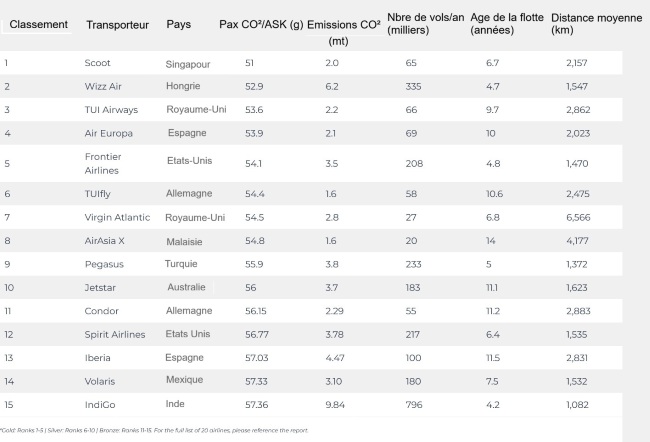
Cirium has just published its rankings of the most virtuous airlines in terms of fuel emissions. It must be noted that it is mainly the low-cost airlines that are the least polluting, confirming the consultant's analyses from previous years.
Of the top 15 most efficient airlines in terms of emissions, 9 are low-cost or so-called hybrid carriers. The reason is simple: these companies are particularly attentive to cost reduction and generally have a fleet of recent aircraft, which are more fuel-efficient... and therefore, less polluting.
This is also a low-cost airline that has won the Palme d'Or for "ecological virtue". Singaporean Scoot has thus been named the world's most fuel-efficient airline in the Cirium EmeraldSky Annual Review 2025. It has snatched first place from Wizz Air, the leader in 2025. Qatar Airways, Ryanair and Turkish Airlines have each been recognised as the three most efficient global airlines, ranked on the available seat kilometre (ASK) criterion.
Cirium's ranking is based on CO₂ emissions per ASK and includes the 100 largest airlines globally. The methodology is independently verified by PwC according to standard ISAE 3000. It ranks airlines into Gold, Silver, and Bronze categories according to global performance, covering the top 15 airlines as well as regional carriers and performance on certain key routes.
" The emissions performance of airlines depends on decisions that airlines can control: fleet choices, seat configuration, and aircraft utilisation according to routes. », explains Jeremy Bowen, Cirium CEO. « The companies at the top of these rankings have mastered these fundamentals, and it shows. Better emission efficiency and lower fuel costs go hand in hand. "
Low-cost airlines, the most virtuous carriers
Scoot is the first Southeast Asian carrier to take the global top spot in the Cirium rankings. Its average density of 242 seats per aircraft, operating on longer medium-haul segments, allowed it to take the lead this year.
The results confirm a consistent trend in the industry: airlines operating younger fleets and higher seat density are outperforming their competitors in carbon efficiency, with low-cost carriers thus dominating the rankings. Wizz Air ranks second (having been first in 2024), followed by TUI Airways, Air Europa and Frontier Airlines. These five carriers feature in the global top 5 and have achieved Gold status. Each has younger aircraft fleets than their competitors' average.
In Europe, Wizz Air remains among the top performers with an average fleet age of less than five years. The Hungarian low-cost carrier is followed by two other low-cost airlines: Jet2.com (UK) and Transavia (Netherlands/France). The same trend is seen in North America or Asia: the top-performing ethical airlines are Frontier Airlines, Spirit Airlines, and WestJet. In Southeast Asia, the leaders are Vietjet, Singapore Airlines (an exception to the rule!), and Lion Air.
Long-haul operators, on the other hand, are narrowing the gap primarily through fleet renewal, phasing out older, less fuel-efficient aircraft. Airlines such as Virgin Atlantic demonstrate that recent wide-body aircraft and higher-capacity configurations can offer competitive carbon performance even on long-haul routes. On the North Atlantic, the British carrier is most efficient in reducing CO² emissions on its flights, followed by Air Canada and Ireland's Aer Lingus. Air France is just behind in fourth place, ahead of KLM and Delta, and more broadly, Lufthansa and British Airways.