
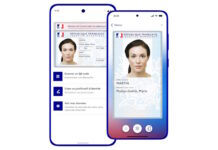










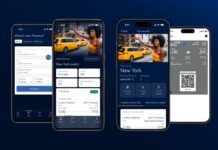


It was with smiles on their faces that four of France's top business leaders gathered on Thursday 3 December 2015 in a plush lounge in the Pavillon Gabriel, a stone's throw from the Élysée Palace, to present a partnership that is set to revolutionise the way people travel in France. Guillaume Pepy, Chairman of the SNCF, Elisabeth Borne, CEO of the RATP, Stéphane Richard, CEO of Orange, and Olivier Piou, CEO of Gemalto, unveiled the creation of Wizway Solutions that day. From 2017, this joint venture will make it possible to buy train, metro, RER and tramway tickets using a mobile phone. In addition to the investment of several million euros, each company is contributing its expertise to the development of the platform: Gemalto for digital security, Orange for contactless NFC technology, and RATP and SNCF for multimodality, the customer journey, ticketing and control.
One of the major innovations is that tickets, stored in the phone's SIM card, can be read by ticket inspectors on trains and recognised by underground ticket inspectors. All this, thanks to NFC technology, without the need for a network connection, even if the mobile phone is switched off or its battery is flat. "Wizway Solutions marks a new stage in the marriage between digital technology and mobility"says Guillaume Pepy. "We are going to set up an interface on the Voyages-sncf.com website so that you can talk to the platform and load tickets onto a mobile phone.We're going to be able to offer our customers the best possible service," explained Barbara Dalibard, Director General of Passenger Services at SNCF, who was also present at this major event.
To ensure the success of the project and encourage rapid adoption of the application by passengers, the platform is already open to other partners. Contacts have been made with operators such as SFR and Bouygues Telecom, as well as with other transport operators. At the same time, cities already using NFC solutions in their urban transport systems (Nice, Strasbourg, Caen, etc.) will also be encouraged to join Wizway Solutions. "We are going to create a single standard for all operators and carriers to work together."Barbara Dalibard, who is already planning to add additional services that will further enhance mobility.
While awaiting the arrival of this solution, which will be tested later this year, SNCF has already made significant progress in offering a "seamless" journey, based on the dematerialisation of tickets. Business customers, 80 % of whom use a smartphone when travelling by rail, are the first to benefit from these new features. The company has therefore integrated its new iDPass offer into the TGV Pro mobile application. This service makes it possible to plan a "door-to-door" journey by complementing the train journey with other mobility services, such as booking a taxi or chauffeur-driven vehicle (VTC), accessing a car-sharing service, reserving a parking space at a station and geolocating self-service bicycle stands located near stations, etc.
"Beyond the train, we want to be able to offer our customers an end-to-end journey"In particular, iDPass is connected to Ouicar, a private car rental company in which SNCF has held a 75 % stake since spring 2015, and to Zipcar, a car-sharing company and subsidiary of Avis. This allows passengers to hire a self-service car by the hour or by the day, either in Paris or at France's main TGV stations. The SNCF is determined not to miss the train - so to speak - of shared mobility, which currently accounts for 15 % of the travel market, but is expected to rise to 30 % by 2030.


DIGITAL CONCIERGE SERVICE
Among the many technological developments made by the carrier, the TGV Pro app is becoming increasingly essential for business passengers. Since the start of the 2015 autumn season, Fréquence and Fréquence 25 season ticket holders have been able to use it to load their train ticket, Voyageur loyalty card and Fréquence season ticket onto their mobile phone, in a way foreshadowing what the SNCF will be able to bring to the Wizway Solutions JV. During the journey, TGV Pro also provides access to the Kiosque Presse, a digital portal offering Pro 1ère or Fréquence 1ère passengers free downloads of two press titles.
This online service complements the newspapers distributed free of charge every day in the 12 Grand Voyageur lounges, including the new lounges in Lille Flandres, Marseille, Paris-Est and Paris- Nord. As part of the new made-to-measure services, an online concierge service has also been launched, offering everything from dry cleaning to childcare, from shoe repair to meeting room hire...
Across the Rhine, Deutsche Bahn (DB), the German railways, has the same desire to combine different modes of transport in its offer. When booking a train ticket online, the City Mobil option offers the purchase of an urban transport ticket that allows passengers to use the S-Bahn regional rail network, the U-Bahn underground or trams, either for two or three hours, or for the whole day. The company's website has also been expanded to include offers from the Flinkster car-sharing network, which has 800 stations in 140 towns and cities in Germany, as well as in Switzerland and the Netherlands, and the 'Call a Bike' bicycle hire service, which belongs to DB and is available in 40 German towns and cities. Some cities, such as Stuttgart and Hamburg, even offer the first 30 minutes on two wheels.
This "door-to-door" travel policy can be found at Eurostar, which has entered into a partnership with CarTrawler, a transport platform that distributes pre-booked taxi transfers on the railway company's website at the main stations it serves, including Paris, London, Brussels, Lille and Lyon. The advantage: the driver will be waiting for the passenger with a sign at the end of the platform when the Eurostar train arrives, avoiding the often interminable wait at the taxi rank. But the big news expected from Eurostar is the forthcoming introduction of Siemens e320 trains, which will feature a more contemporary interior design by Pininfarina, an on-board WiFi connection that will be operational throughout the journey, and an entertainment programme accessible via an online portal.
HIGH-SPEED WIFI
At Thalys, on the other hand, there is still a lot of progress to be made when it comes to door-to-door travel. While the company does offer MobileTicket via a 2D barcode on the smartphone, passengers wishing to continue their journey by metro have to buy their tickets at the TGV bar. And to take a taxi, whether in Paris or Brussels, they will have to make their reservation with the on-board staff in Comfort 1. In 2015, the company's efforts focused mainly on on-board WiFi, the speed of which has been increased, and on lounges, with the opening of a lounge near the Gare du Nord in Paris. Located at 22, rue de Dunkerque, the new Thalys Lounge&More boasts a sleek, modern design and offers business travellers the opportunity to relax or work with a WiFi connection, as well as to eat, get newspapers or use the luggage service... This space also offers a meeting room that can be booked for two-hour periods and can accommodate up to six people. A similar lounge will open in 2016 at Brussels-Midi station.

Thalys has also upgraded its on-board catering by entrusting Christer Elfving with the production of the menus offered in Comfort 1. For the winter season, the Swedish chef has developed recipes combining local produce and Nordic cuisine. "We focus on taste, originality and quality, said a Thalys spokeswoman. Frequent customers mean that menus have to be changed frequently". The menu changes every 15 days. The meal is included in the price of the Thalys ticket, unlike the SNCF's Espace Pro 1ère, which is available at peak times on eight business services.
For Pro passengers who are afraid of getting peckish during their journey, SNCF is planning to set up an online meal reservation service to be collected and paid for at the TGV bar. Customers travelling on TGV Pro 1ère can also enjoy a free hot drink during their journey, unless they prefer to collect the drink from one of the SNCF lounges, or from the Paul and Relay shops located in certain stations. All you have to do is present your travel document loaded onto the TGV Pro app on your mobile phone. However, the app does not forget the basic services: buying, exchanging and cancelling tickets, and providing travel information. These are still the most important services used by business customers.
SNCF supports start-ups with Digital Ventures
Alongside the Wizway Solutions project, the SNCF is preparing for the expected explosion in digital travel. To this end, it has set up an investment fund, Digital Ventures, to support start-ups active in the fields of transport and new technologies. Endowed with €30 million, Digital Ventures will be able to invest between €500,000 and €4 million per start-up, while retaining a minority stake in the capital of these companies, whether they are French, European, American or Israeli. "Our aim is to step up initiatives that are likely to revolutionise tomorrow's transport market, explained Yves Tyrode, the railway company's Director of Digital, when presenting the project. We can't just rely on our own strengths. We need to look outwards, and in particular to start-ups. We need an ecosystem around us. This aspect, Open Innovation, is a fundamental part of our digital plan.". In particular, the SNCF plans to participate in the development of companies specialising in the Internet of Things, surveillance drones, big data, mobile applications dedicated to information and customer service, the sharing economy, digital tools for agents, etc.