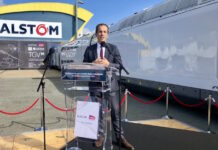














It's now official: high-speed rail is finally set to take its first steps in the United States, after many aborted projects over the last few decades. Visit ground-breaking ceremony on 22 April to start construction of the Brightline West high-speed line, named after the group that is carrying out the work and will operate the 350 km service between Los Angeles and Las Vegas. It is scheduled for completion in 2028, a symbolic date that will see Los Angeles host the next Olympic Games, after Paris this summer.
The journey between the City of Angels and the gaming capital of Nevada will then take 3 hours, compared with around 4 hours by car. A time that may still seem long and uncompetitive compared with the car, but this new high-speed line (LGV) has a special feature: it won't go all the way to Los Angeles! In fact, the current project reveals that passengers will first have to take a regional train between LA Union Station and Rancho Cucamonga, a town 60 km further east and the starting point of the HSL on which the high-speed trains will travel to Las Vegas. During the 2h10 journey, there will be two stops, at Hesperia and Apple Valley. The terminus station will be located in the heart of VegasJust south of the famous Strip, the city's main thoroughfare lined with hotels and casinos.

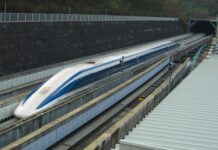
As for the trains that will run between the two cities, Brightline has just chosen Siemens' American Pioneer 220 high-speed trainspreferred to Alstom's Avelia Stream tilting trains. With an order for a fleet of 10 trains adapted to the American market and derived from the Velaro platform, currently in service in Europe. Capable of reaching 220 miles per hour - or 355 km/h - these TGVs will be made up of seven cars and can carry between 434 and 450 passengers. " We are delighted to be working with Brightline to transform rail in America. The high-speed chapter in American rail history will build on Siemens' 40 years of experience in designing, building, testing, delivering and maintaining trains in the United States." said Marc Buncher, General Manager of Siemens Mobility North America.
A line for tourists and business travellers
The cost of the project, now estimated at 12 billion dollars, is supported by 3 billion dollars from federal funds and the US Department of Transportation. Brightline has already proved its worth in the USA, operating the high-speed train line running at speeds of up to 200km/h between Miami and Orlando since 2018. The line is due to be extended as far as Tampa, in northern Florida. In its business plan for the future line, Brightline West is banking on the 17 million people who live around the stations it will serve, on tourists travelling to Las Vegas (4.7 million international visitors a year), and also on the fact that it will be able to attract a large number of tourists. the very high level of MICE activity of the city, with the Las Vegas Convention Center alone welcoming 6 million visitors in 2023. As well as reducing journey times, the Brightline West project is also designed to be environmentally friendly, saving 400,000 tonnes of CO2 per year by eliminating 3 million car journeys.
As part of its $66 billion rail transport stimulus plan, voted through at the end of 2021, the US government will allocate $8.2 billion to help finance ten projects across the country. And in particular the most emblematic one, the Los Angeles-San Francisco linea project that has been announced many times but never carried out. An endowment of 3 billion euros has also been earmarked to speed up the project, for which studies have already begun. This California High Speed Rail will serve Fresno, Bakersfield, Palmdale, Burbank and will continue beyond LA to Anaheim to carry passengers to the Anaheim Convention Center and the various leisure parks around this Californian city, including the first Disneyland Resort. Last but not least, this second high-speed line will be connected, via the future High Desert Corridor, to the Brightline West in Palmdale, a city that will become a multimodal hub linking the North, South and East of the State of California, as far as Nevada.
The other HSR projects in the United States likely to benefit from federal funding are Houston-Dallas in Texas, a line from Portland in Oregon to Vancouver in Canada via Seattle in Washington State, and another HSR line from Atlanta in Georgia to Charlotte in North Carolina. A small revolution in the land of the king of planes and the queen of the motor car. As a reminder, apart from the Brightline line in Florida, the Acela Express, inaugurated in 2000 and linking Washington D.C, Baltimore, Philadelphia, New York and Boston, is the only other American high-speed rail line at present.