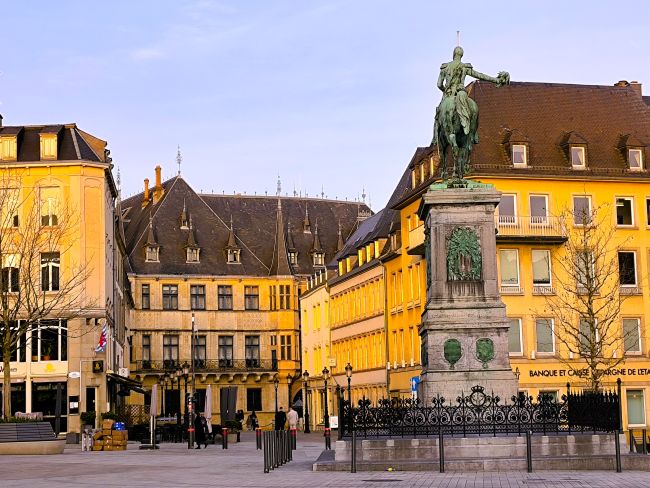







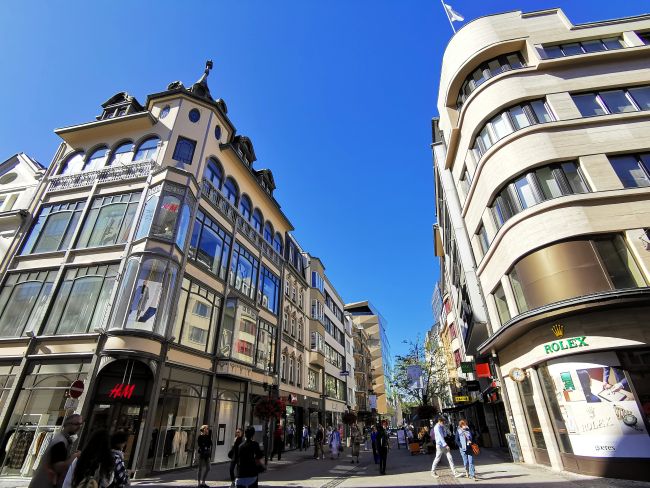
"Luxembourg, the destination, has all the makings of a big city" to paraphrase a famous 1980s advertising slogan. This is indeed what comes to mind when discovering Luxembourg City. Admittedly, it “only” has 140,000 inhabitants, but it offers all the attractions of a capital city – on a small scale. This is certainly one of its greatest assets.
Luxembourg concentrates in its heart state institutions, banks, tourist attractions, museums and hotels, accessible on foot or by a formidable public transport network, which every MICE sector contact enthusiastically repeats is free.
The entire area is easily accessible from the rest of the world thanks to around a hundred airlines and numerous rail links with France and Germany.
An ideal destination promoted by the Luxembourg Convention Bureau, which is responsible for convincing conference organisers. Luxembourg's geographical location, at the heart of Western Europe, its infrastructure and ease of access are real assets. Furthermore, in Luxembourg, almost everyone is quadrilingual, if not multilingual. Besides Luxembourgish, most people here speak French, English and German perfectly. And with a significant community from Portugal, Portuguese is also one of the most widely spoken languages in the Grand Duchy. », says Bettina Bunge, Director of the Luxembourg Convention Bureau, who is herself of German origin.
The small size of Luxembourg as a country – and its capital – offers event and conference organisers great flexibility in planning. Everyone knows each other – or almost everyone – in the MICE sector microcosm and benefits from the support of the Convention Bureau, which is responsible for promoting and coordinating venues, partners and service providers.
The ECCL, the quintessence of events, "made in Luxembourg"
Beyond the practical aspects of a conference in Luxembourg, there is another element that is appealing: the symbiosis that exists between the history and cultures that shape this city and MICE.
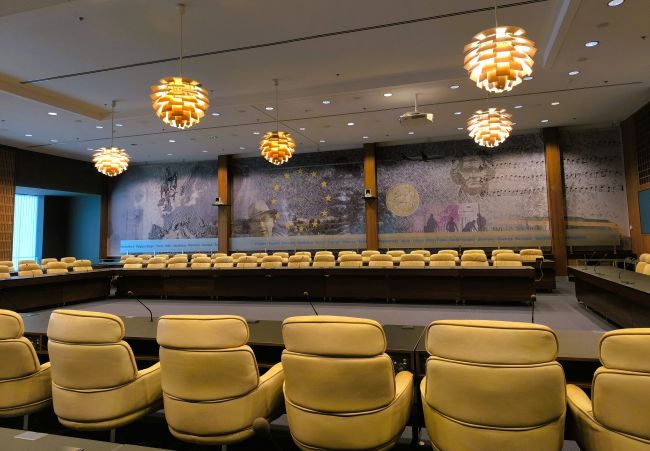
This is, for example, what is promoted The European Convention Centre Luxembourg, situated on the Kirchberg plateau, the district of European institutions. This conference centre was built to host parliamentary sessions in the early 80s. It has partly retained a certain "vintage" charm and solemnity. Particularly in the Hemicycle, whose amphitheatre still hosts the EU Council sessions three times a year. And which can be rented outside of official sessions. Dark wood, frescoes evoking the construction of the European Union, retro lighting, the ECCL clearly plays with pleasure on its retro side, as its director, Patrick Hoffnung, points out. " We are proud of this historical aspect, notably with the Panoramic Room offering one of the most beautiful views of Luxembourg. "he says.
A few years ago, the ECCL acquired a more contemporary building which hosts most conferences and congresses. The ECCL thus offers around 2,600 m² of modular spaces with over 40 rooms – with a maximum capacity of 800 people in plenary session. The structure hosts an average of 160 events per year, generating over 107,000 participants in 2025.
Patrick Hoffnung also likes to highlight another of the ECCL’s strengths: the ‘Convention Park’, a unique concept that brings together the hotels, restaurants and bars in the vicinity of the ECCL, as well as two leading cultural institutions, the Philharmonie and the MUDAM, the museum of modern art.
The five hotels on Kirchberg offer a total of 785 rooms, while the museum or the Philharmonie provide their programmes and are also suitable for organising events. This allows participants to fully enjoy Luxembourg as a destination. It also offers a product where everything is done on foot, without multiplying travel, and therefore, is simpler for organisers to manage. », explains the Director of the ECCL.
With the added possibility of going to Luxexpo The Box, the Exhibition Centre adjacent, or to reach in 20 minutes with the free tram, whether it be the airport, the historical heart of the capital or the central station.
When history gets involved in events
In the city centre, history enthusiasts are spoiled for choice when it comes to organising an event in locations where history and culture rub shoulders with the best of high-tech. Starting with the magnificent complex that is Neimenster Abbey in the Grund district, one of Luxembourg's most picturesque areas. The abbey, built in the 17th century for Benedictine monks, experienced a varied fate, serving as barracks and even a men's prison until 1980. Some remnants, such as the heavy wooden cell doors or the chapel, have been preserved from that era.
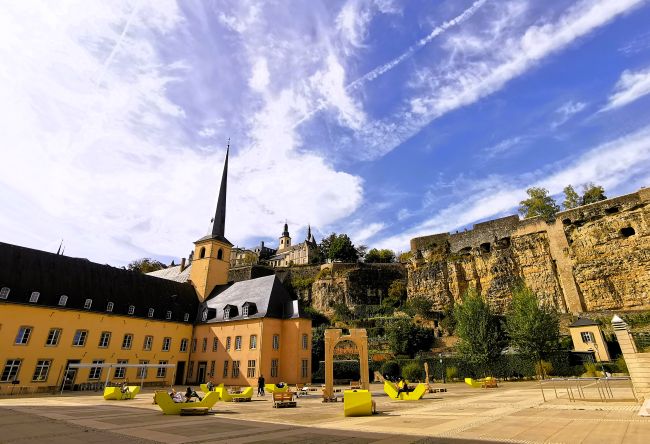
Nevertheless, today, the historic and sumptuous setting of the abbey hosts exhibitions, concerts, artistic activities, as well as events, symposia, conferences, congresses, and dinners. In total, a dozen rooms including a theatre that can accommodate 280 people, the Agora Marcel Jullian for 400 people, or the beautiful cloister, capable of hosting 300 people. Two rooms in the attics are appealing for both their intimate and historic atmosphere, with a capacity for 160 or 180 delegates. The abbey's MICE team also offers bespoke solutions or "conference packages".
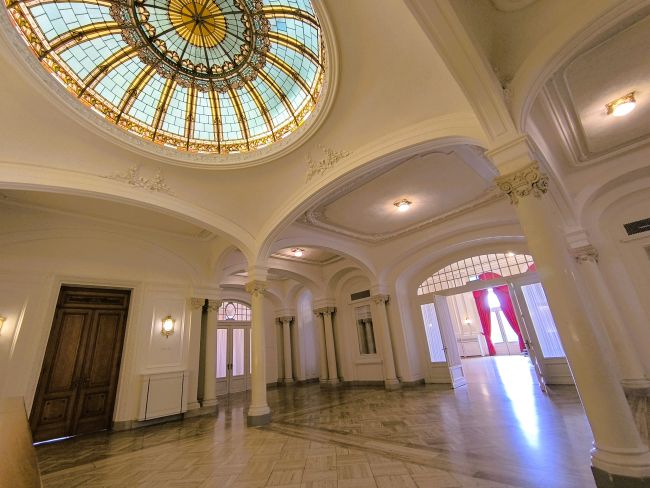
Another place, another atmosphere: in the city centre, The City Circle First, the former Municipal Palace, which hosts prestigious celebrations and events in the capital. Closed for five years between 2005 and 2010, the Cercle Cité is now distinguished by its grandeur, with its grand staircase, its state rooms, its large glass roof, and its private lounges, which are reminiscent of French ministries steeped in the "gilding of the Republic". A conference centre, located in the adjacent building, offers 3 rooms and two auditoriums on the 5th floor.e floor, which can accommodate up to 142 people.
Luxembourg Marriott Hotel Alfa, a tribute to Art Deco
Finally, for those fascinated by Art Deco, the iconic Luxembourg Marriott Hotel Alfa it is unmissable for an event. It's impossible to miss the impressive building, which faces the Luxembourg station.
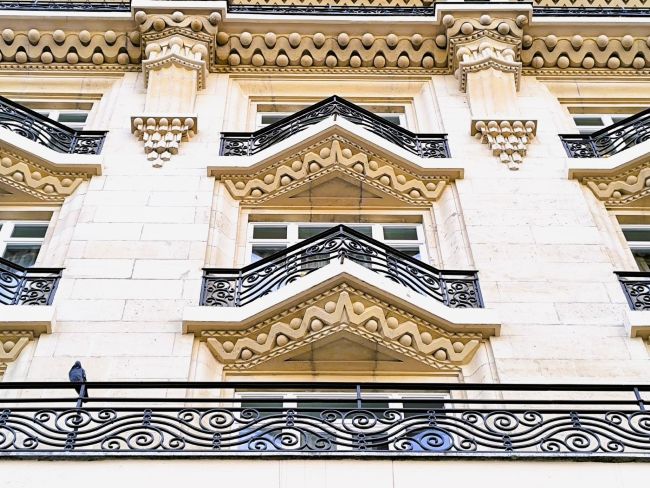
The establishment, destined to become the benchmark of prestige in Luxembourgish hospitality, opened its doors in early 1932, notably including a famous brasserie. A focal point of social life in the 1930s, the hotel underwent a complete restoration and modernisation that preserved its soul and, above all, its Art Deco style. It took seven years for the interior architecture firm Iria Degen Interiors to transform the hotel, now managed by the Marriott chain. The four-star establishment has thus reinterpreted all the details of the Art Deco building – including the zigzag motifs on the facade – in a timeless contemporary style for its 153 rooms and suites, as well as its meeting spaces.
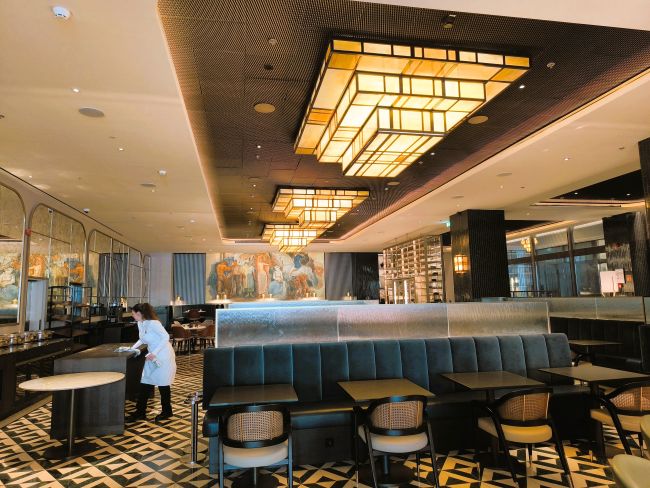
The Marriott hotel has two meeting spaces on the ground floor integrated into the brasserie, five meeting rooms, and a boardroom on the first floor. In total, these can accommodate up to 150 participants by combining the Churchill and Charlotte rooms.
Here again, history and art are also an integral part of the conference facilities, notably the magnificent Bradley Room. In fact, participants' gaze will certainly wander over the monumental fresco retracing the history of Luxembourg, created by the hotel owner's son, an artist in his spare time.
With its gold tones, vibrant colours, and elegance, the Bradley Room is certainly the most prestigious room on offer at the Luxembourg Marriott Hotel Alfa. It can accommodate up to 64 participants when combined with the neighbouring Patton Room.
The hotel can privatise Brasserie Alfa for a small group. This restaurant is probably the most "Art Deco" spot in the hotel. The original tiles, another fresco by Julien Lefèvre, the son of the hotel owner, the mirrors on the walls and the light fixtures, all recall the atmosphere of the mythical brasseries of Montparnasse between the two World Wars. The menu, incidentally, is largely inspired by France. A perfect conclusion to a special event stay before catching the train... bound for Paris!
PRACTICAL GUIDE
Getting to Luxembourg
From France, several daily direct TGVs from Paris via Metz. TGVs also link Luxembourg to Montpellier via Mulhouse, Dijon and Lyon. TER trains from Nancy and Strasbourg. Towards Belgium, regular regional trains to Arlon/Namur and several Intercités to Brussels and Liège.
By air, Luxair connects Findel Airport from Paris CDG, Bordeaux, Biarritz and Nice, as well as Geneva; Volotea offers a route to Toulouse while Ryanair provides a daily flight from Marseille.
Stay
Luxembourg Marriott Hotel Alfa, 16 Place de la Gare, Luxembourg - Tel: +352 279-40000
https://www.marriott.com/fr/hotels/luxmc-luxembourg-marriott-hotel-alfa/overview
Find out more
Luxembourg Convention Bureau: 35 Avenue de la Liberté, Luxembourg
Website: lcb.lu; Email: info@lcb.lu.