


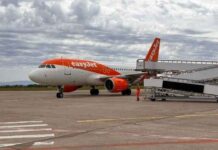

















The Airbus A320 ofAir France left at 3.30pm Berlin-Tegel on 8 November, closing a chapter in aviation that will have lasted 70 years. It also marks the official debut of theBerlin Brandenburg International airport whose commercial acronym is BER.
"It's certainly a complicated time to be opening an airport, but we wanted to be optimistic," said Dietmar Woidke, Minister-President of Brandenburg, where the airport is located, at the official opening. "This airport is being built to serve the whole of eastern Germany," he added.
Hub dream
BER is certainly the largest airport on the territory of the former GDR with the possibility of handling 55 million passengers eventually. In 2019, the two Berlin airports welcomed 35.64 million passengers.
The current capacity is 43 million passengers, including the former Schönefeld terminal. Renamed BER Terminal 5, it caters for ultra-low-cost passengers. By the end of the decade, a new pier is planned as an extension to terminal 1. A second pier could be added by 2040.
"Bringing Berlin's airport traffic under a single roof will finally enable us to assert our position as the world's leading airport operator. our role as a transfer airport. And to affirm our profitability," declared Rainer Bretschneider, representative of the Land of Brandenburg and Chairman of the Airport Board, at the inauguration.
Except that it will be an arduous task. Berlin is far from being a hub capable of competing with Frankfurt or Munich in Germany..
What's missing is high-contribution business traffic, destinations and airlines.
As a result of the pandemic, passenger numbers in Berlin have also plummeted - as they have around the world. There were just under eight million passengers at the end of September. And it's not even certain that traffic will break through the eight million mark. the ten million passenger mark by the end of the year.
At present, 66 out of more than 90 pre-covid carriers officially come to Berlin. But in reality only 23 carriers land in the German capital this November.
An un-Berlin-like Lufthansa
The two most important protagonists are Easyjet and the Lufthansa Groupwhich together account for 50% of passenger volume.
However, Easyjet is the leading international operator in Berlin, with 90 destinations at any one time. It currently offers flights to seven cities in November, a figure that will rise to 14 in December. Its timetable will become even denser from February onwards.
The Lufthansa group is present with five airlines to eight destinations. Lufthansa and Eurowings fly only domestic routes, while Brussels Airlines, Swiss and Austrian offers connections to their respective hubs in Brussels, Zurich and Vienna.
"We are in the process of consolidating our market share, which represents a third of traffic. As Lufthansa, we could eventually be aiming for 25% of total BER traffic, compared with 14% at present", explains Group CEO Carsten Spohr.
The aim will be to attract more intercontinental airlines to strengthen the hub. Before the crisis, half a dozen intercontinental airlines landed in Berlin. At present, only Qatar Airways lands in the German capital with five weekly flights.
France-Berlin services to resume in February
On theFrench-speaking Europe, four airlines fly to Berlin. Air France is in fact the leading airline operator in terms of seats and frequencies. The national airline offers two to three daily flights between Paris-CDG and BER depending on the day.
However, no German airline now connects France with Berlin. Brussels Airlines does, however, offer three weekly frequencies to Berlin. The airline is planning five flights a week from December. Luxair also offers five flights a week to Luxembourg.
From his side, Easyjet only flies regularly on Basel/ Mulhouse with two to three weekly flights. The carrier will resume two weekly flights to Paris (Orly or CDG) in December. It will once again be offering daily flights to Basel/Mulhouse, Nice and Paris from February.
Lyon and Marseille will also be connected to Berlin from February with two and three weekly flights respectively. Montpellier and Nantes will also be offering three flights a week to the German capital from the end of March. During the high season, Easyjet will also be offering a number of flights to the German capital. Corsica and Biarritz.
In the rest of French-speaking Europe, Easyjet will be resuming flights to Geneva (four times a week). Following at the end of March Brussels and Luxembourg.
Finally, the low-cost Transavia will be relaunching two weekly flights between Nantes and Berlin.


