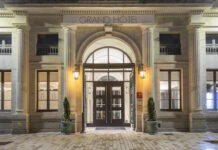















The crisis has deserted the corridors of Paris's most luxurious hotels. The Crillon and the Bristol were fully booked in the last quarter of 2010, while the George V announced an occupancy rate of 90 % for the summer period and the Plaza Athénée enjoyed a record July, unmatched since 1923. As we all know, the French capital remains an essential stop-off point on the round-the-world tour of the world's great fortunes.
What's more, it holds the record for the number of rooms - some 1,150 units - with an average price of over €750. All the more reason to attract investors. For all chains, especially Asian ones, looking to expand internationally, Paris remains a must, provided they can find the right location for a palace-level establishment.
Paris will always be Paris
Raffles, Shangri-La, Mandarin Oriental and Peninsula have all found their niche. The former has taken over the Royal Monceau, which has been completely renovated, while the latter, which opened in December, has made the former private mansion of Prince Roland Bonaparte its first European address (see box). In mid-2011, it will be Mandarin Oriental's turn to inaugurate a new establishment that promises to be a truly unique experience. "ultra-sophisticated in an Art Deco building on rue du Faubourg Saint-Honoré. Finally, in 2013, the former international conference centre on avenue Kléber will be home to the Peninsula.
 Asian offensive
By this date, the capacity of Paris's exceptional hotels will have increased by almost 60% compared to 2010. This is cause for some concern in the Paris microcosm, despite the serenity displayed by the directors of the historic palaces. It's only 564 extra rooms," says Christopher Norton, General Manager of the George V, "but that's not all. "The market is perfectly capable of absorbing them. Especially as, for eight months of the year, we are even under-capacity." On a positive note, Asian brands should attract a new clientele to the capital - particularly Chinese, but also Russians, Indians and Brazilians - who are not looking to cut corners. "Of course, the adjustment phase is likely to be a little tense, especially in off-peak periods, and this is likely to have an impact on occupancy rates. But they won't fall below the vital 65% mark".he continues. Could the battle between establishments shift to the price arena? This prospect does not seem to worry observers. Selling off is not in the palace spirit. Firstly, because wealthy regulars are less sensitive to the price argument than to the quality of service. But, above all, because the cure could turn out to be worse than the disease: instead of taking market share from the competition, you run the risk of attracting a clientele looking for bargains, thereby lowering the standing of the establishment.
The battle will be fought over positioning, style and quality of service, against a backdrop of fear that the older establishments will be overtaken by the newer, more modern ones. "We're not just sitting back and waiting for the new arrivals to move in, we're making changes right away.says the man behind the Four Seasons. Because, in old buildings, you not only have to maintain the historic aspect of the premises, but also keep up with the latest technology - equipment as trivial as plumbing or lifts - and technology. The George V, for example, has embarked on a complete renovation of its rooms and suites to bring their decor up to date. "We're keeping the same classic 18th century style while adding more modern touches with fresher colours, light effects, LCD screens and TVs inlaid in the bathroom mirrors."says Christopher Norton. It's also time for extensions. In 2008, the Sultan of Brunei, the wealthy owner of the Plaza Athénée, spent some €10 million to modernise it - several floors and bathrooms have already been renovated - and also took over three neighbouring buildings, which are to be converted into bedrooms and workspaces.
Le Bristol, for its part, has installed 26 additional rooms, a bistro and a swimming pool in an adjoining building. And by the end of March, all its rooms and suites will have been renovated. "The Oetker family has invested a total of €15 million. Today, apart from the Royal Monceau, we are the most recently renovated hotel in Paris", says Didier Le Calvez, who runs 112 rue du Faubourg Saint Honoré. And he admits that in other circumstances, "these are renovations that would have been carried out, but not at this pace".

Faced with such a revival, the Crillon and the Ritz will no longer be able to rely on their reputations to get by. Fortunately, the palace on Place de la Concorde has just been sold by Starwood Capital to Prince Mitab Ben Abdallah ben Abd Al-Aziz Al Saoud, son of the King of Saudi Arabia. The latter has confirmed to the Crillon's employees his intention to launch the vast renovation plan previously devised by the previous owner, but never implemented. Work has also begun on the façade, whose state of deterioration could not wait any longer. The Ritz, which has not been refurbished for several years, could also change hands, with Anglo-Egyptian billionaire Mohammed Al Fayed thinking of parting with his Parisian jewel.