












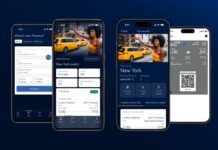

Meanwhile, since October 2005, the SNCF electronic ticket has been available from travel agencies. As a result, business travellers who buy their tickets through the travel agency contracted by their company can collect the tickets in question from self-service kiosks in stations.
For employees responsible for business travel, this option offers a number of advantages. Tickets can be purchased right up to the last minute in a travel agency, with no need to wait for delivery. What's more, exchanges are made easier because they can be done by telephone. No need to issue a paper ticket. In financial terms, the company avoids the delivery charges invoiced by the agency. Flexibility, time saving and savings...
In practice, to obtain an electronic ticket, the customer must use a card as an identifier, such as the frequent flyer card or a simple bank card. The passenger, or one of his or her staff, simply gives the number of the card to the agency when making the reservation. They can then use the same card to collect their ticket from a self-service terminal just before departure. As this operation takes less than a minute, it allows passengers to arrive at the station at the last minute.
The electronic ticket is available as a priority on the routes used by these nomadic customers. But the SNCF has many other projects in the pipeline. From this summer, it will be testing a more flexible flat-rate pass for daily travellers on the Paris-Reims route. In addition, it is looking into the possibility of retrieving the data on paper tickets directly from a mobile phone, at least for regular customers. This would be a way of developing ticketless services, already introduced by its subsidiary Thalys for Cybelys cardholders.
Thalys at the forefront with Cybelys
Since July 2004, Thalys regulars have been able to travel without a ticket, thanks to a personal smart card used as an identifier. Purchasing online or via a call centre, they never have a ticket in hand. "This dematerialisation solution is particularly advanced, because the ticket inspector has the 'ticketless' tickets by downloading them onto a control station", explains Éric Breuil, Distribution Systems Manager.
This online reservation does not, however, allow you to choose your seat. For Thalys, as everywhere else in France on the TGV network, booking is compulsory. As a result, the definitive seat is allocated as soon as it is sold. That said, ticketless means that paper tickets are not lost. And as with other SNCF services, remote exchanges are possible by telephone or Internet. Added to this is access to personalised services associated with the journey: seat reminders by text message, text messages sent in the event of traffic disruption, etc.
The e-ticket can also take the form of a printed ticket. In this case, the passenger buys the ticket over the Internet and then prints it on ordinary paper. For these often promotional fares, it is sometimes still possible to cancel the ticket before it is printed.
Despite this technological revolution, Thalys ticketless and printed tickets still only account for 3 % and 2 % respectively of total sales. These rail scores can be explained by the absence of GDSs (global distribution systems) or centralised reservation systems, such as Amadeus. "Although there is no target for moving completely to ticketless, we can assume that trans-European initiatives, such as Railteam aimed in particular at facilitating the sale of European high-speed trains, will accelerate the breakthrough of dematerialisation solutions", Éric Breuil predicts.
A magnetic stripe ticket at Eurostar
Available for booking in France via travel agencies, the electronic ticket allows Eurostar customers to collect their ticket at the last minute, before boarding. Another advantage of this flexibility is that it is easy to exchange a ticket in France for the outward journey before departure, and in the UK for the return journey. As a result, any electronic ticket can be modified right up to the moment it is printed on the terminals. And a ticket printed in Paris can be exchanged in London. Since the end of April 2007, customers have been able to select the journeys they want from the Eurostar terminals only, without having to collect all the journeys in their travel file. This last-minute ticket collection means that customers can limit the risk of losing or forgetting their tickets.
"In the medium term, our distribution system will evolve from a magnetic strip ticket to a barcode ticket", says Eurostar. There is also talk of offering a mobile ticketing solution, so that travellers can obtain their travel file directly by text message on their mobile phone.
Air carriers ahead of schedule
In the airline industry, e-ticketing is well advanced. If only because IATA (International Air Transport Association), which has more than 260 members and accounts for 94 % of world traffic, is demanding that e-tickets replace paper tickets definitively by the end of 2007. A challenge to be won in order to cut costs. "While a paper ticket costs $10 to process, an e-ticket costs less than a dollar", says IATA. This enormous difference would save 3 billion dollars a year. What's more, it would eliminate the circulation of some 315 million traditional paper tickets a year.
Last December, electronic air tickets already accounted for 73.9 % of air transactions worldwide. On the American continent, this figure reached just over 90 %, compared with almost 80 % in Europe and just 22 % in the countries of the Middle East and North Africa. In Russia and the former Soviet republics, the proportion of e-tickets was around 10 %. The practice has recently been legalised in Russia. Despite this, IATA estimates that by the dawn of 2008, the traditional paper ticket will quite simply have disappeared. More than just an estimate, this is a challenge from IATA to its member airlines. IATA members who fail to take these measures by 2008 will be penalised.
GDSs are helping travel agencies to prepare for the era of the 100 % electronic ticket. For example, by the end of 2006,Amadeus had implemented e-ticketing in 174 airlines and distributed 70 % airline tickets electronically. The company has also set up the largest interline e-ticketing community.
Galileo, a subsidiary of Travelport, is implementing a similar strategy. "As Jérôme Moisan, Managing Director of Galileo France, explains, "In addition to the convenience for travellers, the e-ticket represents a major productivity gain for the agency and the airline. Before IATA, the low-cost airlines led the way, as electronic tickets became popular with their arrival in Europe. For these low-cost carriers, virtual tickets are a good way of making significant savings.
The example of the United Kingdom
Depending on the country of issue, the advance of the virtual ticket is more or less strong. Taking the UK as an example, over 19.7 million airline tickets were issued in 2006. Of these, 15.6 million were in electronic form, giving a take-up rate of 79 %. However, 350,000 tickets are still issued each month in paper form.
Also in the UK, 161 airlines sold tickets last December. Of these, 64 did not issue any electronic tickets. And only 33 % were above the 90 % of e-ticket sales.
British Airways has been encouraging the development of e-ticketing for around ten years. "Our simple objective is to put the passenger in control of their journey in order to optimise their travel experience," says Patrick Malval, British Airways' Sales Director for France. In October 1998, British Airways was the first airline in the world to launch e-ticketing for direct sales. Since October 1999, electronic tickets have been available to travel agencies via their GDS. "Patrick Malval continues: "By the end of 2007, British Airways will have reached 100 % e-tickets, and all its air routes will become e-ticketable. In France, for example, on a seasonal route such as Grenoble-London, which runs four months a year with four weekly flights, passengers will be able to use electronic terminals at the airport this summer to travel without a paper ticket.
A surcharge for paper tickets
Since 1 May 2005, British Airways has been levying a charge of around 25 euros on paper tickets issued for routes on which electronic tickets are available, i.e. more than 75 % of its network. The British airline is not the only one to apply this surcharge policy. Since 3 April 2006, Air-France-KLM has been applying a surcharge of €8 per journey on paper tickets. This applies to customers who insist on obtaining a paper ticket even though an e-ticket is available for the destination and fare they are interested in. The e-ticket is systematically offered on the airline's website, when available, i.e. 98 % of Air France routes. The objective is, of course, to reach 100 % in 2008.
For direct sales, Swiss applies a surcharge of 15 euros per ticket. The Swiss airline intends to switch to 100 % e-ticketing for sales via GDSs by the end of the first quarter of 2008 at the latest, and if possible by the end of 2007. Since January 2007, e-ticketing has been operating interline with Air France. Only five stations in the network are not e-ticket compatible: Luxembourg, Tripoli, Muscat, Jeddah and Riyadh.
Instructions for air passengers
In practice, passengers book and pay for their flights online. On the day of departure, they go to their airline's check-in counter with only their identity document and a code showing that they have paid for the service. Unlike a traditional paper ticket, passenger reservations and flight details are stored securely in the airline's system. If passengers wish, they can receive a summary of their itinerary by e-mail.
The virtual ticket no longer needs to be sent by post. So it cannot be lost or stolen. All you have to do is print it out, which avoids the costs that can arise in these situations. Details of the flight, payment and booking details appear on the "passenger itinerary", also known as the "ITR" (Itinerary Receipt). Passengers only need to show their ITR - in fact their e-ticket - and a form of identification to check in.
Airlines also allow passengers to print out their own boarding passes at home or at the office. So they can choose their seat on board. On airfrance.fr, for example, boarding passes can be printed from 24 hours to 30 minutes before the flight check-in deadline. This means you can go directly to the boarding lounge if you have no baggage to check in. This service is available on 90 % stations served by Air France and KLM.
Another option is to print out your boarding pass at one of the 320 self-service kiosks at Air France's French and European airports. The airline plans to make 450 of these available by 2008.
There is no doubt that the virtual ticket is taking off, along with the e-services deployed by most of the major airlines. It's a win-win situation for carriers, travel agents and passengers alike.
Special report - Plane train: towards total dematerialisation
- Plane train: towards total dematerialisation
Air France self-service kiosks
Catherine Lefebvre-Feat, Operations Director EMEA at Regus
Accelio terminal - SNCF


