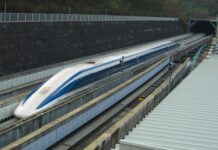
















This is the biggest project to be undertaken in the Baltic region for over 100 years. If there are no delays, around 2026s first high-speed trains. Rail Baltica will run from Finland to Warsaw via theEstoniathe Latvia and the Lithuania.
This new high-speed line, with trains travelling at an average of 200 km/hourThis will in fact reconnect the Baltic States with the rest of Europe, a historic return in fact. Before they were annexed by the former Soviet Union, Estonia, Latvia and Lithuania were well connected to Poland and Germany, and indeed to the rest of the European continent.
Supported by the European Union, the project should represent a total investment of 5.8 billion euros for the construction of 870 km of new lines. Lithuania will contribute the most to this project, with €2.5 billion, followed by Latvia with €1.9 billion and Estonia with €1.4 billion.
Seven stations and three multimodal freight hubs are planned. For passengers, trains on the new Baltic high-speed line will depart from Tallinn, stopping at Pärnu in Estonia, Riga and Riga-Airport (the region's most important air hub) in Latvia, and then connect with Panevėžys, Kaunas and Vilnius in Lithuania. A second branch from Kaunas would then head for Warsaw.
Such a project will significantly shorten journey times. Rail Baltica forecasts that a rail journey between Tallinn and Riga, for example, will take 1 hour 40 minutes, compared with more than five hours at present for the 295 km distance, while a high-speed train between Riga and Vilnius will cover the link in less than two hours. There is currently no rail link between the two capitals, with bus and air travel the only alternatives for covering the 300km distance.
At the same time, there is an independent project for a tunnel under the Gulf of Finland that would only accommodate rail convoys. This project could be accelerated to connect Helsinki to the Rail Baltica network in Tallinn. The two capitals are just 80 km apart. The tunnel, which would cost around €9 billion, could be operational by 2030.
All Rail Baltica high-speed trains from Tallinn to Warsaw and from Tallinn to Vilnius should run four times a day once the line is in service. These frequencies could then be increased to six trains a day within ten years of the start of operations. In addition, up to ten trains a day will run on the Vilnius-Kaunas-Warsaw line. This means that Rail Baltica will provide a fast rail link between the Baltic capitals every two hours.
The project also includes the launch of two night trains on the Tallinn-Riga-Kaunas-Warsaw-Berlin and Vilnius-Kaunas-Warsaw-Berlin lines, enabling passengers to reach the rest of Europe.
Travellers can also use the high-speed trains to Riga International Airport from Riga Central Station in around 10 minutes. Regional trains could run every 30 minutes. The hub is in fact the number one for passenger traffic in the Baltic region, having welcomed seven million passengers last year.
The frequency of high-speed trains is based on forecast passenger demand, which has been assessed in Rail Baltica's traffic development plan for the period 2026-2056.