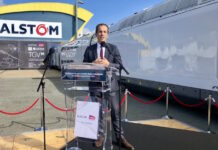
On Monday 29 April, SNCF unveiled the livery of its future Inoui TGV at Alstom's Belfort plant, where some of the trainsets are assembled. A little surprise: for the first time, the trains will feature a white livery with black accents on the nose of the locomotive, grey accents on each carriage and red accents on the boarding doors to make them instantly recognisable. The company justifies this choice because white reflects the sun's rays and therefore reduces the heat in the train during the summer months. This will reduce the use of air-conditioning and, ultimately, electricity, as the SNCF now aims to set an example in terms of ecological transition and points out " that rail is the most carbon-free mode of transport" .
" This TGV M will be more environmentally friendly, consuming 20% less energy than the current generation, and more capacity of 20%says SNCF CEO Jean-Pierre Farandou. In fact, this little jewel of technology is revolutionary, since the locomotive has been redesigned and shortened so that it can be extended from 8 to 9 carriages. This means 720 passengers per train set, compared with 630 for current TGVs. More than 97% of its components will be recyclable when the trainset reaches the end of its life after three decades in service.
Seats for all types of passengers
The interior layout of the trainset presented on Monday in Belfort, on the other hand, was carefully concealed. The SNCF has been teasing the arrival of this "TGV of the future" for months now, and had previously presented the refined design cars and seats designed by Japanese agency Nendo in association with architecture firm Arep, the station designer for SNCF Gares & Connexion. As if levitating, so that luggage can be slid underneath, these seats will feature a softer seat that adapts to all body shapes and journey times.


In terms of new features, the 1st class chair will be more reclining, 5 cm wider, with a longer shelf and a USB port. In 2nd class, the major improvement will be in legroom thanks to 5 cm extra spacing between the seats. The headrest will be height-adjustable in both classes, which will be equipped with a swivel reading light, electrical sockets and better-quality wifi compatible with 5G. The colours chosen are blue in 2nd class and pinkish-red in 1st class. Another major innovation is that the SNCF has promised that the carriages will be modular, so that they can be converted from one class to another in the workshop, depending on travel periods and markets. Some of these TGVs will be used for international travel, particularly to Spain and Italy.
Commercial launch in the 2nd half of 2025
Since the end of 2022, SNCF has been testing this 5th generation TGV using its first four pre-production trainsets in order to determine whether it is capable of delivering a high-speed service.test the reliability of the train in different weather conditions, at specific points on the network, in degraded modes, and in single or double configuration. And Hervé Pellois, Director of the SNCF's Agence Essai Ferroviaire, explained that " Current tests on braking, acoustics, dynamics, signalling and electrical behaviour are designed to reproduce all possible situations in commercial operation. We are also running the trains through the very sharp curves of the Alps or in extreme climatic conditions." .
The speed of the trainsets is obviously at the heart of the tests carried out, with speeds of up to 320 km/h, in order to obtain marketing authorisation from the European Railways Agency. Covid, shortages and the soaring cost of materials, not to mention the countless technical innovations of the TGV M, meant that the project was significantly delayed from the outset.
Initially expected at the end of 2023, then this summer to coincide with the Paris 2024 Olympic Games, its commercial launch is now scheduled. in the second half of 2025 on the South-East network between Paris, Lyon and Marseille, then internationally as far as Milan. The 4 test trainsets will have to return to the workshop to complete their interior fittings and be integrated into the 115 trainsets ordered by SNCF from Alstom at a cost of 3.5 billion euros. " It will be a zero-failure TGV offering the highest level of reliability" Jean-Pierre Farandou has already promised. Good news for the French, who are eagerly awaiting it.