Vietnam reveals roadmap for new Long Thanh airport in HCM City
Vietnamese authorities have confirmed the opening of the new Long Thanh airport in Saigon and the future allocation of flights.
By Luc Citrinot -
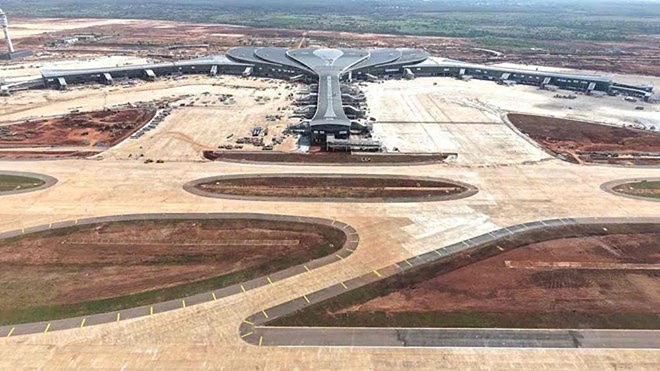
The new Long Thanh airport in February 2026 (Photo; Lao Dong-Photo: Ha Anh Chien)
Approved in 2015 by the National Assembly of Vietnam, with construction beginning in 2021, Long Thanh International Airport, which will serve Ho Chi Minh City (Saigon), will finally open its doors on 1st December 2026.
Located 40 km east of the southern Vietnamese metropolis, the new platform will gradually become the Ho Chi Minh City's main international gateway, replacing a large part of the operations currently handled by Tan Son Nhat Airport, whose saturation has been evident for several years.
The airport represents a massive investment of close to 13 billion dollars, one of the largest airport projects the country has ever seen. Long Thanh aims to equip Vietnam with a true regional hub capable of competing with the major airports of Southeast Asia, offering a level of service equivalent to Singapore-Changi or Kuala Lumpur.
The state-owned operator Airports Corporation of Vietnam (ACV) hopes to capture a share of the long-haul connecting traffic that currently transits through these major regional hubs. In particular, it aims to win business from Bangkok-Suvarnabhumi, the expansion of which is continually delayed by the indecision (often a hallmark of corruption!) of the local authorities...
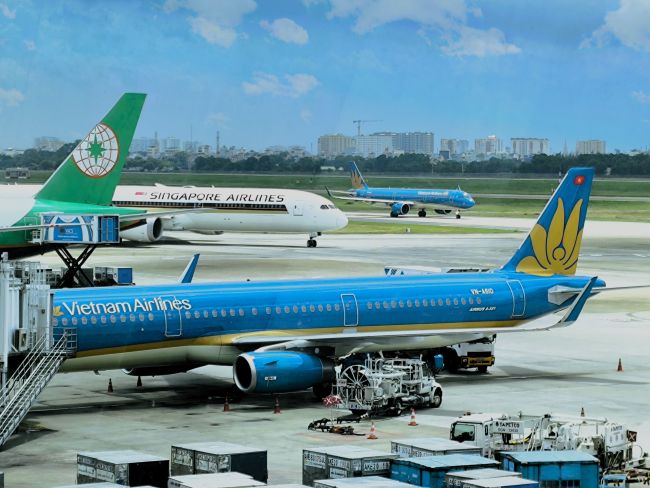
The current Tan Son Nhat International Airport is extremely congested with 42.5 million passengers in 2025 (Photo: Luc Citrinot)
A gradual opening
During its initial phase of operation, Long Thanh will have an annual capacity of 25 million passengers, which is still a long way off from the capacity offered by competitors. However, in the long term, after several expansions, the airport will be able to accommodate over 100 million travellers per year, making it one of the largest airports in Asia.
One of the sensitive points is the distribution between Long Thanh Airport and Tan Son Nhat Airport, which will continue to handle flights. The transfer of international flights will therefore take place in three phases.
From 1 December 2026, Long Thanh will handle all long-haul international flights, cargo operations and new international routes. This first phase will account for approximately 19 % of international traffic from the Ho Chi Minh City region. Vietnam Airlines has stated that, on that date, it will transfer 12% of its flights to the new airport, whilst Vietjet, Vietnam’s largest carrier, will operate at least two international flights to Long Thanh.
From the summer season of 2027, all flights to Europe, the Americas, Oceania, Africa, the Middle East, the Indian subcontinent and Central Asia will be transferred to Long Thanh. The new airport will then handle 55% of international traffic.
Finally, from the end of October 2027, more than 90 % of international traffic will be handled by the new airport. Only regional flights of less than 1,000 kilometres operated by Vietnamese airlines will continue to use Tan Son Nhat. This is expected to include routes to Cambodia, Vientiane and Bangkok.
Domestic flights will remain primarily concentrated at Tan Son Nhat. Nevertheless, it is likely that Vietnam Airlines and Vietjet will also offer domestic routes to major cities at Long Thanh, in order to feed their respective international hubs.
Accelerated road access
The Vietnamese government is also trying to speed up the completion of the road infrastructure essential for the operation of the new airport. And here, things are more complex. The various motorway and road infrastructures have experienced considerable delays due to the difficulty of expropriating landowners along the road routes. The main motorway connecting Saigon city centre to the new airport will suffer from the absence of a mega-interchange in the east of the city, which will not be completed until the third quarter of 2027.
The government has even requisitioned the army to finish the 43 km highway linking Vung Tau city on the coast to the Cai Mep-Thi Vai port complex. Another highway is also to be widened to connect to the future ring road number 4 of the southern Vietnamese metropolis.
The motorway network is all the more essential as a rail connection is a distant future prospect. It is true that the authorities have planned for Long Thanh airport to benefit from at least two rail lines, including the metro. However, work is also bogged down there, and it is unlikely that such a line will be operational before the 2030s.
With Long Thanh, Vietnam is determined to establish a new world-class mega-hub for the whole of ASEAN. This infrastructure should also enable the country to establish itself as the region’s new economic powerhouse. With GDP forecast to rise to 9% in 2026, up from 8.2% in 2025, Vietnam is the region’s new driving force. Per capita GDP has already overtaken that of the Philippines and is expected to surpass Indonesia’s this year. By the end of the decade, it is also expected to have overtaken Thailand’s, making Vietnam the fourth-richest country in ASEAN.
The digital arrival card is becoming mandatory at Vietnam's airports
Launched last April as a trial at Tan Son Nhat Airport in Ho Chi Minh City, the digital Pre-Arrival Information Card from Vietnamese immigration services is now being extended to the airports of Danang, Hanoi, Nha Trang and Phu Quoc. Online registration can be done three days in advance at prearrival.immigration.gov.vn.
It is certainly possible to scan a QR code on arrival at the airport. But, for example, in Hanoi in mid-July, the arrivals hall did not offer a WiFi connection… So it's better to take precautions!
By using our site, you consent to the use of cookies.
We use cookies on our site to store and/or access information about your device, in particular to offer you advertising and to compile statistics in order to improve ergonomics, navigation and editorial content.
Analytical cookies enable us to gather valuable information to optimise the performance of our site and improve your user experience.
By accepting cookies, you are supporting the work of our editorial team in providing you with quality information, while enabling us to offer you content and services tailored to your interests.
For more information, please consult our page Privacy policy.