Wojo aims to become the European leader in coworking over the next few years. How will your offer be rolled out so quickly?
Stéphane Bensimon - We currently have ten sites, eight in Paris and two in Lyon, with 5,000 members and over 350 corporate customers, and our ambition is to have Europe's leading coworking network within the next three years. To achieve this, we're going to create a dense network with our co-shareholder Accor (EDITOR'S NOTE: with Bouygues Immobilier) by installing Wojo Spots in the group's hotels. In other words, places where mobile executives, rather than going to the local Starbucks or McDonald's, can spend an hour or two working in the lobby, bar or restaurant. The conditions already exist in all these hotels, but we're going to make them more visible, because apart from the regulars, few people have the reflex of pushing open their doors to come and work.
What equipment will travellers find in the Wojo Spots?
S. B. - Wojo Spot is a kind of label that guarantees that the establishment offers excellent quality wifi and good working conditions with decent seating and tables. At the end of the day, while we're in the process of finalising an application that will enable us to geolocate them, we think that business travellers will find a Wojo Spot ten minutes from where they are. This will be our great strength. We think we'll be able to offer more than 1,000 spaces in Europe within the next two years. The roll-out will be very rapid, starting with Paris and Lyon, then the whole of France in 2019, before the rest of Europe in 2020.
Is this offer free or chargeable?
S. B. - We offer a freemium packageFor regular customers, a €9.90 monthly subscription will also be available, offering discounts and advantages at hotels. What's more, subscribers will become part of the Wojo member community, which will eventually be run from the app. That, too, is our strength.

Alongside the Spots, you're also developing a second offer, the Wojo Corners. What does this consist of?
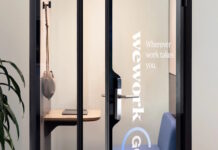
S. B. - With Wojo Corners, we're taking things a step further, transforming existing venues into new ones. real coworking spaces where professionals, and freelancers in particular, can work for half a day, a day or a month, depending on their needs. These quiet, enclosed spaces, with snacks and coffee available, will be located in hotels to start with, but tomorrow they could be in a railway station or shopping centre. We plan to transform around a hundred locations in Europe by 2023.
What about your traditional offering, the Wojo spaces, formerly known as Nextdoor?
S. B. - Our ambition is to have around fifty sites in Europe by 2022-2023, compared with ten today. To achieve this, we are relying on our shareholders. We could very well imagine combining hotels and coworking spaces with Accor, for example. But it is above all Bouygues Immobilier that is going to help us strengthen our offering in markets where they have a strong presence - France, of course, but also Poland, Belgium and Spain. Bouygues Immobilier is also considering new ways of dealing with office buildings and we're working with them on a number of projects, the idea being to set up a Wojo coworking space while taking charge of the whole building. I'm convinced that we can create something new in the approach to the work experience compared with a traditional building.
Is this change necessary to meet the expectations of the new generations?
S. B. - If you want to recruit today, it's not the same story if you're welcoming a young graduate in a coworking space or in a building from another era. There is a real awareness of this. Our aim is to create places that are in tune with this new way of working which aims to promote both performance and greater harmony between private and professional life. A fulfilled employee is one who feels better about himself, and therefore performs better. This becomes a global societal movement. For some years now, many companies and their employees have been looking for a deeper meaning in their work. Management methods, driven by the digitalisation of tools and the business nomadism that this allows, have evolved considerably. Added to this, in the image of social networks, is the desire to create links and exchange ideas between companies.
Our aim is to create places that are in tune with this new way of working, which aims to promote both performance and greater harmony between private and professional life.
How is Wojo approaching this new way of working?
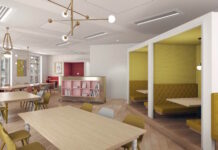
S. B. - We're approaching it with spaces made up mainly of dedicated offices - workstations for 2 to 4 people and open spaces for 10 to 30 people - but also quiet coworking spaces and others that are more lively. We try to cultivate different places, because the way you work changes during the day. Employees sometimes need places to interact with their colleagues and inspiring meeting rooms to work together, sometimes quiet places to isolate themselves and reflect, and sometimes livelier places to chat over coffee in the morning or during afterwork sessions. We're even going so far as to include areas for napping, all in order to offer a multitude of moments that correspond to new uses. We want to promote pleasure at work, without it being fake.
And what do these 'truly' inspiring spaces look like?
S. B. - These are places that inspire employee fulfilment through a maximum of services and emotional experiences. We've summed it up with the term "workspitality. This is achieved first and foremost through the design of our sites, which is different every time. For example, the next Wojo, due to open its doors at the end of the year on boulevard Malesherbes, a stone's throw from the Madeleine church, will have as its theme the spirit of Haussmann, but also Proust's madeleine, all revisited in a slightly pop art way.
Does service also play an important role?
S. B. - Behind 'workspitality', there is naturally this notion of service. This is something quite new for business premises. However, there's no reason not to be as demanding on service offered to the employees or company directors who come to us. The welcome and the morning coffee, the general atmosphere, the business events, the daily activities of a more personal nature such as relaxation sessions and yoga classes, the more basic services that don't always exist, such as suitable catering or concierge services: it's all based on the principle of creating value through customer enjoyment. This particular focus on the customer experience and the customer journey that we find in the hotel industry can be transposed to the tertiary sector. We know how to make workplaces where people feel good and open to the outside world. We have real legitimacy. Three of our site managers used to be hotel directors. They have this reflex to please their customers.
In this context, what guidelines do you set for your teams?
S. B. - Their role is to support companies in meeting their needs, identifying their problems and finding solutions among our members, whether they are start-ups, freelancers or large groups. To this end, our teams will be trained to become business partners. This sense of community is what sets us apart from the traditional corporate world.