


















Manila Ninoy Aquino International Airport (NAIA) has a sulphurous reputation. That of being the Asia's worst airport. Despite its four terminals - including two for international flights -, the airport is totally saturated, offers a very mediocre quality of service and since December has suffered regular power cuts. The last breakdown was last week. The worst one occurred at the beginning of January, leading to the cancellation of 300 flights, leaving 65,000 wandering passengers. In addition to these recurring problems, there is a real mafia around taxis and luggage theft.
So how do you guard against all these potential problems? Given the problems affecting the terminals (particularly Terminals 1, 2 and 3), it is advisable to arrive at the airport three to four hours in advance. Then you can sit back and relax in a café or business lounge...
Philippine Airlines moves
NAIA's Terminal 1 and Terminal 3 welcome international airlines. Chinese companies can be found in the terminal, Korean AirMalaysia Airlines, Thai Airways as well as Gulf Air, Kuwait Airways and Saudi Arabia. Terminal 3 is home to 16 international airlines. These include Emirates, Etihad, Qatar Airways, Turkish Airlines, Cathay Pacific, Singapore Airlines and KLM. However, this terminal is experiencing the biggest saturation problems.
Queues between check-in, immigration checks and security can easily exceed two hours.. However, waiting times are shorter for foreign travellers, who benefit from special immigration counters.
However, facilities are so saturated that the national company Philippine Airlines to transfer its international flights from Terminal 2 to Terminal 1. It becomes effective on 16 June. Unfortunately, it means longer transit times for PAL's domestic routes.
This transfer follows a directive from the airport authority transforming Terminal 2 into a purely domestic terminal. This will increase its capacity from 7.5 million to 10 million passengers with the departure of the immigration counters. The airport management promises that these new counters will boost the screening capacity of T1 and T3.
Taxi and luggage anxiety
There have been numerous reports of "Bukas Maleta" ("Baggage Opening") being carried out by thieves working at the airport, both on departure and on arrival. The best thing to do is have your suitcase wrapped in cellophane. A useful precaution, even if it adds weight to the baggage and costs extra.
As for taxis, preparation is necessary. Before you leave, it's best to look for the destination in Manila and what it would cost by taxi. It is possible to use the Grab (the Asian equivalent of Uber) and book a car in advance. If you don't have internet access, you can always queue for a taxi and get a voucher. Queues are often very long... Beware of certain "employees" with badges who offer taxis that turn out to be scams.. It is advisable to refuse any outside help, even from someone who appears to be sworn in.
When the taxi arrives, passengers must check that luggage is placed in the boot and that the counter is working. A journey between the airport and Makati, the business districtIt should cost no more than 200 pesos (11 euros).
Alternatively, there is an excellent bus service from the airport to Makati, Manila and Quezon City. The only drawback to the UBE Express is a limited number of frequencies (6 per day between NAIA T3 and Makati, for example).
Clark airport as an alternative to Manila
In the offices of the Ministry of Transport and Civil Aviation, he has many plans to improve NAIA's situation. A consortium of private companies has recently been formed.. With the promise of ensuring the airport's continuity and smooth operation. There has also been talk for years of new airports for the capital.
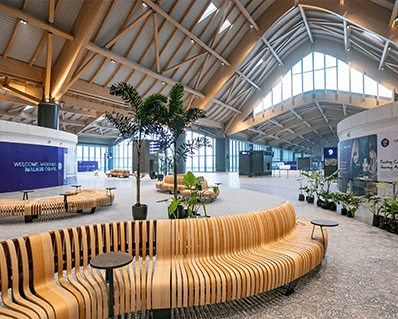
In the meantime, is there an alternative way to avoid arriving in Manila? Travellers will find another airport 80 km north-west of the capital (100 km from Makati). The former US military base at Clark is now a civilian airport. Since last year, this hub has had the most modern and comfortable terminal in the Philippines. Designed for 8 million passengers, Clark welcomes a daily flight from Emirates as well as Qatar Airways. Eva Air alternates routes via Taipei.
So would this airport be perfect for getting to Manila? Unfortunately, there is one major drawback: endemic traffic jams along Manila's urban motorway. Or a journey that takes at least 1 hour 30 minutes and easily more than two hours !