

















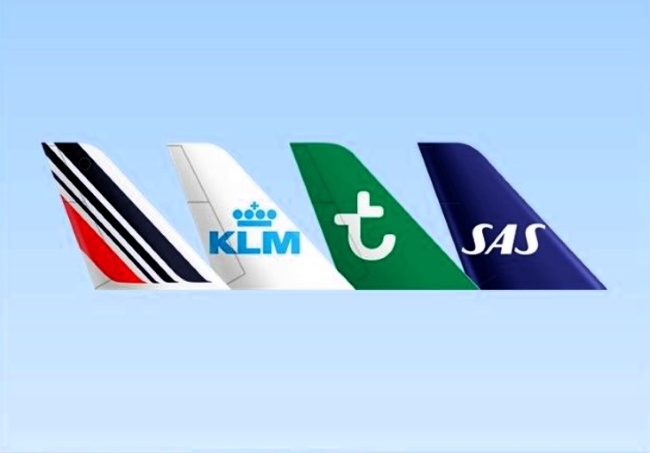
Taking a majority stake in the share capital of SAS Scandinavian Airlines and, possibly, that of TAP Air Portugal, calls into question the name of the Air France-KLM duo, which will have to demonstrate greater "neutrality" in describing itself. With a new historical turning point to anticipate for the Air France-KLM group: a name change, information revealed last week by the Dutch daily The Telegraph.
This last one indeed indicated that the CEO Ben Smith had agreed in principle to a change of name for the holding company, at the same time as the prospect of total integration of the Scandinavian company SAS into the Franco-Dutch group is becoming clearer.
Internally, several senior executives at Air France and KLM have reportedly been informed in recent weeks that the arrival of SAS could lead to the disappearance of the current "Air France-KLM" brand at the group level. The future name would then no longer make any reference to Air France or KLM. The future entity would model its brand on that of IAG (International Airlines Group), the parent company of British Airways and Iberia. This is the complete opposite of what is happening at Lufthansa, whose various airlines are grouped within Lufthansa Group, which regularly causes friction at Swiss or Brussels Airlines.
Increased centralisation
Air France-KLM is indeed aiming for a majority stake in SAS, with validation expected in the second half of the year. This operation is part of a wider consolidation strategy, which could lead to an investment in TAP Air Portugal, which is in the process of being privatised.
A spokesperson for the group believes that it is the logic of opening the discussion on a new name , given that the current structure only reflects two historic brands, when others could join the group. A working or code name has already been found, "Blue Group". However, nothing has been officially confirmed as no definitive choice has been made.
This potential development occurs within a context of profound governance transformation. The convergence between the entities is accompanied by a progressive centralisation of decisions in Paris, reinforcing the holding company's role in the overall strategy and operation of the airlines. It is also accompanied by the integration of numerous KLM managers into Parisian bodies. This time, the future entity would resemble the governance applied at Lufthansa Group more closely, combining centralised strategy with the commercial identity retained by the operating airlines.