


















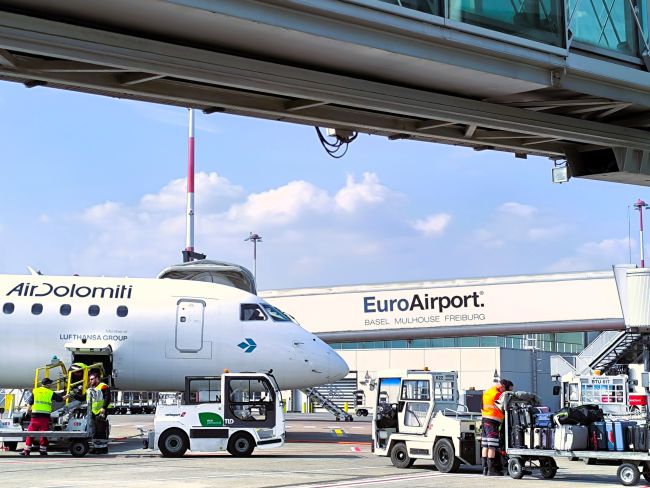
It is probably a unique situation in air transport: that of exemplary cooperation in the management of a binational airport by two supervisory authorities, one French and the other Swiss.
The Basel-Mulhouse Airport has indeed been an official bi-national undertaking since May 1946, which, despite the disagreements that sometimes arise between the Swiss and French authorities, has experienced remarkable development.
The binational status is in fact due to Basel's eccentric geographical position, the airport serving primarily as an air gateway to Switzerland's third-largest city. However, the small size of the canton of Basel-Stadt, bordering Germany and France, favoured this solution of an airport entirely located on French territory, 5km from the border. The Swiss part of the airport is thus connected by a direct customs-free road with Basel, despite the Confederation's integration into the Schengen Area.
What has actually changed compared to the pre-Schengen period is simply the removal of the border within the terminal building. Passengers move between the French/German and Swiss sectors – and vice-versa – without really noticing. Except perhaps by looking at the prices in the shops!
Eighty years of Franco-Swiss cooperation at EuroAirport have led to a surge in passenger numbers: 12,865 passengers in 1946, 696,000 in 1970, the year the current terminal was inaugurated by Presidents Pompidou and Tchugi, over one million in 1985, over four million in 2010 and finally a record 9.63 million passengers last year (+81% compared to 2024).
Works in progress
At 80 years old, the airport is undertaking expansion and renovation work on its infrastructure. The renovation of its main runway concludes on May 21st, allowing for a full resumption of air traffic. Last year, the airport approved plans for the expansion of the terminal building, with a first module to the East (Swiss side).
The new 14,000 m² building and the renovation of 15,000 m² of the current terminal will allow passenger check-in and security screening to be concentrated in a new building, making the passenger journey simpler and more intuitive. At the same time, catering and Duty Free options can be made more attractive. The opening is planned for around 2031.
The rail link, a stinging failure in cooperation
The greatest failure, however, remains the rail link. In an article published in 2025, the Swiss daily newspaper Basler Zeitung from Basel sarcastically pointed out that the idea of a train station at the airport is almost as old as the airport itself.
Although the idea of a train station at the airport has ultimately been recognised by Swiss and French authorities, its implementation continues to be delayed. Originally planned for the mid-2010s, then for 2030, it is now spoken of – without certainty – for 2035.
Especially since France has renounced partial funding for the project, estimated at 468 million euros, for a simple reason: there is no more money in the coffers. The station project would involve simply constructing 6 km of railway tracks with an underground station or one adjacent to the air terminal...
Furthermore, while the airport is nearing 10 million passengers and employs 6,000 people, it is the only one in the greater Rhine region not to have a rail link. Stuttgart Airport, which has the same number of passengers as EuroAirport, has had a train station for three decades, and even Strasbourg, with 1.3 million passengers, benefits from a regional train station.
A failure that is primarily due to Switzerland and France's inability to agree on financing. When cooperation clashes with material considerations…