















No rest for GBTA. The Global Business Travel Association has just published its business travel index for 2026. This provides an opportunity to take stock of how the market has evolved since the beginning of the year, and to look ahead to the future.
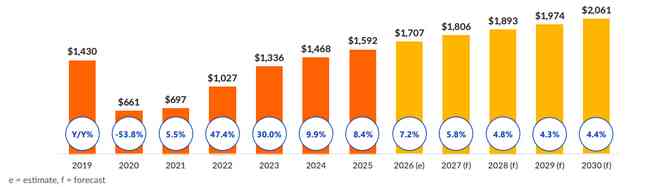
The first finding from this Business Travel Index is that business travel is on the rise. The volume of business travel has increased slightly this year (+1.31% Q3-on-Q3) and is expected to reach a total of 1.84 billion trips this year. The cost, however, is rising much more sharply. Following an 8.4% year-on-year increase last year to 1,590 billion dollars, travel expenditure is expected to grow by 7.2% year-on-year, reaching the impressive figure of 1,707 billion dollars. In the longer term, spending is expected to continue growing, crossing the symbolic threshold of 2,000 billion dollars by 2030. This is one year later than previously forecast by the GBTA.
A trend that, for Suzanne Neufang, CEO of GBTA, is the main takeaway from the study: " The standout fact this year is that companies are not turning away from travel, but are becoming increasingly selective and productivity-driven. While business travel spend continues to grow, the number of trips is increasing more slowly, which forces us all to assess the impact on the sector and on organisations. Travel remains essential, and companies are showing greater discipline regarding where, how and why they travel ".
The US market tops the spending rankings, widening the gap with China with growth of 6.7%. The gap between the two giants and the rest of the world remains vast, despite the growth seen in the German, British and, above all, Japanese markets. France, for its part, maintains its position: with a market worth 50.6 billion, it ranks 7the, ahead of India. South Korea (+11.3 %), Brazil (+13.8 %) and Turkey (+10.9 %) recorded the strongest growth among the GBTA’s top 15. Conversely – and unsurprisingly – the Middle East is suffering from regional instability, with a -12.3% year-on-year decline in business travel volume by 2026. Geopolitical uncertainty is, unsurprisingly, one of the ‘four forces’ identified by GBTA to explain the 2026 trends, featuring resilient economic growth, business investment, and high transport costs.
Top 15 business travel expenses by country
- United States: 423.0 billion1Q4Q (+6.71Q3Q)
- China: 403.7 billion 1Q4Q (+5.91 3Q4Q)
- Germany: 89.7 billion1Q4Q (+6.71Q3Q)
- Japan: 82.4 billion 1Q4Q (+10.01 3Q4Q)
- United Kingdom: 66.7 billion1Q4Q (+6.51Q3Q)
- South Korea: 51.1 billion 1Q4Q (+11.31 3Q4Q)
- France : 50.6 billion1Q4Q (+5.21Q3Q)
- India: 46.9 billion1Q4Q (+8.71Q3Q)
- Italy: 44.4 billion1Q4Q (+7.01Q3Q)
- Brazil: 35.8 billion 1Q4Q (+13.81 3Q4Q)
- Canada: 32.4 billion1Q4Q (+9.21Q3Q)
- Australia: 31.8 billion1Q4Q (+11.51Q3Q)
- Spain: 29.8 billion1Q4Q (+6.01Q3Q)
- Netherlands: 25.2 billion1Q4Q (+4.41Q3Q)
- Turkey: 25.1 billion1Q4 (+10.91Q3)
" As business travel expenditure is increasing faster than travel volume, companies are placing a growing importance on the value of every trip. ", testifies Edward Galvin. The Vice-President and Head of North America at Visa Commercial Solutions adds: " Organisations need greater visibility, control and flexibility to manage rising travel costs and measure ROI. Modern payment technologies help travel and finance teams better track spending, improve efficiency and simplify the travel experience, making it easier for businesses to adapt to the ever-evolving world of corporate travel. ".