














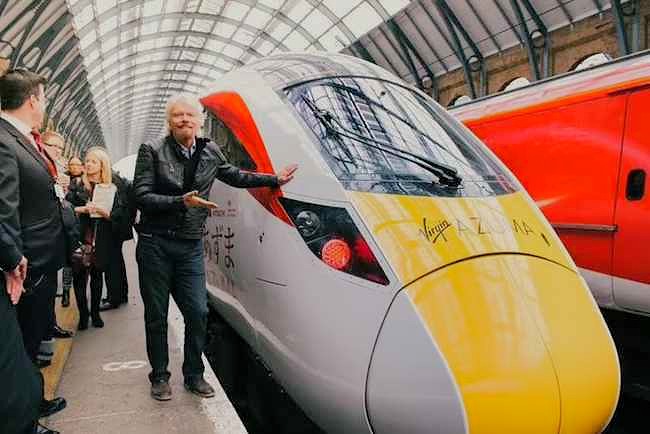
Benefiting from a monopoly in place since 1994, Eurostar is right to be worried about the opening up to competition. Following Trenitalia a few days ago, it is now the turn of Virgin Trains to make its launch on the cross-Channel route official by 2030. Richard Branson's group has for this obtained the green light from the Office of Rail & Road (ORR) to operate up to 20 return trips between London and Europe - Paris, Brussels and Amsterdam.
This authorisation was granted for 10 years, from 1er October 2030 to 31 December 2040. As part of this project, Virgin Trains had already secured permission from the UK regulator by the end of 2025 to share Eurostar’s London repair depot at Temple Mills. Owned by the UK government, the depot still has a capacity of 20%. This decision prompted a reaction from Eurostar, the international subsidiary of SNCF, which threatened to reconsider some of its future investments in Britain.
Trenitalia France, which intends to start its services through the Channel Tunnel in 2029, will carry out the maintenance of its trainsets in France at its facility currently under construction in Maisons-Alfort. This location, close to Paris, will also allow for the servicing of Frecciarossa trains running between Paris, Lyon, Marseille and Milan.
Required train type approvals and safety authorisations
However, the ORR stipulates that further steps must be taken before the commercial launch of Virgin Trains, including the homologation of the trainsets (12 TGVs have been pre-ordered from Alstom) and safety authorisations to run on the British High Speed 1 line, in the Channel Tunnel (managed by Eurotunnel) and on the various European networks.
To boost the profitability of its project, Virgin Trains wants to reopen two English stops abandoned by Eurostar, Ashford and Ebbsfleet, and reschedule direct trains between London and Marne-la-Vallée, as the British are very fond of the Disneyland Paris theme park. This second project announced within a few days plays into the hands of Eurotunnel and London St Pancras Highspeed, which have signed a partnership to increase traffic transiting through the tunnel to London and St Pancras station. The latter is set to undergo major works to absorb these future passenger flows.
Eurotunnel, for its part, claims it can run up to 1,000 trains a day (Eurostar, the Shuttle and Shuttle Freight) through its two tunnels, compared to up to 600 currently in the peak season. With 3 operators on the same routes from the end of 2030, travellers should benefit from cheaper tickets than at present with Eurostar, which is often more expensive than the airlines operating on the same routes. As high-value Eurostar passengers, business customers will certainly be heavily courted by the two new operators.