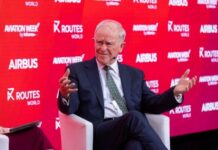









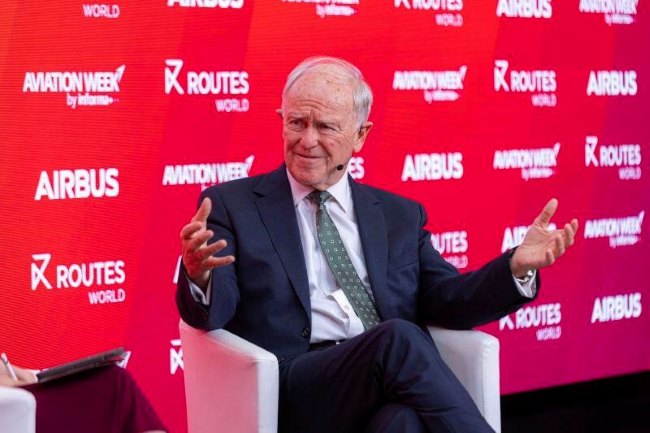
Despite the tensions in the Middle East, the rise in fuel costs and disruptions in air traffic, Emirates intends to continue its long-term development strategy. This was confirmed by the president of the company, the company Emirates, On the occasion of Routes World 2026, which will be held in Frankfurt from October 21 to 23. Routes World allows airlines to meet the airports, often accompanied by tourism offices, in order to assess the opportunities for development and the opening of air routes.
During a session, Tim Clark defended the strength of the Emirates model and his confidence in the recovery of the market. In his opinion, successive crises do not fundamentally undermine the prospects of air transport.
Rather, they constitute «episodes» or the vicissitudes of a cycle that companies must learn to adapt to. Drawing on several decades of experience – as well as several crises ranging from the Gulf War to Kuwait, the subprime crisis, or even COVID – the leader believes that demand always eventually returns once the disruptions have passed.
Tim Clark indicated that Emirates is currently operating at approximately 91% % of its pre-conflict capacity. Despite operational difficulties and increased fuel costs, revenues recorded over the past week exceeded those for the same period in 2025, a record year for the company.« Without the inherent charge in fuel, we would have already exceeded last year’s results. »That's it," summarized Tim Clark.
Dubai remains a strategic hub despite the turbulence
During the interview, the President of Emirates reiterated his commitment to the Dubai global hub model. The emirate’s geographical position, between Europe, Asia, Africa and Oceania, constitutes an undeniable structural advantage for it in meeting the needs of passengers – particularly business travelers – demanding intercontinental connections.
Emirates’ model of combining passenger flows between cities that do not necessarily have sufficient potential to justify direct connections is more than ever viable. Plus, it is efficient in handling transit passengers, which allows Dubai to remain an effective platform.
In the long term, Africa, South America and Asia represent important growth axes. China and India’s secondary cities in particular offer development opportunities. The delivery of Airbus A350 and future Boeing 787 aircraft should enable Emirates to serve markets where demand does not necessarily justify the use of very large aircraft.
Tim Clark remains convinced of the strength of business travel, contrary to predictions that its structural decline would occur after the pandemic. He also sees artificial intelligence as a way to improve the efficiency of administrative functions and optimize the operation of the company’s systems.
Nevertheless, Tim Clark readily admits that regional tensions impose a constant vigilance. Since its creation in 1985, during the war between Iran and Iraq, Emirates had to integrate geopolitical risks into its organization. The company has strengthened its operational procedures, notably through its control center, capable of repositioning aircraft, modifying flight plans and adding fuel reserves to allow for necessary maneuvers if necessary.
The priority remains the safety of passengers and aircraft, even when these measures increase costs.« We acted as effectively as possible during the early stages of the Iran/US war. We provided extended accommodation solutions and guaranteed the return of travelers to their homes, including by having them travel on competing airlines. This is what we always do in the event of disruption, in order to convince a clientele that is likely to forgo their travels." he explains.
A fleet under pressure, but with intact ambitions
The uncertainty of the geopolitical situation is an element for reassessing the strategy. But also, fleet renewal remains one of the main challenges for the company. The delays in delivery of the Boeing 777X complicate the planning of growth. Tim Clark refuses to take delivery of the first aircraft, which would, in a way, «wash away the imperfections.« I prefer to wait for aircraft built according to Boeing's revised production and quality control procedures." he adds.
The availability of the Airbus A380 is also a challenge. Seven aircraft have been grounded due to engine maintenance issues, with response times of up to 85 days. However, Emirates intends to keep the superjumbo until the early 2040s, while continuing to modernize the cabins, develop the Premium Economy class, and improve on on-board connectivity.
Pragmatism and flexibility in the face of the economic situation are two ingredients that, for the moment, are ensuring Emirates’ success.