



















France, which is surpassing Germany as the top destination for business travel, with professional trips growing at a faster rate than leisure trips over the next decade: these are the promising figures emerging from a study published by Accor and based on forecasts by the Oxford Economics Tourism Economics subsidiary.
Certainly, leisure tourism will remain by far the primary reason for travel in Europe with more than 670 million arrivals expected in 2036. That is an increase of +39 % compared to 2026. But since Europe is not just a holiday destination, the continent’s weight in the world of business, trade, or investment will support the arrival of many professional travelers to exceed 160 million arrivals in 2036, a growth of 50 %%, higher than for leisure tourism.
Asia-Pacific and the Middle East lead the growth
This expected growth should be largely attributed to the arrival of professionals from Asia-Pacific (+118 %) and the Middle East (+112 %). Driven by China (+186 %), the United Arab Emirates (+84 %) and Saudi Arabia (+58 %), these two regions are expected to see the number of travelers going to Europe for business more than double compared to the current period. Africa is also expected to see sustained growth (+63 %). By comparison, intra-European business travel would only increase by 46 % and that from North America by 32 %.
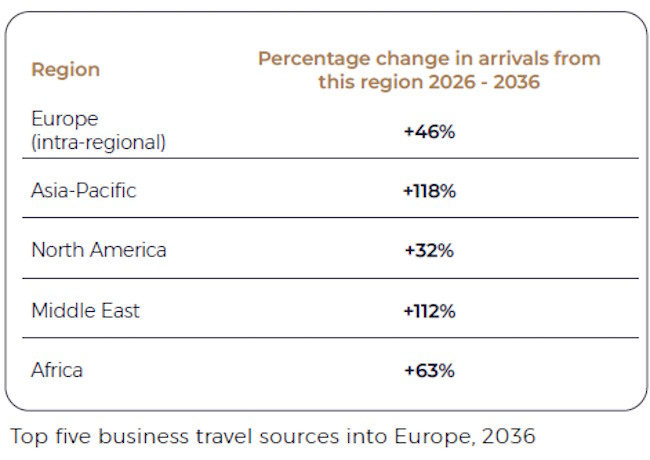
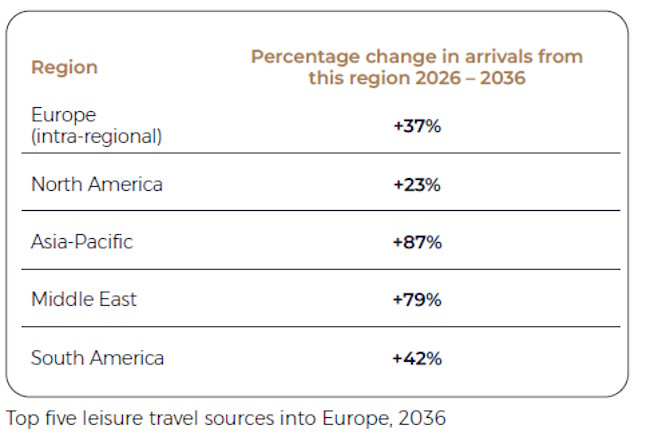
The contrast is indeed quite stark compared to leisure travel, where the differences between regions are less pronounced: +87 % for Asia-Pacific, +79 % for the Middle East, +42 % for South America, +23 % for North America and +37 % for Europe. A lower growth rate, to be sure, but that should not be forgotten that tourism in Europe is dominated by intra-European travel; more than three-quarters of international arrivals (77 %) are therefore expected to come from other countries of the Old Continent in 2036.
France, the future European business hub
In terms of destinations, the hierarchy should also evolve in favor of the hexagon. By 2036, France should indeed become the first European market for business travel, with an 89% growth % over the decade. Germany, the current leader, would move to second place despite a 25% increase %, ahead of Austria (+33 %%). Spain (+52 %) and the United Kingdom (+37 %) complete the top five.