















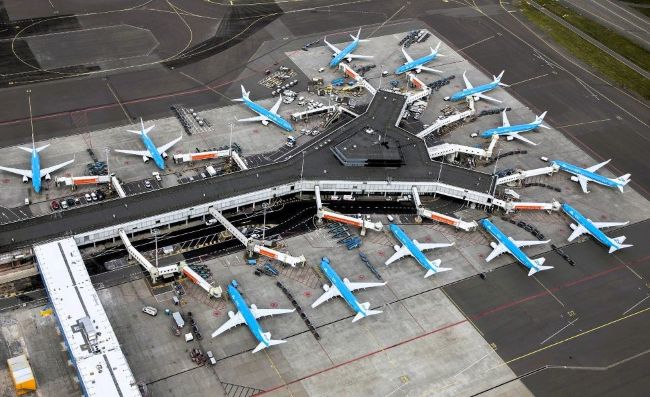
The Dutch carrier KLM For several months, it has been sounding the alarm about a degraded environment, not only due to the soaring prices of kerosene but also due to the burdens placed on airlines by the Dutch government at Amsterdam Schiphol.
A few days ago, the Dutch national airline announced a major restructuring to preserve its competitiveness and guarantee its future in an increasingly challenging aviation environment. Its CEO, Marjan Rintel, does not hide the gravity of the situation: « The future of KLM is not guaranteed », She described it during the presentation of the austerity measures that will hit the company.
Geopolitical instability, fuel prices and the growing pressure on the margins of air transport require decisions that can no longer be postponed. KLM now aims to further improve its annual results by 1 billion euros, bringing its overall financial improvement target to 1.4 billion euros.
The company claims to have already achieved more than 750 million euros in structural improvements over the past few years. But these efforts are no longer sufficient to sustainably maintain its financial situation or to fund the necessary investments in its fleet, passenger services, and human resources.
Nearly 15% of the additional positions involved
The restructuring will have significant consequences for the organization and employment. KLM plans to further reduce its workforce by nearly 15%. Approximately 5,000 positions are affected by transfers of activities, reorganizations, or gains in productivity.
Since the spring, many activities have been transferred or are now managed differently: for example, 1,250 positions in KLM Catering Services are provided in partnership with Gategroup; 800 ground handling positions at the airport have been transferred to external providers. Furthermore, 2,000 positions, including 1,500 within the Cygnific customer relations center, will be merged with Air France within the Air France-KLM entity.
The transformation will thus affect ground handling services, baggage handling, freight and maintenance.
Additional productivity gains are also expected to result in the elimination of approximately 1,000 jobs. KLM therefore aims to achieve a structural increase in productivity of at least 8% by 2028.
A profoundly revamped European network
What should passengers also expect? KLM wants to reassure passengers, stating that the company has no intention of compromising its international network of 160 destinations at Schiphol, nor of compromising its customer relations or operational reliability.
However, the European network will undergo a reorganization aimed at boosting its profitability. The fleet strategy is shifting towards greater use of smaller-capacity aircraft. The Embraer E195-E2 will replace the initially planned A320s in the coming months, but the A321neo -more fuel-efficient- will remain in the fleet. The Boeing 737 and Embraer E190 will be gradually retired from service.
The regional subsidiary KLM Cityhopper will thus play an enhanced role in regional service. The capacities will be allocated preferentially to the routes that contribute most to Schiphol's international connectivity.
The company will continue its investments in new aircraft, onboard comfort, free high-speed Wi-Fi on intercontinental flights, and the digitalization of services.
For Marjan Rintel, these decisions are painful, but necessary.« Doing nothing would ultimately have even more serious consequences, both for jobs and for the connectivity of the Netherlands with the rest of the world. "she stresses.
The increases in taxes planned by the Dutch government will also remain to be renegotiated. Amsterdam-Schiphol Airport, This reduces the appeal of the second European hub Skyteam.
The company has already managed to reduce the airport tax on long-haul flights exceeding 5,000 km. It will indeed go from €30.25 to €59.43 per passenger in 2027. But it was originally intended to reach €74.81. This passenger tax will also increase by almost €20 on medium-haul flights, reaching €49.87 and reaching €31.04 on short-haul flights, a 0.79% increase.
Beyond the future of KLM, it is also the future of Amsterdam-Schiphol as an international air hub at stake. Much of the Netherlands’ commercial prosperity has been built on its airport and airline. A characteristic that the Dutch government should remember…
