















Business travellers are accounting for an ever-smaller proportion of air passengers. According to the latest National Air Passenger Survey (ENPA) published by the Directorate General of Civil Aviation (DGAC), they accounted for just 17% of passengers in 2025, compared with 19% the previous year. This is a far cry from the 28% recorded in the survey carried out in 2015–2016.
Based on interviews conducted in departure lounges with nearly 160,000 passengers, this comprehensive study provides a fairly clear picture of how airline passenger demographics have changed in France. Whilst leisure travellers still account for half of all passengers – 50% in 2025, compared with 49% in 2015–2016 – business travel is no longer the second most common reason for flying, having been overtaken by visits to friends and family. The VFR (Visiting Friends and Relatives) segment now accounts for 29% of travellers, compared with 21% a decade ago.
Arnaud Aymé, France DG and Transport Consultant at SIA Partners, who was asked to comment on this study during a round table at the FNAM annual congress, explained this sharp increase by societal phenomena – globalisation, immigration, expatriation – which mean that “ More and more people want to return to the country. ". In its study carried out last year for the FNAM, SIA Partners noted, in particular, that for VFR travel by French residents, there would be growth of 27% to domestic and European destinations between 2016 and 2024. Furthermore, there is expected to be growth of 1,01% for destinations worldwide and 1,21% to the Maghreb.
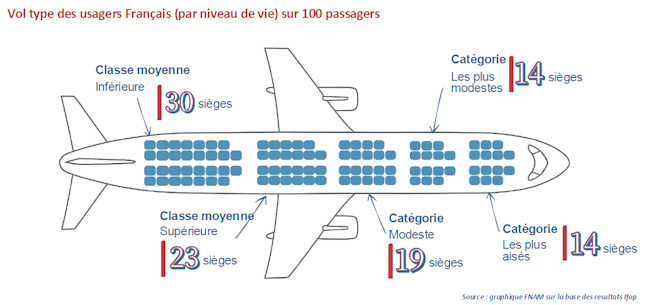
As this may explain that, this growth in the VFR customer base, combined with the ongoing expansion of low-cost airlines offering affordable fares, has led to a significant sociological shift in the cabin environment. Ten years ago, the typical air passenger still belonged to the higher socio-professional categories, whether they were business owners, senior executives or members of the liberal professions. Now, employees and manual workers have overtaken them, accounting for 28% of passengers among French residents – and 32% among foreign residents travelling to France – compared with 27% for the upper socio-professional categories. “ The aeroplane is no longer a privilegee, notes Marc Borel, director of air transport at the DGAC. Democratisation continues with this predominance of the socio-professional category of CSP-, as well as the travel appetite of 18-35 year olds, beyond the question of climate. "
However, while low-cost airlines are used by VFR customers for leisure trips in Europe and North Africa, Sébastien Guyot, Deputy Chief Commercial Officer of Air France-KLM, notes " that a third of our passengers are VFR. Which slightly alters the idyllic image of a legacy airline used only by businessmen and women. Another entrenched stereotype overturned is that of the front-of-cabin classes – premium economy, business or first – being exclusively frequented by business travellers: ‘ It is realised that the VFR and leisure clienteles are important in all classes.notes Sébastien Guyot. For flights departing from the United States, for example, there's a huge appetite for premium classes. "
As for business travellers, although they may be decreasing proportionally, they still represent a key clientele for airlines. But perhaps a little less so on short-haul routes where same-day return journeys fell by -60% and two-day flights by -40% », observes Marc Borel. « Taking the first flight of the morning and the last flight back is becoming less and less common., confirms Sébastien Guyot, for Air France-KLM. The CSR aspect is strong in short-haul, where train travel has become the norm for domestic journeys, and even for destinations in Europe where rail solutions exist. This gives rise, according to him, to a new necessity: “ to have air + train partnerships to prepare for the future ".
The latest National Passenger Survey also confirms trends that hoteliers are observing on their end. Namely, longer stays and, for long-distance journeys, combining several appointments in the same region rather than having to travel each time. We're seeing quite a few circulars on long-haul flights. We go to Japan, we go via Korea and come back. ", explains Sébastien Guyot.
Another major trend emerging from all these figures is bleisure, of course. “We analysed a fairly new element in the study, which is the hybrid trip. Today, a third of business trips are extended with leisure time,” points out the Director General for Civil Aviation. We've noticed that a third of our corporate clients do bleisure., confirms Sébastien Guyot. This is not insignificant. This raises certain questions. Is the flight free? Is the hotel free? Each company has to make its own choice, but in any case, there is an appetite for combining business and leisure once at the destination. And to conclude in the same way as many hotel groups: “ That's good news for the industry ".