



















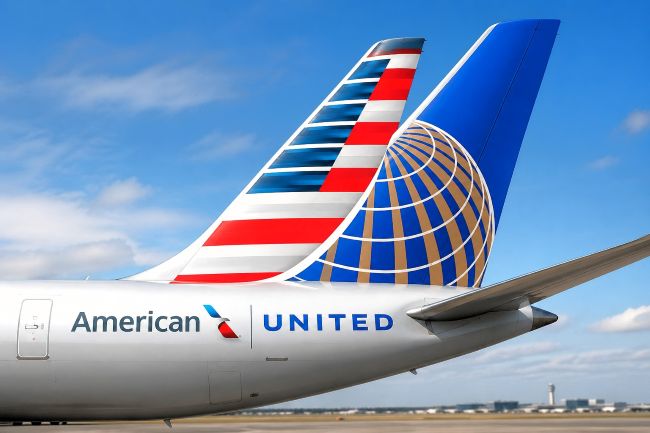
American Airlines slammed the door in the face of United Airlines over an idea for a merger between the two carriers, an idea that the CEO of United AirlinesScott Kirby, seemed to be caressing. Hinted at for several months, the conversation about a potential merger gathered pace this April. Ultimately, however, American Airlines put a brutal stop to it.
In a statement, the American air giant indicated that it is "neither engaged nor interested in discussions concerning a merger with United Airlines. While changes in the broader airline market may be necessary, a combination with United would be detrimental to competition and consumers, and therefore incompatible with our understanding of the Administration's [Trump] philosophy towards the industry and the principles of antitrust law. Our priority will remain the execution of our strategic objectives and positioning American to win in the long term."
And, in passing, to flatter the current US government: "We look forward to continuing to work collaboratively with the Administration as it takes steps to strengthen the aviation industry as a whole."
Scott Kirby has therefore taken up his pen to justify his thwarted merger idea with American Airlines. A rather long text (nevertheless adapted in French translation) which depicts a future "United American Airlines" through the prism of a happy merger with a fairy-tale-like feel...
Over the past two weeks, there's been a lot of chatter about a potential merger between United Airlines and American Airlines. To be direct, here's what happened: I approached American to explore a combination.of our two companiesIndeed, I thought we could achieve something incredible together for the customers. I always knew the only way for a merger to succeed (and be approved) was for it to be great for the customers and with a willing partner who shared my ambitious and bold vision.”
I was convinced that this combination, which would have involved adding rather than subtracting, by creating a truly exceptional airline that customers would love, could have gained regulatory approval. I had hoped to present this vision to American, but they refused to engage in discussion and instead slammed the door in my face. And without a willing partner, a project of this magnitude simply cannot be done.
In the past, airline mergers generally concerned two struggling companies coming together to reduce costs, flights, and staff. My ambitions were entirely different. My bold idea was based on growth, to usher in a brand-new era of leadership for American aviation […] By combining our airlines and using this scale to revolutionise the customer experience, we would have created a prosperous new American airline, the best in the world for customers.
Even though public comments from American clearly show that such a merger is excluded in the short term, I think it's worth describing in more detail what the outcome might have looked like.
The combination of United and American could have: 1) amplified and scaled a winning, customer-centric approach, 2) unlocked significant new opportunities for customers, employees and the communities served by both airlines, and 3) created a new, great American airline with the scale needed to compete and win on a global scale.
Here are some of the benefits such a combination could have produced:
- Flying with a company loved by its customers See even more destinations: United is already redefining what an airline is, with the best service, technology, reliability and products offered for every type of customer, so flying with United provides a better experience than elsewhere. We also have big plans to go even further. Offering these benefits to even more people would give customers of both airlines more choice and value in terms of products, technology, experiences, as well as a more attractive loyalty programme. The combined company would have meant growth — particularly internationally and with expanded service to smaller communities — which is mathematically made possible by a larger network.
- Create even more value If the price is important, the "added value" is also important, unless we consider air transport as a simple commodity. The truth is that in 2025, ticket prices were 29 % cheaper than before the pandemic (adjusted for inflation). Meanwhile, United has focused on adding value to customers by investing in its product: newer, more modern aircraft with larger overhead bins, screens in every seat, Bluetooth connectivity, free Starlink Wi-Fi and an award-winning mobile app. A merger between United and American (and the growth that would have resulted) would have dramatically increased the total number of economy seats in the market, offering customers more affordable ways to travel to more destinations; as well as more choice at all price points, while continuing to offer the best value in the industry. We would not offer a combination that would increase prices for customers.
- To create a truly globally competitive company — based in the United States: today there is a significant trade imbalance with foreign companies. They represent approximately 65 % of long-haul seats into our country while only 40 % of customers are foreign citizens. The combination of United and American would have been a better way to compete with foreign carriers. A larger American global airline would have generated more jobs and economic opportunities in the United States. This American company would have set the standard for the next century [...] It would be a great American company, the best, whether you are a customer in Chicago, Des Moines, or Dubai."
To stimulate the American economy, create millions of jobs, and revitalise the U.S. aerospace industry: America is stronger when U.S. carriers reinvest more U.S. consumer spending into communities, employees, and the domestic manufacturing industry. By offering more seats to more destinations across the U.S., this merger would have boosted local tourism and business travel, generating billions of dollars in additional economic activity and even more jobs.
I recognised from the outset that a merger of this scale would attract considerable scepticism from the media and some government officials. As previous mergers involved struggling companies, legal and regulatory reviews have always focused on cutbacks and what was lost. But a different merger proposal – one focused on growth, customer investment and global competitiveness – would have made the difference. And even if there had been a need to reduce our presence in some domestic markets, I believe regulators would have approved such a deal because they would have recognised the benefits for customers, our joint employees and communities worldwide.
(Translated text, adapted to the French language and shortened compared to the original in English.


