


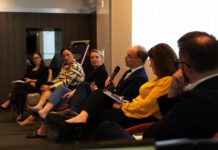








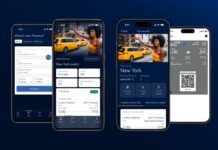


The travel industry celebrates WOMEN'S DAYeach in their own way. Airlines such as Emirates and Air India have chosen to operate flights with all-female crews. For its part, HRS wanted to find out how professional women travellers interact with technology. The survey of 690 women provides information on the use of smartphones by women.
Unsurprisingly, like their male colleagues, women commonly use applications while on business trips. In most cases (69 %), they prepare their trip with the help of three apps to the maximum, which could be explained by the redundancy of certain functions. Once you arrive at your destination, the catalogue of applications used expands slightly, a quarter of female travellers using more than three mobile services. This discrepancy is probably due to the needs of travellers: a currency exchange application is of no use at home, but is essential abroad.
Convenience before safety
One woman in two (49 %), would above all like to use their smartphone to speed up check-in and check-out at the hotel a feature that goes beyond the e-concierge offer (44 %), and what HRS describes as " safety "through a " optimal control system ".
As for artificial intelligence, which is the focus of much attention, the business travellers seem to have a firm grasp of their subject, and are optimistic. Indeed, a large majority of those surveyed (61,67 %) are able to defining AIand 58 % of them believe that it will revolutionise way of travelling and deeply improve the experience traveller ". However, the travellers are not pitting technology against people: 65% of female travellers believe that instead of isolating us, new technologies allow us to make exchanges more fluid with others, while making travel easier.
The authors of the survey didn't hesitate to try their hand at science fiction, sharing with the respondents the " dream "of a perfect business trip ". Women business travellers clearly do not envisage a future without business travel: substitutes such as thehologram (11,67 %) or augmented reality glasses (11,67 %) were not favoured by the sample. Women largely preferred to outsource their organisation to a intelligent virtual assistant (55 %), or even - from a more futuristic point of view - instantaneous travel using teleportation (27 %).