
















A club that is no longer quite so exclusive. Five hotel groups can indeed now boast being millionaires in terms of room numbers. This is what emerged from the Top 10 of global hospitality recently unveiled by the Cabinet MKG and Hospitality On. The British group IHG thus joins Marriott, the first to have crossed this symbolic threshold in 2016 thanks to the takeover of its competitor Starwood, followed by JinJiang at the end of 2019, Hilton at the end of 2020, and the Chinese group H World (formerly Huazhu) at the end of 2024.
To make its entry into the world's top 5, IHG has benefited from its development momentum in the United States and the Greater China region, marked by the achievement of two major milestones in 2025: 4,000e hotel and the 800e properties in these regions respectively. But Europe is also one of its key growth drivers, with its portfolio growing by 27% over the last three years, driven in particular by strong expansion in Germany, the launch of new brands such as Garner, and the acquisition of the lifestyle brand Ruby Hotels.
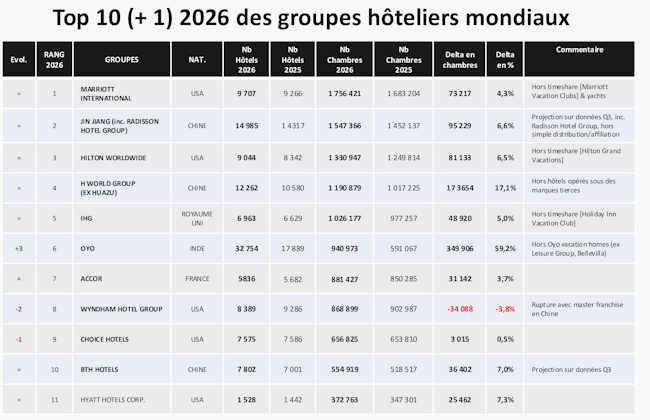
Nevertheless, with almost 7,000 hotels worldwide and a total of 1,026,177 rooms, IHG is still a fair way behind the global leader, Marriott. A group which, with its growth rate of 4% to 5% per year, is gradually approaching the 2 million-room mark worldwide. The American hotel group, which has just opened its 10,000the hotel in the world, the JW Marriott Ranthambore Resort & Spa in India, is certainly not there yet. But with over 1.75 million rooms, it still towers over its competitors from the top of its podium.
Buoyed by its dominance in the luxury segment with its seven brands encompassing 700 establishments, Marriott can also rely on its new strong suit, the mid-range segment, to fuel its expansion. In addition to tapping into the long-stay midscale trend in the United States with its new StudioRes brand, the American group is accelerating the deployment of regional brands dedicated to this growth, such as City Express by Marriott in the Americas, Four Points Flex by Sheraton in Europe and Asia, or Series by Marriott, a brand launched last year that has made a rapid breakthrough in India and is expected to replicate this success in other regions of the world.


However, Marriott has also embraced a significant trend in the development of hotel groups: strengthening their lifestyle offerings. Like IHG with Ruby, Marriott acquired CitizenM last year, a brand familiar to business travellers. At the turn of the last decade, Accor had already established a lifestyle division through its subsidiary Ennismore, building it up through successive acquisitions and consolidating attractive brands such as Mama Shelter, The Hoxton, 25Hours, Mondrian, SLS, and Delano. Other groups have followed suit more recently, including Marriott and IHG, as well as Hilton with the acquisition of NoMad and Graduate, and Hyatt with the purchase of The Standard, which now forms the foundation of its lifestyle division, alongside its Andaz, Thompson, and JdV brands.
To enhance its lifestyle offering, support its luxury hotel portfolio, and rely on brands focused on converting existing hotels: this three-pronged approach broadly underpins the development of all global hotel groups. In addition, of course, to being able to lean on the solid foundations of their historic brands, whether it's Courtyard by Marriott, Holiday Inn by IHG, Hilton Garden Inn and Hampton by Hilton, or Novotel, Mercure and Ibis from Accor.
So many brands and hotels are regularly frequented by business travellers. On the other hand, unless you travel to China regularly, nomadic professionals are likely less familiar with the flagship brands of the world's second largest group, Jin Jiang. 7 Days, Vienna, Jin Jiang Inns, Lavande: these brands, only represented in the Chinese market, account for a large portion of the number two in the rankings' one and a half million rooms.

Nonetheless, the Chinese group's offer is no doubt not entirely unknown to travellers in our part of the world, as Jin Jiang is indeed the parent company of two key players in European hotelkeeping: Louvre Hotels and the Radisson Hotel Group. And in this, it can rely on, to support its expansion outside China, the brand dynamics Radisson Blu, RED or Collection as in the Louvre Hotels return to business, engaged in a vast and necessary transformation plannotably for its flagship brand Campanile.
Whilst JinJiang does not emphasise its global reach, the other major Chinese group, formerly known as Huazhu, has done so more clearly since rebranding as H World Group in 2022, following the acquisition of the German hotel operator Deutsche Hospitality and its flagship brands such as Steigenberger and InterCity. Thanks to these acquisitions, the world’s fourth-largest hotel group now enjoys a significant presence in Europe, particularly in German-speaking countries, though this pales in comparison to its presence in nearly 1,500 cities across China, through its Hanting and JI brands.
With three groups in the global Top 10 – BTH Hotels bringing up the rear – the Chinese hotel industry can draw on a market of unfathomable size, second only to the United States. And perhaps India. For a long time, it was an impregnable stronghold for global groups, against a backdrop of a regulatory jungle, a complicated property market and complex financing arrangements. But 2025 saw these barriers begin to crumble with the association of Accor and the conglomerate InterGlobe, the parent company of IndiGo, to accelerate the development of the French group in India, or Marriott's partnership with a leading hotel management company, Concept Hospitality, to launch its brand Series by Marriott en encompassing about sixty hotels of the The Fern brand. And that's without taking into account a host of hotel announcements in preparation by IHG, Hyatt or Louvre Hotels, already firmly established since its acquisition of the Indian group Sarovar in 2017.
In this context, an Indian group, Oyo, is also making a strong comeback in the global top 10. Founded in 2013, the group enjoyed a meteoric rise that saw it reach the top of the rankings as early as 2019, before experiencing a dip in form and then bouncing back, notably with the acquisition of the budget brand Motel 6 in the United States from Blackstone. Set to go public under the name Prism, this player with a chequered history has made a significant leap up the rankings thanks to growth of nearly 60% in its portfolio. This was enough to overtake Accor, the world’s seventh-largest group with over 5,800 hotels and nearly 900,000 rooms.


While it cannot rely on a domestic market as large as those of all its competitors, the French group has, over its history, managed to secure a pre-eminent position in Europe, more recently taking on the role of leader in almost all regions of the world, with the exception of the United States and China. It has also become a major player in luxury with brands such as Raffles or Fairmont, and Orient-Express, a legend back on the rails, at sea, and on land with a first hotel opened last year in Rome.
In addition to this – and to one of the most comprehensive lifestyle portfolios in the hotel industry – Accor has, in recent years, set about revitalising well-established brands, particularly Sofitel in the luxury segment and, more broadly, those within its Premium, Mid-Range and Economy (PME) division. This phase of transformation and modernisation has led, if not to the closure, then at least to the refurbishment of certain ‘underperforming’ hotels. This resulted in net growth of 3% for the PME division last year, whilst the luxury & lifestyle portfolio expanded in parallel by 7.5%. This strategy is bearing fruit, as the pipeline – confirmed hotel projects – for this same SME division shows growth of 11.6%, compared with 5.9% for luxury and lifestyle. This points to a positive outlook for the coming years.
Among the world’s major hotel groups, ranked 8th and 9th respectively in the Top 10, the two US franchisors, Choice and Wyndham, have experienced mixed fortunes. Choice Hotels offset the optimisation of its portfolio in the United States – which led to a 2.4% decline in its offering across the Atlantic – with record international growth (+12.5%), ending the year with a slight increase. For its part, Wyndham was affected last year by the termination of the master franchise agreement for its Super 8 brand in China, resulting in a decline of 3.8% according to the ranking published by MKG. Excluding this factor, Wyndham reported a 4% increase in its portfolio, with the US market remaining virtually stable (+1%) alongside strong growth in the EMEA and Latin America regions (+7%).