


















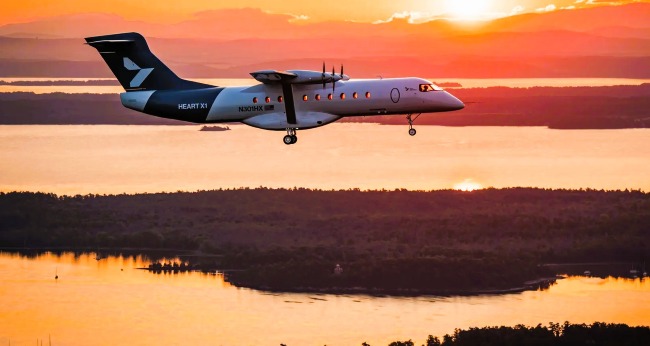
The electric aeroplane has just reached a new milestone in its journey from utopia to reality. The manufacturer Heart Aerospace, originally from Sweden but now based in California, has carried out the first flight of its X1 prototype aircraft, presented as the largest battery-powered plane ever to have flown.
The flight took place on 12 August from Plattsburgh International Airport, in New York State. The aircraft flew for 27 minutes, climbing to an altitude of 335 metres. Its fully electric propulsion system delivered more than a megawatt of power.
With a take-off mass of over 11 tonnes and a wingspan of 32 metres, the X1 is on a different scale compared to previous electric prototypes. The programme aims to demonstrate that electric propulsion can now be tested on a model increasingly close to a regional commercial aircraft.
The flight was carried out under a special airworthiness certificate issued by the Federal Aviation Administration (FAA) in the experimental category. The test programme included taxiing, take-off, climb, in-flight manoeuvres and landing, amongst other things.
Yet it is this figure that will attract the most attention: the X1 is said to have consumed around 5 dollars' worth of electricity for this first flight. In these times of crisis in the Gulf and soaring oil prices, this is a remarkable cost. It would nonetheless be premature to deduce from this that commercial operations using a real electric aircraft would generate a comparable operating cost. The X1 was indeed flying empty…
A step towards the ES-30
Yet this is a genuine step forward towards a future electric aircraft. Heart Aerospace's aim with the X1 is indeed to validate the technologies intended for its future ES-30, a 30-seater hybrid-electric regional aircraft.
The aircraft must have a range of up to 200 km in all-electric mode and up to 800 km in hybrid mode. Heart also plans around 30 minutes for recharging. Certification is currently targeted for 2031.
The manufacturer claims a reduction in operating costs of more than 40% compared with conventional regional aircraft. This claim is once again based on lower energy costs, simplified systems and potentially lower maintenance costs.
For regional operators, the stakes are high. The ES-30 is designed for routes of under 800 km, a market particularly relevant in Europe and North America, where many regional routes remain dominated by turboprops and small jets. And which often prove to be marginally profitable or not profitable at all, as regularly demonstrated by the suspension of regional routes by traditional airlines such as Lufthansa and Air France.
Airlines already committed
Heart Aerospace already enjoys the backing of several major aviation industry players.
United Airlines, Air Canada and JSX are among the companies that have made commitments regarding the ES-30. United and Air Canada are also investors in Heart Aerospace.
The company, founded in 2019, is now headquartered in Torrance, California. It states that it has raised 190 million dollars to finance the development of its technologies and future aircraft.
Heart Aerospace has also launched its Los Angeles pilot plant, intended for pre-series manufacturing. Flight testing of the ES-30 is set to be the programme's next major milestone, potentially opening the door to the future revolution in global air transport.