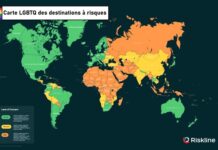

















International SOS has published the 2023 update of its map highlighting the level of security and medical risk in countries around the world. Unsurprisingly, Ukraine has been downgraded to "extreme" risk. " La security crisis in Ukraine has clearly been significant and has had an impact on the country and neighbouring regions in a number of ways" said Sally Llewellyn, Director of Security at International SOS, while her company continued to support the organisations that remained in the country: " this is particularly important for NGOs, the media and service companies, where many Ukrainian employees now wish to return home to visit their loved oness. "
Despite the impact of the Ukrainian conflict, the assistance and safety and security specialist believes that " the underlying security risk environment in Europe has not changed" . A possible rise in social unrest linked to inflation does not alter this analysis either. And so, all European countries are classified as insignificant to low riskWith the exception of Lithuania and the border areas between Serbia, Bosnia and Montenegro on the one hand and Serbia, Macedonia and Kosovo on the other, defined as moderate risk.
Another conflict-ridden region of the world, the Sahel is also, unsurprisingly, highlighted by International SOS for theincrease in potential hazards. " Extreme security risk zones have expanded due to the increased risk of militancy. A trend that is also noticeable in Mozambique and other parts of Africa" says Sally Llewellyn. In the end, several countries as a whole are classified as extreme risks, including Libya, Mali, the Central African Republic, Somalia and South Sudan. Similarly, the risks for travellers are at their highest in several regions of Africa, including the east of the Democratic Republic of Congo, northern Mozambique and north-eastern Nigeria.
Outside the continent, Afghanistan, Syria and Yemen, parts of Iraq and Pakistan, the Sinai region and the Gaza Strip are also affected. other countries and regions of the world to avoid. As for the Americas, Central America is generally a high-risk destination because of its high crime rate. Colombia has been added to the list of sensitive destinations because of " a increase in crime resulting in part from the socio-economic impacts of the COVID-19 pandemic has led to an increase in high-risk areas" explains International SOS.
Mental health risks, a first
While its mapping also covers health-related risks - from high to high in a large proportion of African countries, as well as in Central Asia - International SOS added for the first time, a mental health risk assessment. This new layer is almost a mirror image of the safety risks, since it is the European countries, the United States, Australia and Brazil that are the first to be affected by these illnesses, which are known as depression and anxiety, bipolarity and eating disorders or schizophrenia.
While around 14 % of the world's population is currently said to suffer from one or more mental disorders or substance abuse, this rate exceeds 15% in most of the countries with the most developed economies. It is even between 17.5% and 20% in Australia, Spain, Portugal, Ireland and South Korea. Why this new subject? Dr Irene Lai, Medical Director of International SOS, explains that, ". Although other acute medical problems likely to have a significant impact occur regularly, mental health problems remain in the background and cannot be neglected. Organisations must manage multiple physical and mental health problems to effectively discharge their duty of care responsibilities."