



















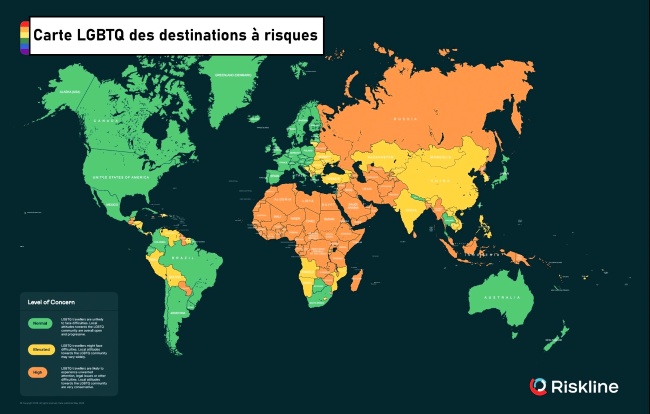
June now being recognised as Pride Month, Booking.com and Riskline we analysed what the high-risk destinations were for populations LGBTQ+ as well as the challenge that business travel can represent…
In an exponentially growing global business travel market, which is projected to generate $2.4 trillion by 2031, companies must ensure the safety and inclusion of all their travelling employees.
Two studies published by Booking.com and Riskline show that LGBTQ+ travellers remain particularly exposed to legal, social and professional risks, depending on their destination.
Business Travel and LGBTQ+ Identity: An Impossible Mission?
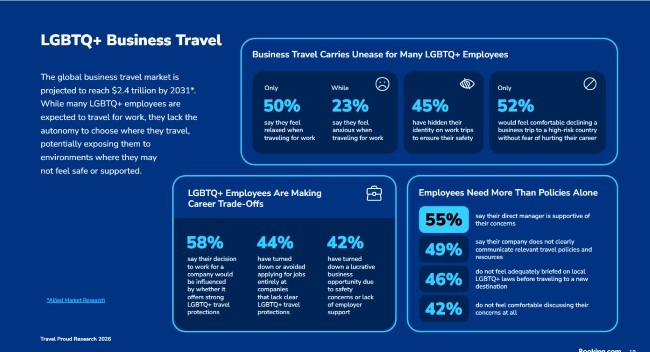
A first international survey by Booking.com of over 13,000 LGBTQ+ travellers in 19 countries reveals that confidence is still fragile. Only one in two people say they feel relaxed when travelling for work, while nearly a quarter of respondents feel anxious before or during their business trips.
This concern is based on concrete realities, according to the Booking.com report. Nearly 45% of travellers surveyed say they have already concealed their identity or sexual orientation whilst on a business trip in order to avoid potentially problematic situations. Even more worrying is that only 54% feel they receive sufficient information about local laws regarding LGBTQ+ rights before they travel.
For businesses, these concerns go beyond the simple issue of well-being. They now have a direct impact on employer attractiveness and career prospects. According to Booking.com, 42% of LGBTQ+ employees have already turned down an attractive job opportunity due to concerns about their safety or a lack of support from their employer. Furthermore, 44% say they have decided not to apply to certain companies due to a lack of sufficient guarantees regarding business travel.
Only 80 countries with minimal risks for LGBTQ+ people
This issue takes on an even more strategic dimension in light of the new global LGBTQ+ risk map published by Riskline. The travel intelligence company now classifies 91 countries in the highest category for potential risks to LGBTQ+ travellers; 62 countries show a level of "heightened vigilance". Only 80 destinations are in the normal concern category.
According to Riskline’s analysis, Western Europe remains the safest region for LGBTQ+ travellers today, with all countries there classified as ‘normal risk’. Conversely, the Middle East and North Africa account for the majority of high-risk destinations. Sub-Saharan Africa also presents a particularly high level of risk, with nearly 80% of countries considered to be of high concern.
" With 67 countries continuing to criminalise same-sex relationships, travel policies must reflect this reality. ", highlights Lorena Peña, head of the Travel Intelligence team at Riskline. " For LGBTQ+ travellers, whether travelling for business or leisure, these figures translate into very real legal, cultural, and sometimes physical risks. "
Moreover, 2026 marks a significant setback in several regions of the world. Among the most concerning developments are the criminalisation of homosexuality in Burkina Faso, the toughening of sanctions in Senegal, the adoption of new restrictions in Slovakia, anti-'LGBTQ+ propaganda' legislation in Belarus, and new constraints imposed on transgender people in India. In the United States, the Supreme Court upheld the removal of the 'X' gender marker on federal passports.
Some advances remain nevertheless. Saint Lucia has removed provisions penalising male homosexual relations, while Botswana has definitively removed from its penal code the articles criminalising relations between people of the same sex.
For travel managers and international mobility managers, these developments highlight the growing importance of "corporate sense of duty," which in English is translated as " duty of care" .
Riskline's experts estimate that standardised policies are no longer sufficient to cater for the diversity of traveller profiles. Companies must therefore integrate dynamic risk assessments, taking into account not only the destination but also the traveller's profile, rapidly evolving local legislation and on-the-ground social conditions.
Booking.com’s findings point in the same direction. More than half of respondents (58%) say that the existence of specific safeguards for LGBTQ+ travellers would influence their choice of employer. More transparent communication about risks, tailored resources and better preparation before departure now appear to be essential factors in building trust.
Corporate inclusion policies are thus becoming a strategic talent management issue as much as a safety responsibility. For global companies, guaranteeing a safe and respectful travel environment for LGBTQ+ employees is therefore more than just a matter of image.