The consequences of both the Israeli-American strikes and the Iranian response to the "Epic Fury" military operation have dramatically altered the state of travel in the Near and Middle East. A state of emergency has been declared in Israel, and Iranian drone attacks in the Gulf States have turned airports and hotels into secondary targets or collateral victims, in addition to US military and diplomatic sites. The safety of expatriates in the Near and Middle East has been put to the test, while employees in transit have been stranded in Doha or Dubai.
And this situation could be prolonged, with International SOS (ISOS) anticipating the continuation of joint operations by the United States and Israel as well as the extension of Iranian retaliation, at least for the next 24-48 hours. Or even longer if, as Donald Trump suggests, the duration of the operation is counted in weeks. " This is just the beginning, the war will go on and on General Dan Caine, the US Chairman of the Joint Chiefs of Staff, stated in this context, even though, according to Defence Secretary Pete Hegseth, it will not be a question of "... the United States taking the lead in the fight against terrorism". of an endless war ".
In view of this, and in addition to a logical invitation to evacuate Iran, the world leader in travel safety and security has reassessed the level of risk in Israel and the Palestinian territories, recommending not only that travel there be postponed, but also that consideration be given to evacuating non-essential personnel. Conversely, the level of risk has not been increased for the Gulf monarchies, despite the numerous drone attacks. " No need to evacuate thanks to robust air defence systems "says Béatrix Renaut, Head of Security at International SOS. However, ISOS logically advises against business travel and travel via Saudi Arabia, Bahrain, the United Arab Emirates, Kuwait and Qatar.
As for people living in these countries, or passing through as is the case for a number of professionals, they are advised to take precautionary measures - remain confined, limit the time spent near military and diplomatic installations, know how to take cover in the event of air strikes, comply with official directives - with only Bahrain having emergency alert systems as in Israel.
" While these attacks do not pose a threat to the security environment in these different countries, risk appetite may vary depending on the sector of activity or the individuals concerned. "says Béatrix Renaut. As a result, International SOS has seen an exponential number of evacuation requests from Dubai over the last few days, alongside requests concerning Israel. " Our support centres in Dubai and London, which are responsible for the region, are fully mobilised to deal with the situation. "says the ISOS safety manager.
However, the continuing volatility of the airspace situation is making things more difficult. Closed in Israel until 6 March, airspace has been suspended until further notice in Qatar, Iraq, Kuwait and Syria. Jordanian airspace, meanwhile, remains open under certain conditions, between 3pm and 6am UTC only, with traffic almost halved over the period. While Saudi airspace is open without restriction, " the United Arab Emirates partially reopened theirs this morning (Editor's note: Monday 2 March) with specific corridors over Oman, whose airspace remains open ".
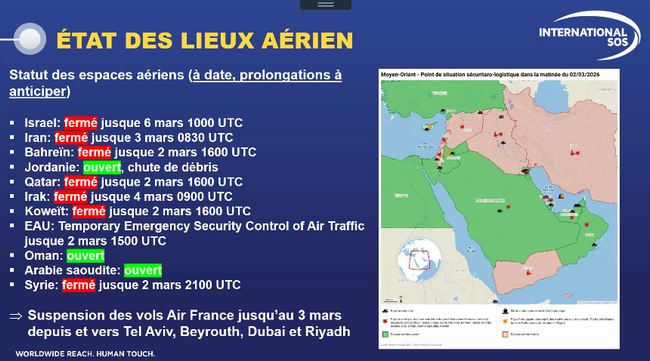
If, as a Dubai Airports representative said midday, " a limited number of operations will commence later on 2 March with a limited number of flights authorised to operate from Dubai International and Dubai World Central - Al Maktoum International "As a result, the Sultanate of Oman - where many nationals are exempt from short-stay visa requirements - has become a way out of Dubai. " From there, you can travel to Cairo, Istanbul, India and Europe. Which gives you some pretty reassuring exit options.says Béatrix Renaut. Several airlines are looking to increase their flight capacity from Muscat "EgyptAir in particular.
Although Muscat airport is an eight-hour drive from Dubai - in addition to crossing the border - ISOS claims to have handled around fifty movements by road on Sunday 1 January.er March, using individual cars, and is now considering setting up a daily bus system with its trusted partners in the United Arab Emirates. At the same time, evacuations have also been carried out from Bahrain to Saudi Arabia. As for the demand for evacuations from Israel, also on the increase, ISOS announced that it had several in progress today, both towards Jordan, passing through the north of the West Bank, and to the south, towards Egypt.