





















To foster new ideas: this is the very essence, etymologically, of a seminar. To sow seeds that may later prove fruitful. Seminars convey this desire to go further and together, a crucible conducive to reflection and, therefore, to action. Whether they focus on the material or the spiritual, for that matter, when it is never forbidden to combine both.
The Abbey of Royaumont provides proof of this, using its monastic setting to host businesses far from the hustle and bustle of everyday life. Companies, small or large, will merely follow in the footsteps of Saint Louis, who chose to have a haven of peace built there in 1228 to house his deep faith, far from Paris, close to Chantilly and what would one day become Paris CDG airport.
With these origins in mind, it's understandable that the abbey is not particularly suited to reward stays, being more focused on spirits than spirituality. With its 53 rooms of monastic austerity, lacking televisions, superfluous luxuries, or indulgent swimming pools and spas, the abbey is primarily intended for reflective seminars and management committees. Numerous CAC 40 companies regularly patronise it, as do Inserm, CNRS, and EHSS for meetings on life sciences, or associations focused on spirituality or culture.

Héritage de son riche passé, Royaumont a de quoi les recevoir à travers tous ses espaces fréquentés autrefois par 120 moines cisterciens retranchés de la vie profane. Que ce soit le cloître pour des cocktails jusqu’à 600 participants ; le réfectoire des moines pour des dîners ou conférences de 400 personnes ; le réfectoire des convers pour de mêmes événements, mais de plus petite taille ; la cuisine des moines ou la galerie pour accueillir les repas ; ou encore, à l’étage, la salle des charpentes – un nom pudique pour les anciennes latrines, surplombant un canal d’évacuation ingénieux pour l’époque – qui peut servir aux cocktails comme aux conférences de 250 personnes.
Do as you will
As these spaces often communicate with each other, groups can move fluidly from a conference in the timber-framed room to an aperitif in the cloister, and then to a musical interlude in the monks' kitchen before sitting down to dinner in their refectory for memorable evenings.
Added to this are around ten meeting rooms which complete the offering and allow the abbey to host several events at the same time. We organise between 260 and 300 business events per year, with a simultaneous capacity of 300 people, spread across several events., explains Sophie Longa Hertault, operations director. It's a real Tetris sometimes, as we have a business activity, but also another dedicated to young people and school groups, with Royaumont wishing to make culture accessible to as many people as possible. "

Lest these pupils or participants be disappointed to learn that, of the abbey itself, little or nothing remains. A section of wall on one side, a turret housing a service staircase on the other, a few traces on the ground giving an idea of the immensity of this quasi-cathedral, 30 m high and over 100 m long. That's roughly the length of Notre-Dame, but built in an extremely short time, barely over seven years, whereas it took almost two centuries to complete its Parisian counterpart.
Among the activities puncturing a seminar, a guided tour of the site is obviously one of the key moments. Here we learn that Saint Louis's intention was to make Royaumont nothing more and nothing less than the largest abbey in Europe. That its construction was his first political decision, at the age of 14, and that it was focused on a spiritual rather than military work, as is often the case. That it was financed with his personal funds for "an investment of 1.5 million euros" as we would say today. Endless funds that partly explain the speed of construction – the presence of a nearby quarry being another reason – whereas that of Notre-Dame was suspended by long periods of strikes.
A visit where we learn, alas, that while it took seven years to build, less than three hours were enough to make it disappear, in 1792. Closed due to the Revolution, the abbey was sold to an aristocrat and industrialist, the Marquis de Travanet, to be turned into a cotton mill. No doubt anxious to avoid the guillotine, he asked his 300 workers to hide these saints that people no longer wanted to see...


Down with the church, long live the business, even if the abbey temporarily returned to its original purpose by hosting a novitiate from 1869 until the 1905 law. That year, Jules Goüin, president of the Société de Construction des Batignolles, acquired the former monastery, and his grandson, Henry, later decided to open the doors of the place to needy artists and intellectuals. This project was perpetuated in 1964 in the form of a foundation, the Royaumont Foundation (Goüin-Lang) for the progress of Human Sciences.
That concludes the tour. As for other activities to punctuate the seminars, they can be numerous and organised in partnership with external providers. And within that offering, one absolute must: the Codex. A team-based thematic challenge based on the history of the abbey, exploring its rich past through a series of riddles. explains the chief operating officer.
The song of possibilities
Another must-see, the Royaumont Foundation, whose primary mission is the training of future opera singers and dancers for the French stage, « This specialisation allows businesses to offer exclusive moments with young artists trained locally, creating unique added value that cannot be replicated elsewhere. », highlights Sophie Longa Hertault. « That's the advantage of Royaumont: being able to disconnect from a concrete environment to reconnect with nature, history, and culture., continues the chief operating officer. This is an unusual product that emphasizes bringing people together and fostering conviviality. Instead of isolating themselves in their rooms, participants will gather in the lounge or on the terrace, enjoying each other's company to share and chat. "
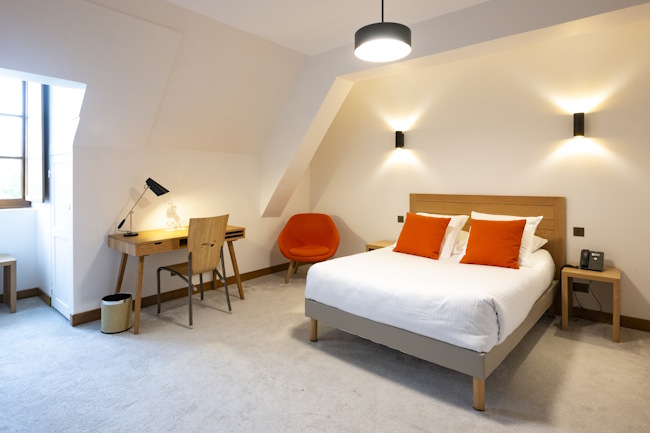
A timeless place, and therefore topical, Royaumont? Sophie Longa Hertault observes « a change in corporate event requests, moving from intensive team building ten years ago to strategic seminars, then to post-COVID re-motivation, and currently a growing demand for what we offer: disconnection. The only hurdle that likely remains in this context is the venue's accommodation capacity. Indeed, the establishment only has 53 rooms, which is far below its event capacity.
However, if seminars held within its walls involve exchanges between participants, then exchanges outside its walls are also crucial to compensate for this lack. Royaumont collaborates with partner hotels, particularly those in Chantilly such as the Mercure for larger events, or for smaller seminars, with its neighbour, the Palais Abbatial de Royaumont. A seminar house from the Chateauform group, partly established in a pavilion reminiscent of Palladian villas built at the request of the last abbot. Or, how to create a collaborative ecosystem for the benefit of all.
