













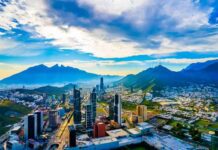





São Paulo is a sprawling city with an official population of 11 million. In fact, it could be closer to 19 million, or even 23 million if you include the greater metropolitan area. In any case, these are fluctuating figures, difficult to determine, as São Paulo moves, advances, changes and expands a little more each year... Yet it is this economic capital that undeniably holds the record as Latin America's 'best business city', the megalopolis where 85 % of the trade fairs and congresses held in Brazil are held. In all, 90,000 events are held each year, generating more than 8 billion reais (around €3 billion) a year in revenue for 16.5 million visitors. While the state of São Paulo is the largest in Brazil in terms of population, with a share of 30 %, it also tops the statistical columns showing the breakdown of national GDP. São Paulo is also the 19th richest city in the world, and estimates put it in 13th place by 2020. If growth, estimated at 80 % over the next thirteen years, continues apace.
FROM LIVESTOCK FARMING TO TRADE AND FINANCE
São Paolo is therefore the tangible economic heart of a Brazil that is gradually climbing towards the status of a major industrial power. Now the world's leading producer of medium-haul aircraft, the huge South American country is the world's fourth-largest aerospace power. Self-sufficient in oil, it is also one of the world leaders in biofuels. Black gold, then, but also orange gold, so to speak, and worth its weight in litres, since Brazil is also the world's leading producer and exporter of orange juice.
The state of São Paulo, at the heart of Brazil's great successes, is not only rich in agriculture and livestock farming, but also in services, trade, technology, research, finance and, of course, business. For its part, the megalopolis is home to no fewer than 26 universities and 146 colleges of higher education, which train the majority of the country's young graduates every year. This is undoubtedly one of the reasons why around a hundred of the top 200 technology companies are based here, and why the bustling city is working to create a solid foundation for innovative industries. Another significant figure is that 63 % of the country's international companies are based here.
OUT OF GALLOPING INFLATION
"Despite the turmoil created by the financial crisis, foreign investment continues to grow. In fact, São Paulo leads Latin America in terms of investment calm," explains Marcel Solimeo, President of the São Paulo Chamber of Commerce. So foreign investors find here not only the gateway to a veritable country-continent of
It has a population of nearly 200 million, but also those of other Latin American countries, such as Chile and Argentina. "Even though we are feeling the crisis on many levels, we are less affected than Europe and the United States", continues Marcel Solimeo, who has been very active in the Chamber of Commerce for 45 years and has enough hindsight to analyse the development of his country and his city. "I've witnessed the great difficulties the country has gone through; galloping inflation, numerous disastrous economic plans, and then, finally, the slow movement towards stabilisation", he explains. And while Brazil is coping with the crisis by boosting its exports of raw materials and food products, such as soya, orange juice and chicken meat, it cannot really be said that its banking system has been significantly shaken. The big companies that borrowed their money abroad turned to Brazil," adds the economist. This is because the country has not engaged in speculation and so-called toxic operations, and operates a highly controlled banking system. As a result, even if our interest rates remain excessively high at 13 % - we recently dropped to 11 %, with a target of between 5 % and 6 % for the coming years - our banks are in a position to lend money". Another positive factor is the end of extravagant inflation, which in the 1980s brought the country to its knees. It was almost like post-war Germany," says historian Ulisses Ruiz de Gamboa. In those days, inflation rates were as high as 8 % per month. In those conditions, and despite index-linked salaries, nobody could borrow... He continues: "Up until 1994, annual inflation reached peaks of up to 20 %. Today, we expect it to stabilise at around 4 % to 5 %."
It is precisely this recent stabilisation that has enabled the economic capital to find its feet. For São Paulo is not just a city of banks, it is also a city of architecture, design, creativity and fashion. Launched in 1996, São Paulo Fashion Week was a direct result of the early days of Brazil's economic stability," explains Gustavo Bernhoeft, spokesperson for the event. This venture would never have been possible before."
The success of Fashion Week, whose media coverage is such that only football can still steal its thunder, has had two miraculous effects: São Paulo has made a name for itself on the "creative cities" scene and has propelled Brazil into an "innovative economic world". This has enabled the country to emerge as a nation," continues Gustavo Bernhoeft. A country with its own specific characteristics, not just as an exporter of agri-food products and minerals or as a producer of oil and cars, but as a target for investors, a sort of convergence point for creativity, innovation and business. SPFW (São Paulo Fashion Week) has become one of the five most important events in the fashion world, along with Paris, Milan, London and New York, and chooses a different theme for each edition. In 2009, France, the cradle of fashion, will be the star of the show. A nod to the Year of France in Brazil, which runs until 15 November 2009, in response to the Year of Brazil in France in 2005.
Bénédicte Salles and Matthieu Halbronn, two Frenchmen who have lived in São Paulo for the last ten years, can testify to the excellent creative relations between France and Brazil. When they arrived in São Paulo, they realised that despite the presence of a large Japanese community - the largest outside Japan - there were no futons to be found there. So they launched their Futon Company in 2001, covering the venerable mattress with wild silk covers in bold, trendy colours. But the couple's originality also lies in their realisation that São Paulo is a goldmine for all things creative, and they have extended this to France, now selling the big names in Brazilian design, such as Mendes da Rocha and Ovo, on their website www.objekto.fr.
FRENCH SMES IN SÃO PAULO
What's more, these good Franco-Brazilian relations are encouraging more and more French SMEs to set up shop in São Paulo, despite the government's strong protectionist measures. "This is because there is a real demand for new products in Brazil," says Sueli T. G. Lartigue, Executive Director of the French Trade Chamber in São Paulo.
The growing middle class, which accounts for 22 % of the population and whose incomes have risen by 20 % since 2006, has stimulated consumption. In 2008, consumption grew by around 7 %. And this is benefiting French companies, which enjoy an excellent image in Brazil. "There are around 350 subsidiaries of French companies in Brazil, and many franchises such as Fnac, Carrefour, Leroy-Merlin and Casino," adds Sueli T.G. Lartigue. Moreover, this reputation for prestige and quality is set to be further enhanced by the fact that, to mark the Year of France, 700 approved projects and events will be launched (Culturefrance.com) and the French Chamber of Commerce will be organising an economic forum in conjunction with the French Economic Mission.
However, as Sueli T. G. Lartigue points out, "it is better to have a very solid project to set up here". In this country, you don't have to rely on business development aid, but instead have to deal with heavy taxation. But there are real advantages. They make Latin America's largest country, bordering ten countries on the South American continent, with São Paulo at its heart, a monster that impresses and that we would like to tame.


