












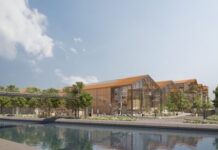







It's not so long ago that, between the deserted car parks and disused warehouses, a Scorsese-style atmosphere reigned here. The old docks, abandoned since the collapse of the fishing industry in the 60s and 70s, have long been a haunt for traffickers of all kinds. Then, at the end of the 1990s, the first attempt at rehabilitation was made with the Boston Convention Center project, which opened its doors in 2004. Timidly, other buildings sprang up, the most striking of all being the sublime Institute of Contemporary Art (ICA), inaugurated in 2006. "At the time when Diller Scofidio + Renfro built the ICA, they were not yet well known, but it was a deliberate choice: a famous architect who copied an earlier creation here was not an option. What was needed was something genuinely new for this unique district." explains David Eisen, President of the Boston Society of Architects.

This professional association, whose mission is to promote excellence in design and architectural sustainability, has set up its offices on the edge of this new district. "I was very enthusiastic about the Seaport project, even though my job is also to point out the mistakes."continues the architect. One of these is the fact that, unlike Hamburg, for example, where the former Speicherstadt warehouses have been redeveloped as an extension of the city, here there is no sense of unity. "This is because the financing is different, and comes largely from private funds. So everyone has built it in their own way, according to their own vision."says the expert.

Innovation crossroads
But it was political will that really got Seaport off the ground. In 2010, the former mayor of Boston, Thomas Menino, announced plans to convert a 400-hectare area on the South Boston Waterfront into a hub for cutting-edge industries such as clean tech, biotech and new media. Hence its title of Innovation District, underlining its primarily economic vocation, geared towards start-ups. Also in 2010, the American pharmaceutical giant Vertex set up its headquarters here, marking the de facto launch of the district's activities.
What might appear to be an isolated project is in fact one of the large pieces of a larger jigsaw, begun in 1991 and completed in 2007: the Big Dig, i.e. the very costly burial of an urban motorway that had split the city in two since the 1950s. The construction of tunnels and green spaces paved the way for a kind of reunification. Suddenly, the port area was no longer a distant, forgotten cousin to the city centre, but a potential goldmine. To speed up the gentrification process, the first strategy was to give Seaport a function, by stimulating entrepreneurship with tax breaks. Very quickly, 5,000 jobs were created thanks to the arrival of 200 new companies, most of them in the tech and creative industries. Some claim that the Innovation District is poised to rival the powerful technology cluster in Kendall Square, Cambridge.
Seaport fits in perfectly with the professional landscape of the 21st century. 40 % of companies, many of them small SMEs, share their offices in coworking spaces and incubators. However, large groups are also welcome. General Electric, for example, has just announced its intention to move from Connecticut to Seaport before the end of the year.
As a result, one hotel after another is opening to accommodate the ever-increasing number of business travellers. For example, in early 2016, Starwood opened two design hotels, an Aloft and an Element, just opposite the Boston Convention Center. Another recent opening is the Envoy, a 136-room boutique hotel, entirely glazed, which is gradually bringing night-time activity to streets deserted at dusk. "One of the biggest drawbacks of Seaport is undoubtedly the slow development of a real neighbourhood life."says David Eisen.

Neighbourhood seeks soul
The initial plan to mix businesses and residential buildings seems to be taking a long time to come to fruition. A stroll along the windy high streets lined with the austere facades of offices for rent suggests that Innovation District still has some way to go."As long as there are no schools or supermarkets, the district's mixed vocation will not have been achieved."concludes the President of the Boston Society of Architects.
However, events are gradually being put in place, especially in the summer, when Bostonians are more inclined to cross the bridges and head to this area, which is still poorly served by public transport, for a Sunday lunch overlooking the sea, with Logan airport in the background. Sponsored by big names like Philips, Bose and Microsoft, the ultra-contemporary District Hall Community Center also offers a new event space."It's a place where you can spend hours in front of your laptop, get advice on setting up a start-up, see an exhibition, dine with friends or make new ones."explains Jenna Walker, a young regular for whom Seaport is no longer just a myth, but already a reality.
Dossier - Boston: New England, a new deal
Boston: The future of a tradition
Success Story: Nicolas Schmidt, Healthcare Solutions Product Manager for Withings
- Seaport: Boston by the sea
Success Story: Mike Larhette, Chairman of Masschallenge
Hotels: Timeless luxury and major innovations
Bleisure in Rockport: Heading for the tip
The spirit of the place according to maestro Keith Lockhart
Boston: address book
