














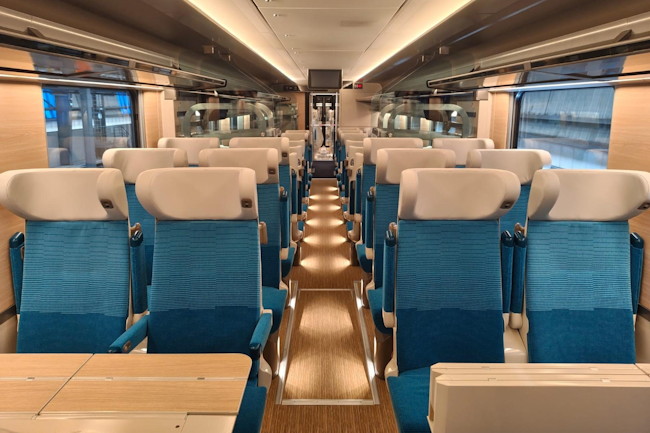
This is a small roadshow to present its future Oxygène trains, in which the SNCF has just embarked. After yesterday’s visit to Austerlitz station, the new trains that will equip the lines from Paris to Limoges and Clermont-Ferrand will indeed be presented to the public during free visits at Limoges Bénédictins station on December 4th and then at Clermont-Ferrand station on January 27th, 2027.
Currently undergoing testing, these trains will be gradually put into service starting next summer in order to replace the old Corail trains that have reached the end of their lifespan, regularly breaking down or being late, and which are the subject of criticism from users.
To remedy this situation, the State will allocate 715 million euros to their gradual replacement through an order for 28 Oxygen trains that are assembled in Reichshoffen by the Spanish manufacturer CAF; 16 of them are intended for the Paris-Orléans-Limoges-Toulouse (POLT) line and 12 for the Paris-Clermont-Ferrand service. Six units are expected to be operational in the summer of 2027 if this new train successfully obtains its homologation in time.
A qualitative leap for these new trains
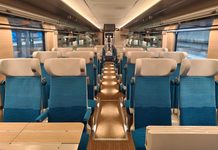
Whether it's in 1era or 2nde Classy, these Oxygène carriages will bring significant improvements in comfort and services to passengers. They feature wider and more ergonomic seats equipped with a footrest, a tablet, a reader, a USB port and an electrical outlet at each seat. Their inclination can be adjusted via a manual control in 2 positions.nde or electric in 1era. This last class even has seats positioned in a staggered arrangement to provide more legroom.
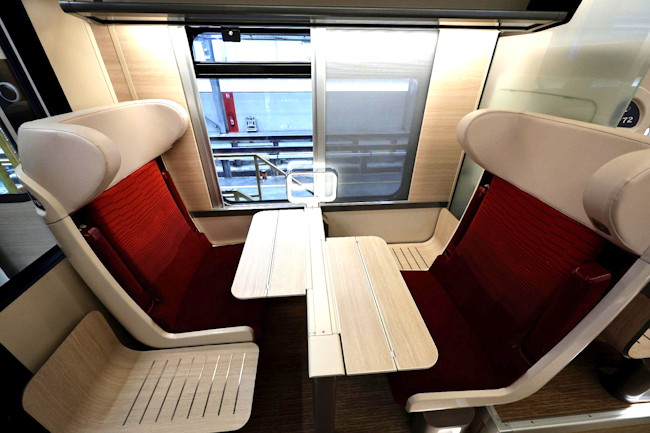
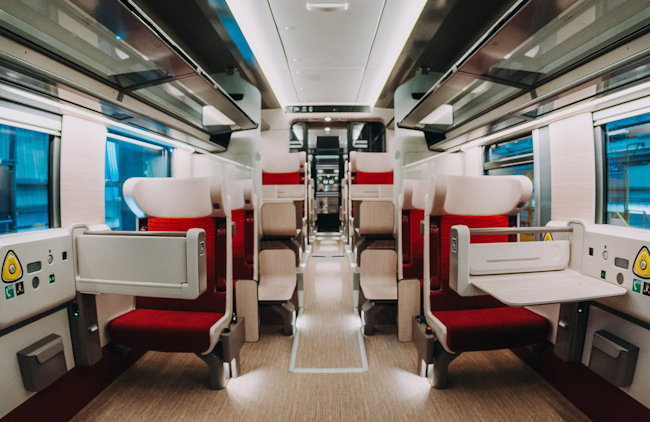
The carriages will also be equipped with enhanced air conditioning adapted to the heatwave periods, and with Wi-Fi to allow passengers to work during their journey. Information about the course of the journey will be displayed on screens located in the carriages. These trains will also provide easy and autonomous access for people with reduced mobility in both classes, on the platform as well as on board with spaces for wheelchair users, specially adapted toilets, tactile and braille signage, places for guide dogs… Finally, these trains will have special spaces to accommodate a total of ten bicycles (reservable online). Furthermore, mobile catering will be provided on board during the journey.
SNCF and Le Train are candidates to operate these two lines
In order to ensure the best possible operation of this rolling stock, 135 million euros will be invested in parallel at several maintenance sites located, among others, in Toulouse, Brive-la-Gaillarde, Clermont-Ferrand and Villeneuve-Saint-Georges, near Paris. Moreover, 3 billion euros have been invested by the State and SNCF Réseau since 2018 in the renovation of the railway lines. With a maximum speed of 200 km/h for these Oxygène trains, these works should thus allow to save 10 minutes on some journeys starting from 2028.
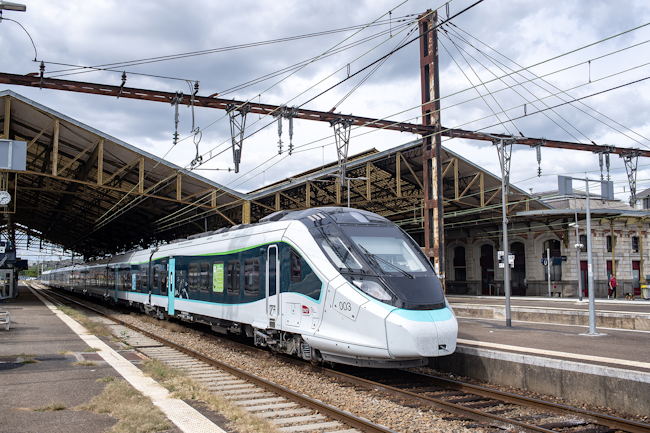
These two lines of the Territorial Balance Trains (TET), which together carry 4.5 million passengers per year, are currently the subject of a tender that has been won by SNCF but also by Le Train, a railway start-up developed in Nouvelle-Aquitaine that primarily aims to operate high-speed trains on the Atlantic coast. The winner of this tender is expected to be known in the coming months, with the contract set to begin in December 2029 for a ten-year term.
Oxygène trains expected on Bordeaux-Marseille
It should be noted that the POLT and Paris-Clermont-Ferrand lines will not be the only ones to see the Oxygène trains operating; 22 trains have also been ordered for the Transversale Sud service, which runs between Bordeaux and Marseille. This financial commitment, too, has been made by the State at a cost of €600 million for deployment planned between 2028 and 2030.