

















The BDL - Bundesverband der Deutschen Luftverkehrswirtschaft (Federation of the German Air Transport Industry) - has just published its annual review of German air transport. The results are still lacklustre, although there are signs of a timid recovery.
It's a bitter pill to swallow. According to the BDL's Managing Director, Joachim Lang, " the gap in air transport trends with our European neighbours is widening year on year. And it is likely to widen even further this year - a serious warning signal for the international connectivity of our economy. "he says.
While air transport in Europe has shown signs of dynamism in 2025, Germany has yet to recover. The BDL notes that air traffic in most European countries is now above pre-Covid levels.
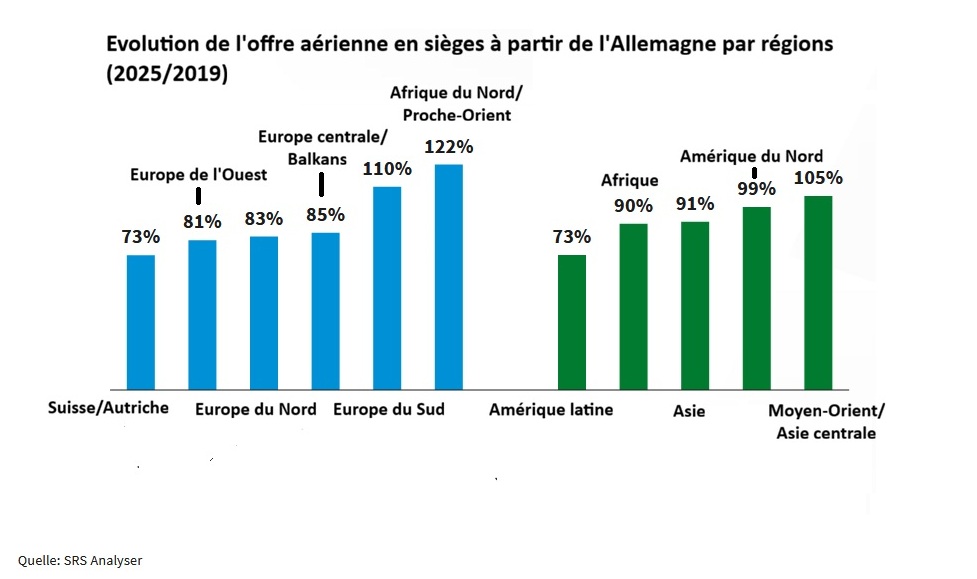
However, in Germany, the number of seats available represented 89% of its 2019 level last year. This compares with 106% in Europe (and even 108% if Germany is excluded) for the same period.
A worrying drop-off
Passenger numbers at German airports rose slightly to 219.6 million, an increase of 3.6%. " While more people than ever are flying in Europe, Germany remains out of touch with this boom".says the BDL's Managing Director.
An excellent reflection of Germany's lack of attractiveness to airlines is the trend in traffic from low-cost airlines, which the BDL refers to as point-to-point airlines. While this segment generally stimulates aviation growth in many countries, it is increasingly avoiding Germany. In 2025, it will be just 66% below the 2019 level, calculated in terms of number of frequencies. That's 50 percentage points below the rest of Europe!
According to the BDL, the main cause of this development is the high location costs imposed by the state. In 2025 alone, the burden on the German airline industry will have risen by €1.1 billion to around €4.3 billion.
Relief measures decided in November by Chancellor Merz's coalition, notably concerning the cancellation of the increase in air transport tax, are considered by the BDL to be an important first step. " These measures can prevent further loss of connectivitysaid the Managing Director. But if Germany is to play its part again in the growth of European air transport, other actions will have to follow".
The German government wakes up
At the same time, the German authorities are finally realising the importance of having a dynamic air transport sector, which is a prerequisite for a strong German economy. At the Aviation-Event conference in Frankfurt At the beginning of February, Manfred Pentz, Minister for Federal and European Affairs of the Land of Hesse - where Frankfurt airport is located - stated that maintaining the competitiveness of German air transport was an essential task, in particular by simplifying existing rules and reducing the burden on transport.
According to the Minister, " Improving the effectiveness of regulation must maintain economic dynamism while preserving long-term growth and innovation. Hesse is one of Europe's strongest regional economies, and aviation plays a crucial role in supporting thousands of businesses through global connectivity. Alongside the financial sector and major trade fairs, the airport remains one of the most important business locations for companies operating in the region. The regional government is therefore reaffirming its commitment to supporting the airport's growth and developing partnerships with key global markets. The reductions in air taxes, which will begin in mid-2026, are a welcome and positive step, but further relief is needed. "he insisted.
This was echoed by Stefan Schnorr, Secretary of State at the Federal Ministry of Transport. " The government's strategy for strengthening Germany as an aviation hub is based on three main pillars: economic competitiveness, reliable regulatory frameworks and a sustainable transformation towards climate neutrality. This includes reducing state-imposed costs, simplifying procedures, speeding up approvals for infrastructure developments and promoting the digitalisation of passenger processes and logistics operations. Not to mention significant investment in sustainable aviation fuels and innovative decarbonisation technologies "explained the Secretary of State.
Radical tax cuts seem to be the German government's new credo. According to the BDL, Germany can take a leaf out of the book of its Swedish neighbours. After taxing aviation heavily for several years, the government completely abolished the tax on air transport in mid-2025. As soon as the measure came into force, supply increased significantly. In December 2025, the capacity offered by airlines was already 8 % higher than the previous year. An example that Germany would now like to emulate. And it should also serve as a benchmark for the French government...