Until 2030, all is well. But what about after that? While the strategy for decarbonising air transport is largely based on the integration of sustainable air fuels, these "SAF" capable of reducing the environmental impact of 60% flights, the risk of running out of fuel by 2035 is looming. At least if we are to meet the requirements of the European Union. Under the European Refuel EU Aviation Regulation, the mandates for incorporation will rise from 6% in 2030 to 20% five years later. This leap is also accompanied by sub-quotas for sustainable synthetic fuels, with 1.2% of e-SAF required in 2030, then 5% in 2035.
Will air transport make the grade? The answer from the President of the International Air Transport Association (IATA) is a resounding "no". " I've always thought that the EU's ambitions were unattainable, and I still do. "As Willie Walsh recently pointed out at the general meeting of the Board of Airlines Representatives France. A few days earlier, at the press conference of the Fédération Nationale de l'Aviation et de ses Métiers (FNAM) (National Federation of Aviation and its Trades)Pascal de Izaguirre, its chairman, also expressed his concern, not about reaching 6% in 2030, a milestone that has almost been achieved, but about reaching 20% in 2035: " It's not all there, especially as there's not the first outline of an e-SAF production chain. "
The obligation to incorporate these synthetic fuels, which are currently non-existent, is the focus of all the concerns of players in the sector. " Our priority remains the development of a sustainable fuels industry, but the resources for developing it are woefully inadequate. "Pascal de Izaguirre points to the French government's €200 million support package. A mere drop in the ocean compared with the cost of a 100,000-tonne e-fuel production plant, which would require an investment of around $2 billion, according to Valérie Goff, head of second-generation fuel production at TotalEnergies.
Cautious pessimism
During a round-table discussion at the BAR France General Meeting, Valérie Goff expressed a ". cautious pessimism "We're going to have to wait and see. One thing is certain: TotalEnergies will pass for the time being. " We obviously have R&D in this area, but we won't be in this market in 2030. "At the same time, SAF from waste and residues will soon be produced at the Grandpuits biorefinery in Seine-et-Marne. A production site in conversion to zero oil which should eventually supply 285,000 tonnes of SAF a year.
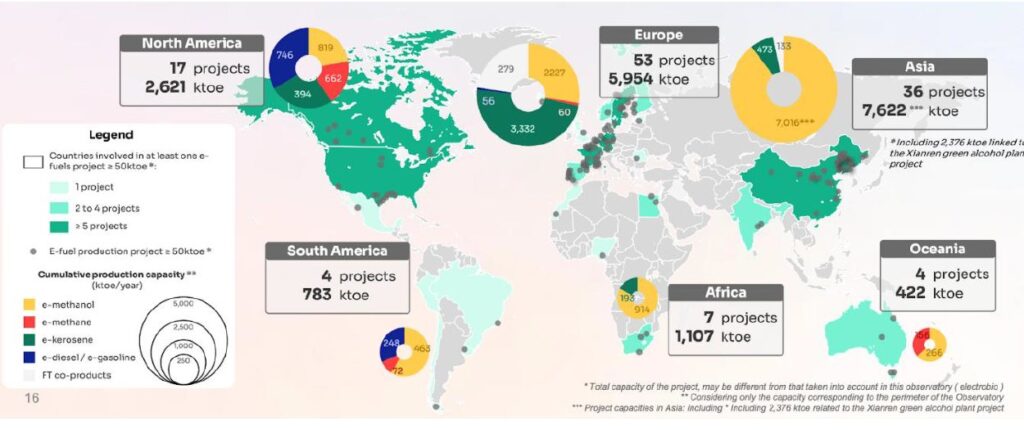
His company is not the only one among the major energy companies to put the brakes on synthetic fuels. While 700,000 tonnes will be needed by 2030 at European level to meet the quotas for the incorporation of synthetic fuels, the e-SAF is far from flowing. Rather than the sector's heavyweights, the candidates for wiping the slate clean on technologies that are still in need of improvement - methanol to jet, Fischer Tropsch - are to be found among the pioneering SMEs, with plans for plants with a production capacity that rarely exceeds 100,000 tonnes.
Among these, Infinium in the United States is aiming to produce 28,000 tonnes of synthetic fuel by 2027-2028, with its Roadrunner project partnering American Airlines and the IAG group. Verso Energy is one of the most ambitious, valuing its LiCHEN project at more than €2 billion, with the aim of producing 150,000 tonnes of e-SAF in the Limousin region by 2031. The E-CHO project, led by Elyse Energy around the Lacq basin in the Béarn region, is expected to supply 87,000 tonnes, while the H4 Marseille Fos project is aiming for 75,000 tonnes of e-kerosene a year. All these potential production units are still at the consultation stage.
One thing is certain, however: as always with technologies in their infancy, the first drops will be the most expensive. The cost of e-fuels is estimated at 10 times the price of fossil fuel, while biorefinery-derived SAF costs 3 to 4 times more than current paraffin. This additional cost will become significant with the imposition of 20% of SAF in 2035. And all this in a competitive environment where only airlines from EU countries and the UK are subject to a regulatory framework, since biofuels are far from being the Trump administration's hobbyhorse, or a stated priority of Asian airlines.

This explains why a group like Air France-KLM alone has acquired 10% to 15% of the world's SAF production, some of which is produced outside Europe, even though it accounts for only 3% of total aviation fuel consumption. " I'm in favour of mandates because they oblige companies and producers to invest in bioSAFs. But of course these mandates have to be sustainable. "says Antoine Laborde, Head of Fuel Purchasing at Air France.
" We have already increased our airfares by a few euros to reflect the incorporation of 2%, which our customers understand, he continues. As we move on to 6%, then 20%, this increase will become more and more significant. And we will have passengers who, to go from Nice to Singapore, will have the choice of transiting via Paris, Frankfurt or Dubai. There is a risk of leakage between activities based in Europe and those based in other non-European hubs. ". Hence his invitation to the European Union to consider mechanisms such as CBAM, the border carbon adjustment mechanism, to protect European companies. At the same time, he is calling for harmonised mandates at global level: " the ultimate solution "according to Antoine Laborde.
A downward revision?
While production capacity up to 2035 is virtually a foregone conclusion today, " the risk is that, when the time comes, we'll realise that we won't be able to meet the incorporation quotas. Although Europe has taken a number of steps in the right direction, production is not up to the challenge. "Pascal de Izaguirre explained at the FNAM's New Year's address, urging that "if we fail, we will be able to take the next step. everyone to be pragmatic ".
The worst is never certain, but why not consider it... Recently, at a panel on clean fuels organised by the World Economic Forum, Patrick Pouyanné, CEO of TotalEnergies, while denying that he was not investing enough, even envisaged reducing investment because of the uncertainty, predicting that European regulations on SAF would follow the same downward trajectory as in the automotive sector. " I'm afraid that if the objectives change, I'll have invested for nothing in biorefineries "he explained, according to Reuters.
When asked about this at the FNAM's New Year's event, Pascal de Izaguirre denied that a revision of the timetable had been put on the table, as in the automotive industry. real visibility "on market trends. " Everyone should be confident about demand. There is no doubt that the industry will need it. "Willie Walsh also explained that, as well as satisfying the companies, this production represented a geopolitical aspect, " an opportunity for many countries that do not produce oil or gas and depend on imports ". The President of IATA is categorical: " airlines remain committed to these long-term objectives ". As for the short term? " In my opinion, we will have to review the objectives ".