
















Tarom is a member of SkyTeam, but remains little visible within the alliance. What does SkyTeam really bring you in terms of visibility and development? Do you plan to evolve this situation?
Bogdan Costas – You are right. We are part of SkyTeam, but as with any alliance, visibility often depends on size. Tarom operates a fleet of 14 aircraft, which remains modest compared to major players like Air France or KLM. Of course, we are proud to be part of SkyTeam and we have codeshare agreements with several important members. But it is obvious that smaller airlines have less weight and visibility than larger ones.
An airline alliance is comparable to organisations like NATO. Do you know all of its members? We mainly talk about the biggest countries like the United States, France or Germany. In SkyTeam, it's the same: the big airlines like Air France, Delta Air Lines or Korean Air dominate visibility. The smaller ones are present, but less highlighted. This is what I am looking to change today.
Do you think SkyTeam is actually beneficial for Tarom today?
B. C. - The analyses for 2024–2025 are not good. At this point, I cannot clearly say that our membership in SkyTeam is bringing us a significant advantage. This is why we want to discuss and improve our cooperation.
Given your geographical position, could Tarom develop Bucharest as a mini-hub for the Balkan region?
B. C. - This is precisely my vision. I plan to discuss it with SkyTeam's senior management soon. We want to position Bucharest as a regional hub connecting Balkan destinations such as Belgrade, Cluj-Napoca, or Sarajevo with major hubs like Amsterdam, Paris, or Madrid.
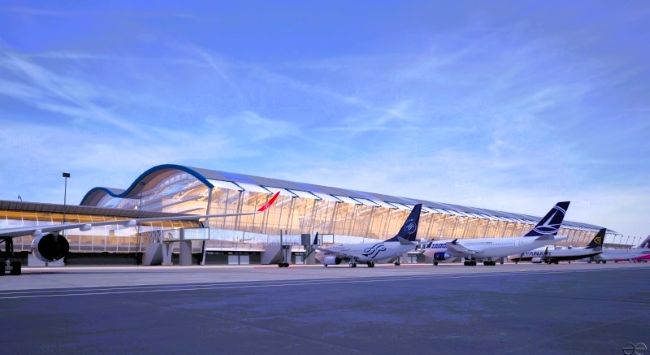
We are also considering cooperation with smaller regional airlines such as Air Serbia or other carriers in the region, for example from Montenegro or Moldova. Bucharest Henri Coandă Airport has seen its traffic increase rapidly, with 17 million passengers last year. However, the infrastructure is not keeping up. Admittedly, a new terminal with a capacity for 30 million passengers is planned, but it will not be delivered until 2030–2035. Nevertheless, there are improvements such as a larger aircraft parking area, a runway renovation project and the construction of a new metro line in addition to the existing train line. These are positive developments.
How many destinations do you serve and how will this evolve?
B.C. We currently serve 27 destinations, but due to our restructuring plan, approved by the European Union, we cannot proceed with expanding our network before January 2027. Our immediate priority is therefore to analyse the profitability of each existing route. More than half of our destinations are in fact not profitable beyond basic costs. It is therefore essential to have a clear vision before any expansion.
So, even a destination like Paris isn't profitable for Tarom?
B. C. - Not for us. It can be profitable for Air France, which is working hard on its load factor thanks to the contribution of the Paris hub. But not for Tarom, which lacks the amplifying effect of a hub in Bucharest. Profitability in aviation depends on several cost levels. Some routes cover direct costs, but not all expenses.
In theory, our operating costs are lower than Air France's, but the load factor is the deciding factor. And, as I’ve already pointed out, the major airlines are primarily focused on filling their own planes. We therefore need better support from alliance partners to feed traffic through Bucharest.
What is your strategy during this period of restructuring?
B. C. - Our priorities are clear: to strengthen the domestic network in Romania, particularly by considering cooperation with other air carriers on domestic routes to achieve better profitability and schedule coordination; to consolidate regional routes in the Balkans; to feed the major European hubs; and to optimise the use of our fleet, particularly the ATRs for short-haul flights.
Do you plan to renew your fleet?
B. C. - Yes. We are going to integrate new aircraft. Three Boeing 737MAX will be delivered in July and August of this year, as well as in March 2027. This will allow us to consider future expansion, particularly towards Africa or the Middle East – when the situation stabilises. As for the ATRs, they are best suited for short, domestic flights, but also for nearby destinations such as Sofia, Belgrade, Budapest or Istanbul. These are flights of one to two hours maximum, perfectly suited to this type of aircraft. We want to be competitive: on these short-haul regional routes, ATRs are therefore more efficient than Boeings.
What is your conclusion?
B. C. - Our priority is restructuring, improving profitability, and developing a stronger regional role. The ambition is there, but we need better partnerships and suitable infrastructure to achieve it.