














We will not go into detail here about the events that rocked Paris and major French metropolises over the weekend, in the wake of protests against rising prices. Nor will we list the gatherings that were allowed or not allowed on Saturday, October 24. The French and foreign news media are already devoting extensive coverage to this situation. However, this chaotic situation may affect business travel in France in the coming days and weeks, with a major trade union demonstration expected on November 5. Therefore, what would an attentive observer of the situation like the global leader in security and safety, International SOS, recommend?
During a videoconference, Béatrix Renaut, Head of Security, and Tamara Naidoo, Senior Analyst, provided an update on the situation while sharing the recommendations of their group. Despite the surge in violence that engulfed its major cities over the weekend, International SOS still considers France a low-risk country for professional travel.
" Although the images may appear quite spectacular from the outside, the riots are actually localized and our risk rating for France has not changed.», Béatrix Renaut specified. «No travel ban of any kind is therefore recommended at this stage, the head of security at ISOS emphasized. The planned business trips and academic exchanges They can be continued by applying the usual safety precautions. "
Among these, basic rules that are obvious – staying away from gatherings and leaving as soon as the first signs of tension appear, or avoiding nightlife venues during times of unrest –, but also not crossing a barrier erected by the protesters or taking photos, or staying informed about the official curfew instructions and the route of the demonstrations. International SOS is pleased to highlight its continuously updated security alerts and its assistance application, which can send alert notifications while also featuring a button to directly contact the Paris assistance center.
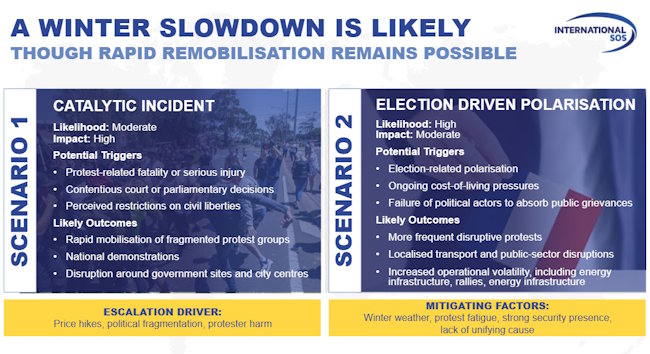
Beyond the current context, International SOS has turned to the crystal ball to consider the future course of events in the coming weeks or months, with the 2027 presidential election in the offing. There are two scenarios: one of minimal harm, where the level of protest activity would subside as the demonstrators grew tired and the winter cold took its toll; the other scenario is one of a lack of a single, unifying cause that would weigh on the mobilization.« In this context, the most likely scenario is not one of nationwide unrest, but one of persistent political fragmentation, with localized demonstrations. »", described Tamara Naidoo. The ISOS analyst thus speaks of «Different unions, different social groups will demonstrate at the same time, and various types of sites could be targeted, such as fuel depots, in addition to educational institutions." ".
But International SOS also envisages another, more anxiety-inducing scenario, with intense demonstrations or sectoral movements that create a turbulent and volatile environment and disruptions, particularly around government sites and city centers.« What we fear, "That's not the case," notes Tamara Naidoo, It is that a triggering incident then causes the demonstrations to degenerate: a death or serious injury during a demonstration, a controversial parliamentary or judicial decision, or the perception of a restriction of public freedoms. ». An element that could take on more body…