



















How do you explain the speed with which Navan has established itself as a key player in business travel?
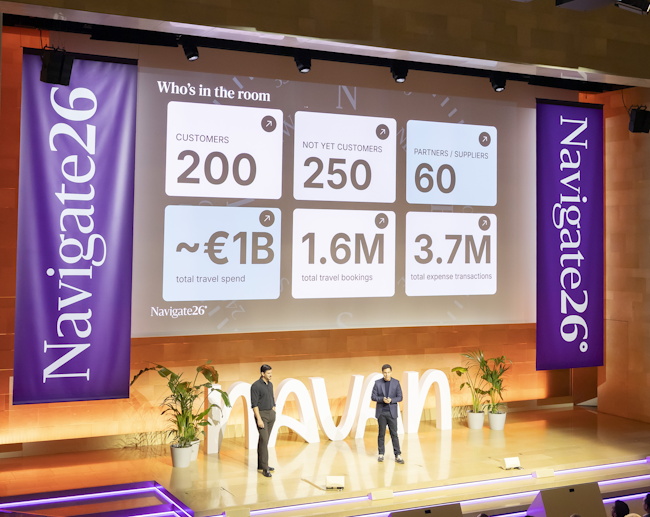
Aurélien Nolf – Companies today intend to manage their travel more effectively through technological tools. And since we are the only ones truly offering this, our growth has been exponential. We are only eleven years old and Navan is already the third largest business travel agency in the world with a turnover of one billion dollars. More than twelve billion dollars in bookings are processed each year through our platform. And this growth has accelerated particularly sharply over the last eighteen months, especially in Europe. We are now the second TMC in England, and our office in Paris is growing very quickly. As a Frenchman, I can only be delighted about this! But we are also expanding in Germany, Spain and Italy. We have also just opened an office in Amsterdam, a market where we see enormous potential. The Nordic countries will probably be the next step.
Will your growth therefore be more geographical than technological?
A. N. – Yes, it is necessary for our development. We already serve our customers all over the world. But, in the countries where we currently work with partner travel agencies, our ambition is to go directly, to offer the Navan experience everywhere. Asia offers great opportunities in this context. And we have just acquired a company in Brazil (NDLR: Smartrips). We are going to make a strong start in the South American market.
Your growth is based on acquiring new customers. How is this customer base evolving?
A. N. – Historically, we were very present in the tech sector. Our clients were companies like us, which are growing rapidly. But thanks to our technology and the improvement of our product, we have managed to convince increasingly large companies. We have grown a lot in the industry over the past twelve months, especially in France where we are deploying a more than hundred-year-old company. The clients or prospects who are interested in Navan today are huge American companies or the CAC 40, large British and German companies.
Originally, Navan also targeted mainly small and medium-sized enterprises. Is your growth now focused on large groups?
A. N. – No, it’s a mix of both. We remain very present with SMEs. But selling our solutions to very large companies, which have travel budgets of tens of millions of euros, has given us increased credibility. This allows us to talk to everyone, from small companies and SMEs to very large companies.
American Express recently acquired the second-largest travel management company, CWT. At what point could Navan acquire American Express?
A. N. – I don’t think that one day we will be interested in buying American Express. Our goal is mainly to be bigger than them. That’s our goal and we’re on the right track. I think we have such an advantage in terms of technology and user approach. Beyond the technology and the product, there is something fundamental at Navan: customer satisfaction, CSAT. Every time we start an internal meeting, we look first at this indicator. It’s the guarantee of our development. A company loves it when its travelers are satisfied. But I’ve never met any users from other agencies who say, «I love what we have.» At Navan, it’s the opposite and that’s our strength.
What convinces a multinational company to choose you over an American Express or a BCD?
A. N. – There are three main reasons. The first, as I just mentioned, is this extremely high satisfaction rate because travelers have much more choice in terms of flights, hotels, etc. We offer them what they want to see, not the booking on which we will earn the most money. Our mindset is to satisfy the traveler first and foremost. Then we make the entire journey much more efficient. Everything is automated. The fee note has disappeared. Our artificial agents check if they fall within the travel policy, if you meet the amount allocated per day, if you are eligible to travel in economy or business class. We have completely removed this task for travelers, which is also a great source of satisfaction.
With the savings opportunities enabled by AI, does the financial argument also speak in your favor?
A. N. – Indeed, we save 15% on average for all our customers. Which of course pleases them. Traditionally, the job of a travel agent was to add margins to the tickets. There were always small fees charged with each call, one or two euros here, there. We completely changed our mindset with a single, transparent price for a booking. And you can then call us as many times as you like: it’s free.

Does direct distribution play a role in this context, with a reduction of intermediaries through the NDC in the air sector?
A. N. – Of course. We connect directly to the airline inventory and therefore benefit from dynamic prices. When prices drop, our customers benefit immediately. On average, it’s much cheaper and, above all, the service is better. When you book via Navan, you can choose your seat directly. You don’t need to go to airfrance.com to do it. There are a whole host of small things like this that make a difference.
Similarly, you recently concluded a direct distribution partnership with Hilton. Do you plan to expand this idea to other hotel operators?
A. N. – We are in discussions with other groups. What we see with Hilton is an improvement in service for our customers. They can choose exactly the room they want, based on photos and its location within the hotel, whether near the elevators or not, and on which side of the property it is located. Direct connection to Hilton allows this choice. These details are important for travelers, especially since AI remembers their preferences. The more you use our platform, the more we learn about their habits, such as choosing a connecting flight over a B777 over a B787… And our travel recommendations take these preferences into account.
Is the share of your sales generated through the NDC channel significant?
A. N. – Yes, and it continues to grow as we welcome new airlines. For example, we are connected directly to Air France, but also to EasyJet and Ryanair. But in Europe, to meet local needs, we have also developed an extremely comprehensive rail service of this type. Deutsche Bahn, SNCF: Everything is now on our platform, which allows you to choose your seat directly on Navan. This was very important for our European customers.
Among the developments, Navan's solutions are now accessible from major AI agents, including Slack recently. Is this an essential move?
A. N. – We are only at the beginning, but this technology will definitely change the industry. That is why we are focused on this topic in terms of product development and new partnerships. Today, if you are a Navan customer and you use Google Gemini, you can book directly from Gemini, with Navan in the background. We also direct connections With Claude, ChatGPT, or Slack recently. This is what we call Navan Anywhere: «I’m in Slack, I don’t want to go to the Navan website. This is where I want to talk to my AI agent.» Our customers have expressed a desire to be able to book and interact with our platform from anywhere. In addition to booking, it also allows our customers to easily analyze all their data. A CFO can very easily ask how much was spent on travel last month. This is very important. When a company sends an employee to the other side of the world, the question is how much it brings in. And technological tools make it very easy to answer that.

What is the reliability rate of these AI agents?
A. N. – What artificial agents are capable of doing is very impressive: making decisions for you, changing your ticket, requesting a refund. Travel is an extremely complex field and we train our artificial agents to know its specifics so that they can react very quickly. We have extremely high acceptance rates because we use our own solutions. This is one of the peculiarities of Navan in having developed its own dedicated AI models for business travel. They leverage all the data accumulated over the past eleven years and can answer what people really need.
You talk about technology, but there is also the service. What place do you give it?
A. N. – A very important place. Our customers have this requirement: they want both. On the one hand, technology, but also the ability to speak to an agent when the problem is too complex or the situation is particular. And I think we do it really well: our technology allows you to choose between artificial or human agents depending on the needs. We have developed algorithms that are able to detect, based on the question, the best way to serve you quickly. People are always very demanding of human contact. That’s why, among our 4,000 employees, we have almost 1,000 agents. And this number continues to grow, since every time we deploy the platform to a new large client, we usually dedicate a certain number of agents to them.
Between technology and service, in the meetings and events sector you recently acquired Boompop. What will this new MICE product bring?
A. N. – We estimate that 30% of the travel budget of companies is dedicated to meetings and events. An extremely high figure. Today, most of these events are traditionally managed in an Excel spreadsheet by an event manager who calls the hotels to request block booking prices, etc. It’s still very manual. What Boompop has done is exactly what Navan did ten years ago: starting from this process and integrating it into a technological platform. We started a few months ago with a partnership with Boompop. Then, very quickly, we realized that our customers’ demand was incredible and that they were blown away by the technology and the efficiency brought by Boompop. We therefore decided to buy this company. By combining the Navan and Boompop platforms, our customers can manage everything. For example, when a company invites a hundred people from outside to an event, these participants will be able to book their plane ticket directly on Navan, and at the end of the event, we will send a bill to our client. Efficiency, consolidation, speed of service: that is what they are asking for.

CSR and safety: In the context of a business trip or an event, these issues are important. How do you approach them?
A. N. – Carbon reporting is not available today, but it is a request we hear a lot and it is in the development phase. Having booking tools that display the emissions of a flight or highlight certified hotels is also on our roadmap. Regarding the duty of care, there is a very strong demand for the solutions we have deployed. This feature was very useful at the beginning of the conflict in the Middle East. Our customers were able to see who was in that geographical area or who was supposed to go there, which flights were booked. And Navan was able to automatically rebook travelers on the correct flight. Some of our customers may use an assistant, but our platform allows, with our AI agents, to manage this automatically.
Let’s project ourselves into the future. In about ten years, Navan has experienced incredible growth. Could a new player follow the same path and go even faster?
A. N. – Of course, we are convinced that technology can disrupt us. We will be paranoid about it, looking at the startups that are emerging and their new solutions. An actor can emerge by quickly building software with artificial intelligence. The business travel market is huge. It is so large that it will obviously attract new entrants. That is why we will continue to invest in all these automation agents, in all these new features, while keeping in mind that the speed at which users adopt change is not necessarily what we read in the press. Our users love to know that there is a travel agent behind them. We will adapt to move towards technology, but at the speed of our customers. They are the ones who ultimately decide.