
















The mere mention of the name Marienbad conjures up images in black and white: images from Alain Resnais's film Last year in Marienbad although no scenes were filmed there; and Barbara, who sang in her crystalline voice "I remember you, and your jade eyes, at Marienbad". So, inevitably, the temptation is strong to go and check that the town of Marianske Lazne - in the original version - lives up to the myth and the nostalgia it inevitably arouses.
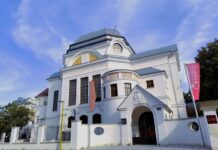
All you need is a full day and an overnight stay. You have to drive due west for two hours from Prague, past the town of Plzen, then climb the gentle hills almost as far as the German border to find the West Bohemian spa, lost in the middle of a pine forest at an altitude of 600 m. You enter via a long avenue lined with more or less contemporary buildings before reaching, at the very end of the road, a carefully tended park surrounded by ochre neo-Baroque, neo-Gothic and neo-Renaissance buildings. It's a remarkable sight, representative of those timeless spa towns - Vichy, Biarritz, Baden Baden or, closer to home, Karlovy Vary, the former Karlsbad - that will delight those nostalgic for the time of Sissi! "Most of it was built in around twenty years, between 1880 and 1912, which explains the architectural coherence.says Milan Vejnar, an auditor for Danubius, the Hungarian hotel group that helped restore the resort to its former glory.
Although the virtues of the CO2-laden waters that gush out of Marianske Lazne have been renowned since the 14th century, and the small town was declared a public spa in 1813, it was almost completely ignored during the Communist period. After the 1989 revolution, the authorities handed over a block of around forty buildings to Danubius, which sold some of them and patiently renovated the others. The company now manages eight hotels and 880 rooms in the city, a third of the total capacity. The two most famous hotels - Nove Lazne and Centralni Lazne - are linked by underground passages, creating a vast spa complex.
The beautiful pages of Gotha

Thanks to this, Marienbad has regained the cachet of its finest years, those of the 19th century, when it enjoyed a reputation that attracted the European gotha and intelligentsia, from Goethe to Chopin and Edward VII. The King of England stayed here nine times and met Austro-Hungarian Emperor Franz Joseph I in 1904. Today, Czechs, Germans and Russians are once again flocking here to take advantage of the fifteen or so active springs - out of the original forty or so - that treat a wide range of illnesses. The choice of treatments is almost limitless: standing, sitting, lying down. The more adventurous can try a cryotherapy experience, in which the body is exposed for one to three minutes to a temperature close to - 160°!
Yuri Gagarin on the ceiling

You may have just stepped out of the baths for a visit to the small local museum or the Orthodox church, or for a walk in the fresh air of the central park, or even, and above all, to go to the colonnade, the majestic arcade that resembles the Grand Palais at the heart of the resort. With its iron lacework, wooden ceilings and old-fashioned shops, it is still the meeting place for spa-goers after their morning's treatments; it is also the place where you can fill up your glass or bottle free of charge at the three springs, Caroline, Rodolphe and Source de la Croix. Without expecting a miracle, and sometimes with a pinched nose! Depending on the day and the season, the springs are more or less mineralised, have a more or less ferrous taste and can give off a hint of sulphur... In short, just like the local beer, it's best not to overdo it!

In this timeless interlude, a few details here and there remind us that we are indeed in another century: the paintings adorning the ceilings of the colonnade offer the attentive eye a glimpse of Yuri Gagarin in his cosmonaut outfit amidst allegories; the 'singing' fountain that borders the colonnade plays classical music every odd hour. It's not enough to disrupt the gentle rhythm of the day, which inevitably ends with a shopping spree along the Hlavni Trida thoroughfare. Lace and crystal, as well as a few cheap souvenirs, make up the bulk of the goods on display in the shop windows. "O time! Suspend your flight"wrote Lamartine. He could not have found a better illustration than Marienbad...


Special report - Prague: a brand new score for the Czech capital
Prague: a brand new score for the Czech capital
- Prague getaway: a night at Marienbad