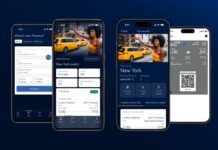
Mobile travel has barely begun to emerge from the inexorable emergence of smartphones, and the practices of the future are already taking shape. Among the experiments, the Toulouse Blagnac is now testing contactless technology Near Field Communication (NFC) in partnership with Orange, Blackberry and SITA. Around fifty frequent travellers have been offered a terminal with an NFC chip. Like the RFID chip Navigo pass, the NFC smartphone is used as a key to enter the station. car parkthen to open the access door to the premium ticket-cutting service which the airport launched in April and, once through the security checkpoints, allows access to the airport. VIP Lounge. The result is a smooth journey and significant time savings for business travellers, whose time is always at a premium.
"What's more, passengers will simply have to hold their phone in front of strategically placed displays, near the lifts for example, to "wake up" the terminal and send them information about departing flights. At the exit of the car park, these will provide information on traffic to Toulouse."explains Bruno Balerdi, Marketing Director at Toulouse-Blagnac airport, who adds that ".This is not the first time that NFC technology has been tested in real life. But it is a world first with an intelligent SIM card, where rights can be encrypted.".

For some years now, this technology has been part of everyday life in Japan, serving as a means of
electronic purse to pay for your purchases at the corner shop. Thanks to her, the airline
ANA is making a clear promise to its customers armed with their keitai - the Japanese version of the smartphone - that it will take them from the moment they arrive at the airport to the boarding gate in just a few minutes,
15 minutes chrono. "
The development of NFC has been anticipated for several years," comments Evantia Giumba, Business Development Director at Amadeus France. Everything is moving very fast when it comes to mobility, but we mustn't forget that we're only at the beginning. We have to be ready to meet the challenges by constantly adding new functionalities to our mobile solutions.."
At the dawn of the mobile era
And what can we expect the day after tomorrow? According to
Air PlusContactless technology is set to transform the world of business travel. Not just because the telephone becomes a train ticket, boarding pass or even a hotel room key, but above all because it can be transformed into a credit card to pay a restaurant bill or a taxi fare. The corporate payment specialist is thus looking forward to even smoother business travel for travellers, as well as better consolidation of expenses on the company side. The prospects are huge, but we'll have to wait for a new generation of mobile terminals - the iPhone 5 could be equipped with an NFC chip, for example - before this new technology becomes commonplace.

Until the 'new new' technology of the future, biometrics, radically changes the landscape? That remains to be seen... But before we look to the future, let's take a look at how these developments came about.
29 June 2007 will probably go down as the tipping point in an era that is likely to become 100?% mobile. On that day, Steve Jobs, the emblematic founder of Apple, presented the iPhone, paving the way for the democratisation of smartphones and, a few years later, the iPad and digital tablets. With their design, but above all their ease of use and a host of services that take advantage of mobile Internet access, Apple's trendy toys were quickly adopted by the general public.
Since then, these nomadic tools have become the spearhead of handset manufacturers, led by the Cupertino-based firm, but also including Asian manufacturers Samsung, LG and HTC. The big losers: Blackberry, long the smartphone of choice in the corporate world, and Nokia, still the leader in mobile phone sales, but clearly losing ground in the smartphone sector. These two players will have to speed up the development of their offerings to try and regain a foothold in tomorrow's market.
Productivity gains

The stakes are indeed crucial. Already, in 2011, according to Gartner, an analyst firm specialising in information technology, 'smart' phones accounted for 31 % of terminals sold worldwide - a growth of 58 % compared with 2010 - and should rapidly make up the majority of the market. Similarly, according to the US institute NPD, sales of tablets are set to rise from 121 million in 2012 to 416 million in 2017, by which time they will have overtaken sales of portable PCs. By then, notebooks will surely be a thing of the past.
Quite naturally, businesses have been caught up in this wave. And with the ever-increasing variety of personal devices being introduced into the business world, this is not without its problems. Very few managers go anywhere without one or even two phones in their pocket. When they don't take their iPad as their only piece of luggage. The use of personal tools in the workplace, also known as the BYOD (bring your own device) phenomenon, is giving IT security managers a few grey hairs, while, for their part, operating systems (OS) are far from infallible when it comes to connecting to the company network.

However, the resolution of this gap between business and personal use seems inevitable in the short term. After all, these thin, light terminals are the perfect complement to the ever-growing nomadic lifestyle, and are highly popular with users. "Companies have a vested interest in offering their employees the tools of their choice, because at the same time, productivity is rising significantly. Smartphones and tablets make it possible to work on the move, in a corridor between two meetings... something that was not possible before", points out Stéphane Sabbague, a former Microsoft employee and founder of Calipia, a consultancy that focuses on mobility issues and collaborative technologies. Tablets are therefore beginning to make inroads into businesses, as professional solutions designed for iPads - such as mobile CRMs for travelling salespeople - come out, and as managers adopt the tool to make their presentations more modern.
But, above all, what could be more practical than a smartphone, always tucked away at the bottom of a business traveller's pocket, for organising business trips and managing the unexpected? As the cornerstones of mobility, airlines and hotel groups have understood this and, as early as 2009, began offering iPhone applications, which were then rolled out on other OSes, starting with Google's Android. "Mobility is obviously a strategic issue for us. We have been positioning ourselves on the mobile channel for four years now. Today, we have applications for all operating systems and all types of handset, enabling you to find a hotel for the same evening near your meeting place", explains Emmanuel Ebray, Director of the HRS hotel reservation platform in France.
Applications galore
Business travel agencies have followed suit, with the appearance of the MobileXtend application at American Express in 2010, followed in 2011 by BCD Mobile Companion and CWT To Go at Carlson Wagonlit... Egencia has also launched Egencia Mobile, a logical development for this leading online business travel agency, which can now draw on the expertise of Traveldoo, a mobile platform publisher acquired at the end of 2011.
These solutions all have more or less the same functions. Customers can find their entire itinerary - flight, hotel and car hire - booked with the agency, whether online or offline. All this is accompanied by practical services: real-time flight information, geolocation of the hotel and its meeting points - useful for guiding the taxi driver -, weather forecast, etc. "In addition to this roadmap, which can be accessed without having to go through your papers, we offer our customers the possibility of pre-registering with the airline partner, if the latter offers this service", explains Stéphane Birochau, Carlson Wagonlit's Key Account Director for France.
The major advantage of these applications is that they give travellers a great deal of autonomy. "Using our m-Power solution, travellers can make last-minute changes to their flight bookings without even having to contact their travel agent. However, if the need arises, they can call or email the agency at the click of a button, without having to search for the agency's contact details", explains Evantia Giumba from Amadeus, a GDS and reservation solutions provider that naturally took an interest in the subject.
However, despite all these obvious attractions, the smartphone version of business travel has not - yet - completely taken off. "Everyone's talking about it. And I have to admit that we are winning tenders thanks to our mobile solutions. But it's still far from being overused. Firstly because our customers don't equip all their employees with smartphones because of the purchase price of these terminals. And also because companies are also sensitive to roaming costs and IT security", points out Stanislas Berteloot, Marketing Director at KDS.
Today, the volume of "mobile" bookings remains fairly low. For example, Air France only recorded 1 % of the 2 billion euros worth of sales made on the web last year. At HRS, the mobile channel accounted for 3 % of hotel room bookings in 2011. However, in line with the trend expected by all professionals, HRS expects mobile to account for between 6 and 7 % by the end of this year. This should rise to 30 % by 2015.
And there's every reason to expect exponential growth. Everything's coming together: the maturity of users, all-in-one solutions from corporate travel agencies, but also new uses to make business travel more fluid. Take, for example, paperless ticketing and mobile check-in, now offered by most air and rail carriers, or the possibility of checking in/checking out directly on your phone with hoteliers, as Louvre Hotels has just introduced.
Self booking tools mobiles

Today, a second phase is being prepared, which should increase the use of mobile solutions offered by technology suppliers and travel agencies. With the launch of genuine mobile self-booking tools! By the end of 2012, Amadeus will be testing an application based on its e-travel management solution. For its part, Carlson Wagonlit is working with KDS to develop an offering that matches the needs of its corporate customers. "We first need to set up validation circuits and check with them what information will be on the smartphones. The launch is expected by the end of the year", explains Stéphane Birocheau.
As a CWT partner, KDS has been offering its KDS Mobile solution since 2011. "Travellers can consult their itineraries and pre-fill their expense reports. KDS Mobile allows the manager to check the conformity of trips and expenses before approving or rejecting them instantly. This is important, because fares are constantly changing, and a rapid trip validation process means you can take advantage of lower prices," explains Stanislas Berteloot.
As a logical next step, the publisher recently added a booking function to this solution: Book on Mobile . "It's not just our self-booking tool on smartphones. It was a major undertaking, because we had to rethink the graphical interface, since the screen offers less space". So, for greater convenience, three fares are directly highlighted for each search, with the others of course remaining accessible. "These fares are those that best correspond to the company's travel policy. They can be configured according to several parameters: a simple fare aspect, coupled fare and preferred supplier criteria, or even according to other criteria such as travel classes or carbon footprint", describes the marketing director.
Towards "all-in-one" solutions

KDS Neo, another of the publisher's current developments, is currently being tested and is due to be launched in January 2013, aimed directly at iPad users. The solution promises nothing less than to book a point-to-point journey in just three clicks. Using essential information - departure point, destination address, time and duration of appointment - the entire system will organise the best possible itinerary. This starts with the purchase of the plane ticket and the booking of the taxi that will pick the customer up from the office and take him to the airport, then the booking of the hotel in the best position according to the appointments, and finally the pre-filled expense account that the user will only have to adjust according to his expenses.
All-in-one mobile solutions of this kind are bound to have a bright future. Firstly, because they help to bring some order to the magma of applications offered by the various players. Concur has developed a solution whose ambitious credo is the "perfect business trip". To achieve this, Concur Mobile traditionally covers the booking of plane tickets and hotels - with visual identification of fares in line with travel policy - as well as practical information. But its scope extends to payment, with the option of integrating the business traveller's corporate card number and/or the company's corporate card.
Its other strength is that it facilitates the management of expense claims, Concur's core business. As soon as they leave a restaurant or taxi, travellers simply pull out their mobile phone and enter the amount of their fare or meal into the system, attaching a photo of their bill as proof. The manager, for his part, will receive these reimbursement requests and can validate them directly on his mobile phone. "In this way, the company has visibility of everything that has actually been spent, on expense claims as well as on the ancillary costs that now surround air travel", explains Patricia Daumarie, Concur's Operational Marketing Manager for France.
With the acquisition of online travel assistant TripIt in 2011, Concur turned its attention to a long-awaited development: the use of social networks in business travel. Thanks to the TripIt Pro application, mobile executives can view their itineraries on their smartphone or tablet, as well as share their schedules within the company, making it easier for employees to share experiences and travel tips. This also enables the company's travel manager to identify the most mobile travellers and those who comply most effectively with the travel policy.
Choosing your neighbour via facebook
"The new era will be digital, mobile AND collaborative", warns Evantia Giumba, while Amadeus has also integrated the possibility of sharing itineraries on Facebook or Twitter into its m-Power solution. Among the initiatives giving an idea of the potential of this community aspect of travel, the SNCF has enhanced its Facebook page with a "petits voyages entre amis" application, making it easier, as its name suggests, to organise weekends with friends by sharing information via the leading social network. Launched in 2011, only 288 users had taken advantage of this feature by July this year... Clearly, this is a very small number, but it opens up new avenues for reflection, where everything, or almost everything, has yet to be invented.
For its part, KLM is taking a different route with its Meet & Seat service, which in a way takes up the concept of Bluenity, a community created by Air France in 2008 around its loyal members. Meet & Seat, like Bluenity before it, is based on a simple idea that must have crossed the mind of every traveller at one time or another: "it would be so much better if we could choose our seatmate! This is now possible. Passengers who agree to share their Facebook or LinkedIn profile will be able to find each other according to their affinities or professional backgrounds and choose to travel side by side. At the same time, KLM is also using Twitter to communicate with its customers, who can use mini messages to ask the airline about the best fares to a destination on a given day or over a given period.
One of the great strengths of the mobile age, and also one of its great merits, is that it can offer a multitude of information to make travel easier. Most applications in the airline industry send real-time information on delays, indicate boarding gates, etc., thereby reducing the stress level of executives who are always between planes. This desire to both reassure and inform is, for example, behind Air France's AF Connect application. In the event of irregularities, we wanted to be able to inform our customers and apologise in real time," explains Carole Peytavin, R&D Marketing Manager at Air France. Today, we want to go further and also inform them when everything is going well. Customers need to be reassured with messages like 'we can confirm that your flight will leave on time from gate X'." In other words, the smartphone, a miraculous tool for preaching the good news.