



















For six years now, Hamburg has been consuming 100% clean electricity. A miracle accomplished under the leadership of Hamburg Energie, an organisation whose profits are systematically reinvested in new wind, photovoltaic and hydroelectric production units. It's a virtuous circle that the "most southerly of Scandinavian cities" intends to extend by becoming "the place to be" for wind power from neighbouring Denmark. "Most of the major specialist companies such as Nordex, Vestas, Repower and Siemens now have their headquarters in Hamburg, explains clean energy consultant Martha Liegl. In 2012, for example, while there were 23,000 installations in Germany, the greater Hamburg area was leading the way by employing 25,000 people in this field.
It has to be said that the banks of the Elbe and the coasts of the North Sea represent a formidable playground for these big rotating arms. In addition to this, Hamburg has another advantage that no other city in the world can boast: it is surrounded by a national park of around one hundred km2 overlooking the sea and including numerous islands. An area 90 % wild. "This park, located outside the city limits, is a legacy of the prerogatives dating back to the Middle Ages, which enabled Hamburg to control the coast and the mouth of the Elbe and thus protect itself from pirate ships", explains Volker Dumann, spokesman for Hamburg City Council's environment department.
Industrial past with green highlights
 Yet this unusual advantage plays almost no part in Hamburg's position as Germany's leading green city. Rather, it is the 64 km of canals, green spaces and parks - more than 20 % of its surface area - that have earned it this title.
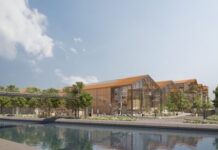
By 2025, the chlorophyll surface area should even reach 35 %. The reason for this? Urban expansion towards the southern districts, with their industrial wastelands and former port warehouses. First there was Hafen City, a 157-hectare project to 'recycle' the former port, resulting in a 40 % expansion of the city's surface area, totalling 37 % of open and public spaces, 10 km of promenade along the water, 26 hectares of green spaces planted with 2,700 trees.
"Through a modern project, we wanted to achieve a return to a less modern way of life, by reducing the presence of cars thanks to good accessibility, cycle paths, a hybrid bus system serving the entire area and a new metro line", explains Susanne Bühler, spokesperson for Hafen City. This "priority zone", for which all building plans are approved by a specially created urban planning commission, should see a reduction of 40 % in its CO2 emissions by 2020 compared with 1990, thanks in particular to a sharp reduction in car traffic and an innovative energy and heat supply.
Another hallmark of Hafen City is sustainable living. In 2007, the district launched Germany's first certification system, awarding a gold label to the most environmentally-friendly buildings. "The difference with other regeneration projects of this kind is that, typically, the old docks are on the outskirts of the city, whereas we're a hop, skip and a jump from the centre; which greatly reduces the need to own a car."adds Susanne Bühler. Two-thirds of the cycle paths are located away from car traffic, and the proportion of motorised individual traffic should soon be reduced by 30 %, thanks in part to the hydrogen-powered internal bus service.
A responsible university
As a result, the Hafen City way of life has become very attractive. Today, 2,000 people live there full-time and 450 companies and organisations - including Greenpeace and WWF - employ 9,000 people. By 2025, 12,000 people are expected to be living in the district's innovative buildings, not to mention the nearly 2,000 students who, from the start of the new academic year, will be flocking to the unique Hafen City Universität, where the art of eco-friendly urban planning will be taught.
This southward expansion, the famous "Elbe leap", a real river ring road that for a long time formed the psychological boundary beyond which Hamburg was no longer really Hamburg, is now continuing towards the former industrial district of Wilhelmsburg. A gigantic park has already been created on a marshland that has dried up over the centuries, to coincide with the Internationale Gartenschau, an exhibition devoted to gardens that will be coming to an end in October.
Just 15 minutes from the city centre by S-Bahn - the local S-Bahn, which is also environmentally friendly! -It's a promising location. Among the various modifications undertaken in Wilhemsburg, a former landfill site has been completely cleaned up and transformed into a hill dedicated to electricity production. Wind turbines have been planted at the top of what is known as the "energy mountain", and will soon be supplying power to the 55,000 residents of this rather disadvantaged district.

Wood for hotels
"In order to demonstrate its commitment to revitalising Wilhelmsburg, the Hamburg government will be relocating a large number of its institutions to new environmentally-friendly buildings close to the park", says Volker Dumann. This is where everything is happening, with new leisure areas, but also creative and ecological housing designed for another event, the IBA, one of the major construction fairs held every year in Hamburg.
Since 2007, the IBA has been showcasing the latest inventions in sustainable housing. Among the seventeen creations of 2013 that can be visited until November: a hotel on the theme of the forest, the Raphael Wälderhaus, made of wood from floor to roof, as well as the BIQ, the very first building in the world to be equipped with micro-algae grown inside its glass façades. The system produces heat through photosynthesis and solar energy, while absorbing CO2. "The aim is to make Wilhelmsburg a CO2-free district".concludes Volker Dumann.
It's a challenge that could well be met, as projects abound in Hamburg, Wilhelmsburg and throughout the city. In the Altona district, the former central station will soon be transformed into ecologically responsible residences, while a new fleet of hybrid buses is due to be introduced throughout the city in 2014. In addition, 'Car 2 Share', a new electric car hire system similar to Paris's Autolib', has just been launched, while 300 'Umwelt Taxis' already travel the city without polluting it. "Hamburg is attracting more and more tourists, because it is banking enormously on the quality of life of a major international metropolis with all the advantages of a green city".says Beatrix Haun, Director of the German National Tourist Office in Paris. And she concludes: "With a network of 400 km of cycle paths, it's hard not to fall under the spell of a modern city whose pace also allows you to slow down and breathe?
