



















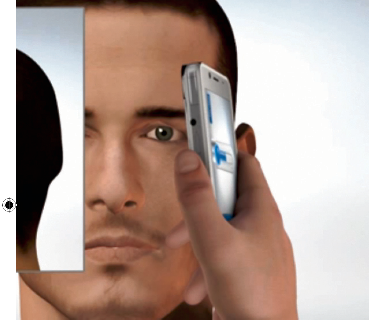
At the Mobile World conference, LifeWatch, a company specialising in heart monitoring solutions, unveiled a mobile tool that will appeal to more than one hypochondriac business traveller: the LifeWatch V7 smartphone. Or should we call it a 'healthphone', since this sensor-equipped device can be used to carry out all the basic health checks (see photo). Are we witnessing a boom in high-tech health? In just a few years, applications on this subject have invaded download platforms. Research2Guidance lists over 97,000 of them, including iStethoscope, which turns the iPhone's microphone into an oscillation tool, and Asthma Monitor, which helps monitor asthma symptoms. AliveCor, a smartphone case validated in the United States by the Federal Drug Administration, analyses heart rhythm. Some projects are broadening their scope by combining technological solutions with human skills. French start-up Youkali looks after company directors and key talent. These are busy executives who, unlike top-level sportsmen and women, do not have the support they need to perform at their best, even after a 12-hour flight. Alongside connected objects that deliver raw data, around thirty specialists - medical professors, sports trainers, physiotherapists, nutritionists, image specialists - interpret the results, listen to how each individual feels and suggest areas for improvement. The aim is for managers to feel good about their bodies, their minds and their companies. This has an impact on everyone because, just like stress, well-being is a value that spreads by capillary action to all employees...
An intelligent sleep mask
 Designed by a Polish student, NeuroOn is designed to help you recover quickly from jet lag. Fitted with sensors, this mask records eye movement and brain activity to identify the different phases of sleep. The device can therefore be set to wake you out of REM sleep, which is more restorative.
Connected devices, the future of healthcare?
 At the Consumer Electronic Show held in Las Vegas in January, the French start-up BodyCap presented its eTact electronic 'patches', which are stuck to the torso to continuously analyse heart rate, and its eCelsius capsules, which are ingested and send the temperature by radio signal to a smartphone, as well as to the doctor, for day-to-day monitoring.
Simultaneous translation
It's the Holy Grail of all 'lost in translation' professionals: delivering your message in real time in the language of the person you're speaking to. Will this dream soon become reality? Operator NTT DoCoMo has launched a simultaneous translation application for Android smartphones and tablets. The only catch is that Japanese is one of the two default languages. On a more international scale, Swiss inventors have created Sigmo, a box that analyses the voice and sends back a translation in 25 possible languages.
"Productivity, loyalty, attractiveness".
 The move towards greater flexibility in the world of work has more than one advantage, for companies and managers alike. Less stressed by organising their day as they see fit, with a better work-life balance, employees are more efficient and creative. According to a recent study by Regus, 75 % of senior managers worldwide consider that this way of working contributes to their productivity. Employees enjoy the flexibility of the company, with the corollary benefits of developing 'high potentials' and attracting future talent. In this context, Regus likes to innovate. Following on from workspaces in petrol stations and business corners near public transport hubs, this specialist in professional mobility has teamed up with car tuner Rinspeed to develop the XchangE concept car. Presented at the Geneva Motor Show in March, this intelligent, driverless car can be transformed into a meeting room on demand. The seats swivel, creating a workspace for four people. Or how to stay productive, even in a traffic jam!
Contactless business cards
 French start-up PopWings has launched business cards with an NFC chip. In practice, when the person you are talking to has an NFC-enabled smartphone, all you have to do is bring the devices together to transfer the information to the phone. Moo has developed a similar solution.
A smartphone for safe driving
 Developed by Israeli operator accel Telecom, Voyager is a smartphone specially designed for use in the car. The sound and position close to the steering wheel are designed not to interfere with driving.
The device responds to voice and is connected to the user's 'real' smart phone by twin SiM cards.


