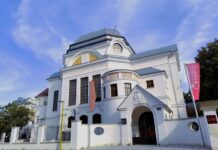

















A cathedral by the sea. It's rare, unusual, almost out of place. But there it is, the cathedral of Palma de Mallorca, imposing its Gothic mass of yellow ochre stone. It stands there, a little narcissistic, reflecting itself in the waters of a small lake that, in the 1960s, replaced the narrow quays that had always separated it from the Mediterranean. This cathedral dominates the old capital of the Balearic Islands and is the must-see, the must-see, the very first 'must-see' when visiting the city. And why is that? Because it practically tells the whole story of the island. Obviously not that of the Phoenicians, Greeks, Carthaginians, Romans, Vandals or Byzantines - in short, all the invaders, conquerors or occupiers - but that of the Muslims who ruled the island from the 8th to the 13th century.

This Gothic monument, one of the most beautiful in Spain, was built in the 14th century on the site of a former mosque. This explains the position of the bell tower, which is slightly out of step with the rest of the building, as it stands on the former minaret. The interior, with its 44-metre-high central nave - one of the largest in the world - is an enchantment. Not least thanks to the light diffused by its countless multicoloured stained glass windows, including the extraordinary large rose window, 12 metres in diameter and made up of 1,200 stained glass windows. Then there's the strange baldachin hanging over the high altar, symbolising Christ's crown of thorns, which is clearly not Gothic. The heart of the building was extensively remodelled between 1904 and 1914 by Antoni Gaudi. Modernism, then. Modernism, but also contemporary, represented by an extravagant chapel created by Miquel Barcelo, an artist born on the island. A masterly piece of art by way of an appetiser, since, as we shall see later, contemporary art is omnipresent in the archipelago. Everywhere, in ancient monuments and hotels, in institutions and restaurants.

Majorca, kultur in the sun
In the meantime, let's wander through the old town, around the cathedral, and wander through its very narrow historic streets, perfectly preserved and remarkably clean. The countless patios of the vast mansions that once belonged to the nobility or the upper middle classes set the pace for a discovery of the district that lasts around two hours. Flanked by staircases that gently climb to the upper floors, they are all different, with examples dating from the 14th to the 20th century. They tell stories, social and political ones, but also the inevitable tales of thwarted love. Based on the Andalusian model, they are now brightened up to a greater or lesser extent by beds of potted plants. Corporate agencies are no exception, making them their own private areas for an elegant cocktail party, or even transforming them into showrooms for the launch of a top-of-the-range car model.
Magnificent opulence
The past, the past, the stones... Majorca, historically the richest island in the Balearic Islands, has no shortage of them. Palaces, large and small, are of course omnipresent in Palma, but in fact they are a feature of the island's geography. Starting with the heights of its capital, royally crowned by a Gothic castle that ranks among the finest in Europe. It was built at the beginning of the 14th century, when Mallorca was an independent kingdom and the gold from the maritime trade flowed freely, covering everyday life in magnificent opulence. That was until the discovery of America and its precious metals, which plunged the island into deep poverty. Let's just say that, at the same time, the lusts of foreign princes and Moorish pirates, if they did not cease, at least lessened considerably.
We saw earlier that modern art is everywhere in the Balearic Islands. So let's go to the city's contemporary art museum, the Museu Es Baluard, whose building is in itself a veritable masterpiece. It's minimal, made up of unstructured white walls, mezzanine-like spaces opening onto other spaces, false floors and glass lifts, and very clean exterior walls enveloping the ancient ramparts. It's beautiful, and fortunately so, because the permanent collection on display is a little poor. Except perhaps for some ceramics by Picasso and a few paintings by Miro. Nevertheless, corporate groups can take advantage of the museum's meeting facilities, in particular a former vaulted cistern that can accommodate up to 300 people, as well as a sublime, huge terrace overlooking the marina where sophisticated cocktail receptions are held.

But the ultimate in modern art on Mallorca is to be found at the Pilar i Joan Miro Foundation. The wonderful world of one of the twentieth century's greatest painters opens up here, at his studio built in 1959 by his friend, the Catalan architect Josep Lluis Sert. Miro lived in Mallorca from 1956 until his death in 1983, during which time he created hundreds, thousands of joyful works inspired by the tones of the Mediterranean. His studio, which can be visited, is there, intact, with easels, works in progress, brushes and colours, worthless objects picked up on his walks from which he drew inspiration for his paintings... in short, everything that makes up the ordinary life of an artist's studio. On the hill overlooking the studio is a charming old eighteenth-century building. The artist loved to isolate himself here, and to paint too, as the huge sketches drawn on the whitewashed walls testify. In 1992, the famous architect Rafael Moneo built a third building alongside these emotionally-charged premises, which now houses a permanent collection of more than 2,500 works, drawings, sculptures and lithographs. It's a magical place, and it would be a sin not to visit.


However, on the island of Mallorca, the capital alone does not have the monopoly on culture, art and heritage. You only have to travel a few kilometres north-west towards Andratx or Valldemossa to realise this. This magnificent little road winds its way through the Serra de Tramuntana. It gently weaves its way through canyons, climbs hills, passes through pine forests and then orange groves, gives a glimpse of some pretty isolated farmhouses, leaves the hikers and the countless cyclists to their delightful labours, and finally arrives at Valldemossa with its ochre stone walls covered with Roman tiles, all clustered around the old convent. A palm tree here, a cypress there, and shutters inevitably painted green.
To the tune of a polonaise
As a result, the village, now a favourite with artists and intellectuals, is particularly popular with foreigners. Especially the French, who discovered in cell number 4 of the monastery the place where George Sand and Frédéric Chopin lived for a few months. Hence Un hiver à Majorque, a work by the writer recounting his stay without complacency. Cellule is a very big word indeed, since it is in fact a small flat, admittedly rather spartan, but nonetheless comprising a bedroom, a living room and a kitchen. It opens out onto a delightful hanging garden overlooking the gentle land and orchards of Mallorca. Background music during the visit: Chopin, of course.
And then the road goes off to live its life on the seaside, discovering towers and lighthouses, beaches and coves, peaks falling into the Mediterranean. It's a far cry from the image of 'beaches and concrete' that Mallorca conjured up a few years ago... Of course there are tourists, especially Germans, but they are concentrated on the eastern side of the bay of Palma, which was anarchically disfigured in the 60s and 70s. And everyone knows that summer is not the season for corporate groups, who prefer spring and autumn. So they can even take a vintage train for a private ride along the old country track between Soller and Palma. In the evening, they can enjoy a gala dinner at the Son Amar cabaret, a combination of the Lido and the Moulin Rouge in Paris, and a breathtaking revue worthy of the best European shows. Flamenco presented by excellent Spanish dancers, songs, acrobats, contortionists, transformists, modern ballets, and even a horse on stage... It's dizzying and understandable when you realise that the troupe is made up of around forty artists, and not the least, from all over the world. Recently, Son Amar, which has been in existence for just over fifty years, completely overhauled its lighting, equipping itself with five laser machines. It's a huge undertaking, generating a total of 500,000 watts of power that pierce the Spanish night.
You'll never be disappointed by this Spanish night, which, more than any other, knows how to use anything and everything as a pretext, and in fact needs no pretext to go on until the wee hours of the morning. In Mallorca as elsewhere, the neighbouring island of Ibiza takes the cake for wild nights.

Ibiza is a party
Ibiza, then. Ibiza and its famous clubs, some of which can accommodate up to 20,000 people in season. Young people, young people and more young people waving their arms high in front of the performances of a star DJ, including Bob Sinclar and David Guetta at the Pacha.
Young people, then, but also the gotha of world show business, TV, fashion and modelling. They're young, they're beautiful, and some of them are rich. So they dance their endless summer away, unknowingly knitting themselves memories for later, when they're no longer young or beautiful... Stooop! Let's not spoil their party. Corporate groups are no exception to the nocturnal ritual. However, the agencies that, without exception, all offer the experience almost always place their groups in the VIP room, with a preference for the Pacha. It's less risky. The competitors, Amnésia and Privilège, are judged to be too crazy.
These clubs are the face of Ibiza, as evidenced by the walls of video images in the duty free areas of the airport and the huge posters along the motorways. And, as if the night wasn't enough, the day is redoubled in open-air beach clubs such as the Nassau and the Blue Marlin, where the electro, techno and trance sounds drown out the surf. But who cares, you're not here for the beach, which is made of uncomfortable pebbles anyway, you're here to see and be seen, and to dance under the blazing sun covered in sunscreen. There's no doubt about it, you need to be healthy on Ibiza. At least, that's what the beaches tell us, as they suffer a severe hangover every morning.


In fact, it's in the morning, when it's still cool and the narrow streets of the old town are still recovering from the night, that you should climb up to the citadel, which crowns an entire district that has been a UNESCO World Heritage Site since 1999. Ramparts, fortified gates, a cathedral and noble residences opening onto the steep slopes of the cobbled streets... The soul of Eivissa, which means Ibiza in Catalan, is there, dominating the old seafarers' quarter and the commercial port. "We are looking for corporate clients, says Tomas Paris Hidalgo, director of the city's tourism promotion department. We never say no. What's more, for events ranging from 80 to 800 people, we can privatise unique venues such as bastions overlooking the port, a cloister or a former powder magazine. In all cases, success is guaranteed. In fact, we've just hosted a German heavy metal cruise at one of our bastions, who, against all expectations, asked us to perform... traditional dances!". As you can see, anything is possible in Ibiza, anything can happen. In fact, there's no doubt about it once you've spent an evening on the terrace of a café in the lower town, near the quayside. Extravagance is the order of the day. You'll see everything: drag queens perched on platform shoes, girls with skirts so short and cleavage so deep you wonder why they still invest in textiles, leather-clad boys with wide-open, body-built torsos, UFOs of indeterminate sex...
Ibiza is obviously the wildest party in the Mediterranean. But that doesn't stop the island's interior offering countryside, real countryside, largely unspoilt and distilling a perfect art of living in the shade of its orange, lemon and other umbrella pines. Everywhere are fincas, in other words farmhouses dazzling in their whiteness, footpaths that are only disturbed by the buzzing of insects and, on the north coast, sublime coves lazing in the sun.


As much as Mallorca remains a bit on its own, hidden behind its stone walls, Ibiza is all about lightness. And you can feel it. It's as if a spring mist were perpetually floating in the air. No doubt it's also due to the unpretentious vernacular architecture: small, low houses that are admirably proportioned, in fact whitewashed cubes laid side by side, sometimes on top of each other. They are so perfect, so modern in design, that they inspired Le Corbusier, among others. "That's Ibiza, says Shana Lacroix, official guide on the island. People here are naturally very respectful of others. They are permissive and don't really judge. The hippies who settled here in the 60s and 70s made no mistake about it. They were free, or more or less, to live as they pleased. Today, it's the same with gays, provocative outfits and naturists, especially on Formentera, the neighbouring island. As long as you don't bother the other person, a lot of things are accepted. It's rare, I think".
Formentera, peace and quiet
Formentera, then, could almost be mistaken for a peninsula of Ibiza, so close is this small island lying at sea level, just four kilometres away. Half an hour on the express ferry and you're there. However, in an infinitely more chic option, corporate groups can charter a schooner for the day; a real schooner, once used to transport goods. It's very elegant, but obviously a bit expensive. It's easy to understand why when you realise that a whole crew, five to eight sailors plus a few trainees, is needed to handle the huge sails. "It's excellent for team building, explains Gerald Delgado, skipper of the schooner Cala Millor. You can be short or tall, muscular, skilful or clumsy, but everyone has to take part in the manoeuvres, taking into account the actions and decisions of others. It's the sum of individual wills that makes the boat go. In fact, the English understood this a long time ago, that the boat can only really work if everyone pulls together. Basically, a bit like a company".
Peace and quiet over 85 km2... birdsong, quiet farms, a crystal-clear sea in almost every shade of blue, deserted or almost deserted beaches, a limited number of hotel facilities, cycle paths criss-crossing the island on all sides, a few beach restaurants, but not too many, like Vogamari, serving Balearic specialities: there's no doubt about it, Formentera is a seaside paradise. The island, which is just 19km long, also attracted hippies in the sixties, as well as pop artists and bands such as Bob Dylan, Led Zeppelin, Pink Floyd and King Crimson. Today, they have been replaced by showbiz stars who come here discreetly to take a break from the excesses of Ibiza, as well as renowned architects and designers. In short, Formentera is now riding the bourgeois-bohemian wave.

As a result, the activities on offer to groups exclude all unwanted noise, except perhaps for scooter rides, in favour of hiking and cycling, and water sports, sea kayaking, catamaran excursions and the inimitable paddle surfing, a surfboard on which you stand, trying to move forward by paddle. But the most extraordinary of all is a scuba diving baptism, guaranteed in complete safety. The waters around Formentera are so clear that they allow visibility of 50 metres. Extremely rare. This is due to an underwater plant, the posidonia, which produces phenomenal quantities of oxygen and absorbs three times more CO2. The sun does the rest, producing exceptional shades of blue, turquoise and emerald. The hippies of the 60s had good taste, and the bobos are not mistaken. Neither do corporate groups. And we understand them.


Special report - Balearic Islands: ultramarine variations
- Balearic Islands, ultramarine variations
Balearic Islands: address book